Contribute to Our Research |
By Michael - July 14th, 2010 As we take a brief intermission before we start looking at Disney artist Herbert Ryman’s contributions to Imagineering – contributions that would occupy the last thirty-some years of his life – perhaps it would be nice to hear, for the first time, from the man himself. Author John Donaldson has uploaded this video, which originally aired on the Disney Channel in 1988.
The piece was filmed in Disneyland on February 4th, 1988, barely a year before Ryman would pass away on February 10th, 1989. It’s great to see him walking the park with a spring in his step, obviously enjoying himself.
Related Posts...
By Michael - July 14th, 2010  Olivia Wilde and Garrett Hedlund in TRON: Legacy. They’re talking about how excellent Ratatouille was. It’s been a while since we’ve mentioned anything having to do with Walt Disney Pictures, but there’s a tidbit that’s just emerged from Entertainment Weekly that’s too good to go without comment. According to them, Pixar filmmakers Brad Bird and Michael Arndt (screenwriter for Toy Story 3) signed on briefly last month to script re-shoots for the upcoming TRON: Legacy.
That’s right. Brad Bird. TRON. Together.
Now, typically re-shoots don’t necessarily spell good news for a production, although they’re fairly common. And sometimes it can mean that the filmmakers have really found something that works in the piece and want to develop it further with some re-writes. It’s also true that Bird and Arndt only wrote enough pages for about six days of shooting, so it’s unknown how much they will affect the final film, but the fact that they were hired to punch up scenes to deliver more emotion, character and theme can only be seen as a good thing.
We all know the original TRON wasn’t exactly a character piece, and even those of us who love it unconditionally admit that its script isn’t bulletproof. We proud nerds have been waiting almost thirty years for a sequel, and while there’s so much that makes TRON: Legacy an unknown quantity, mixing in the name Brad Bird brings an extra bit of excitement to the proceedings.
I think it’s pretty cool that TRON: Legacy director Joe Kosinski and the other filmmakers decided to show their work-in-progress to some respected vets at Pixar and in Hollywood for some feedback in advance of last June’s re-shoots. And anything, and I mean anything, involving Brad Bird – who I’ll remind you has directed The Iron Giant, The Incredibles, and freakin’ Ratatouille – demands my full and undivided attention.
Related Posts...
By Michael - July 13th, 2010 The great Martin Smith pops up again with the latest of his EPCOT tribute videos; this time we get to take a look at Norway – Gateway to Scandinavia, the 11th and (to date) final World Showcase pavilion. Originally slated to be a Denmark pavilion, the concept evolved into a Scandinavian Showcase before being winnowed back down to focus solely on the nation of Norway. There are a lot of mysteries in this pavilion’s past: the abandoned designs for the Denmark pavilion, the first unrealized concept for the Maelstrom which featured a song by the Sherman Brothers, and whatever we as a society have done to be punished by another princess meal in the stunning and unique Akershus.
Enjoy the movie and, while you’re at it, check out our classic, acclaimed, riveting expose on the Lost Water Closets of Denmark as well as our recent video from the opening of the pavilion in 1988.
Related Posts...
By Michael - July 13th, 2010  It’s another month of exciting events at the Walt Disney Family Museum in August. For animation fans, award-winning animator and film historian John Canemaker will present his greatly anticipated new book, Two Guys Named Joe. Meanwhile, Disney film stalwart and Swiss Family Robinson actor Tommy Kirk swings in to visit the museum, which will be showing that 1960 film throughout the month. It’s another month of exciting events at the Walt Disney Family Museum in August. For animation fans, award-winning animator and film historian John Canemaker will present his greatly anticipated new book, Two Guys Named Joe. Meanwhile, Disney film stalwart and Swiss Family Robinson actor Tommy Kirk swings in to visit the museum, which will be showing that 1960 film throughout the month.
Let’s take a look at the schedule, courtesy of the Museum:
FILM OF THE MONTH
Swiss Family Robinson (1960)
1:00pm and 4:00pm, Theater
(except Tuesdays and August 13, 14, and 21.)
Tickets available online
A family … a shipwreck … a deserted island … What should they do to survive? Build a home (in a tree), protect themselves (from pirates, of course), and fall in love! Live on an uninhabited island doesn’t sound so bad after all.
LECTURES
August 13 + 14 – John Canemaker Presents Two Guys Named Joe
6:30pm, Theater (August 13); 3:00pm, Theater (August 14)
Tickets available online
Academy Award-winning animator and renowned animation historian/author John Canemaker presents an illustrated lecture on Joe Grant (1908-2005) and Joe Ranft (1960-2005), two unique and important creative influences on the art of storytelling at the Walt Disney and Pixar studios. Join us for a book signing following each discussion.
August 21 – Inside the Tree House with Swiss Family Robinson Actor Tommy Kirk
3:00pm, Theater
Tickets available online
An adventure of a lifetime! Learn what it was like to salvage food, live in a tree, build new inventions, and explore the island. This presentation will give you an inside look at what it was like to work with Walt and be a member of the Swiss Family Robinson cast.
AUGUST DISNEY DISCOVERIES! + LOOK CLOSER SERIES
DISNEY DISCOVERIES: Second Saturday of each month
August 14 – Disney Discoveries! Survival Crafts and Survival Rafts
1:00pm – 3:00pm, Learning Center Art Studio
In honor of the film of the month, Swiss Family Robinson, create your own survival gear. Using a variety of materials, you will make a basket for picking fruit or a miniature raft that you can use to sail away on.
Imaginations and creativity will soar with our new Disney Discoveries! The second Saturday of each month, join us for family fun and activities in the Learning Center. The activities planned by our education staff will inspire the hidden artist in young visitors while learning about the life and work of Walt Disney.
The Disney Discoveries! Activities are free with paid admission to the Museum. No ticket is needed for members—just show your membership card.
LOOK CLOSER
August 27, 28 + 29 – Look Closer: Swiss Family Robinson Original Lobby Card
11:00am and 3:00pm, Theater Lobby
Would you like to know more about one of the artifacts in the galleries? Our Look Closer series will give you that opportunity—staff will reveal little known facts, behind the scenes information, or just additional information during the 5 to 8-minute gallery talk.
The Look Closer series is free with paid admission to the Museum. Members are always free and no ticket is needed. Just show your membership card.
Be sure to follow the Museum online, and on Facebook and Twitter!
Related Posts...
By Michael - July 11th, 2010  Herb Ryman with one of his paintings of the circus, 1953 It seems so strange today how great a hold the circus held on the psyche of young Americans in the last century. For Herb Ryman, it was no different; he, too, was drawn to the romance of sawdust and greasepaint and the open road. A chance meeting in 1948 with Bill Antes, advance man for the Ringling Brothers Circus, led to a friendship and the eventual invitation to travel with the circus. Ryman, eager to document the circus in his paintings, gladly accepted the invitation and, after taking his leave from 20th Century Fox, joined the circus in Chicago in the spring of 1949. For two summers, in 1949 and again in 1951, he would travel with the circus and live amongst its performers.
 The Drummer Girl The Drummer Girl by Herbert Ryman, 1949 In his travels, Herb would pay witness to the constantly changing sights of the circus. Every day was different, and the constant hustle and bustle provided an endless stream of stimuli for the artist. In fact, it was almost frustrating for Ryman; no endless amount of sketching and painting could capture everything he was experiencing on a daily basis. He was also faced with the challenge of distilling the essence of the circus into a purely visual medium, when its atmosphere was so dependent on the rich blend of sounds and smells and music. This held true for the sights onstage as well as backstage; the constant machinations of everyday life for the circus crew was something that Herb took great pains to document.
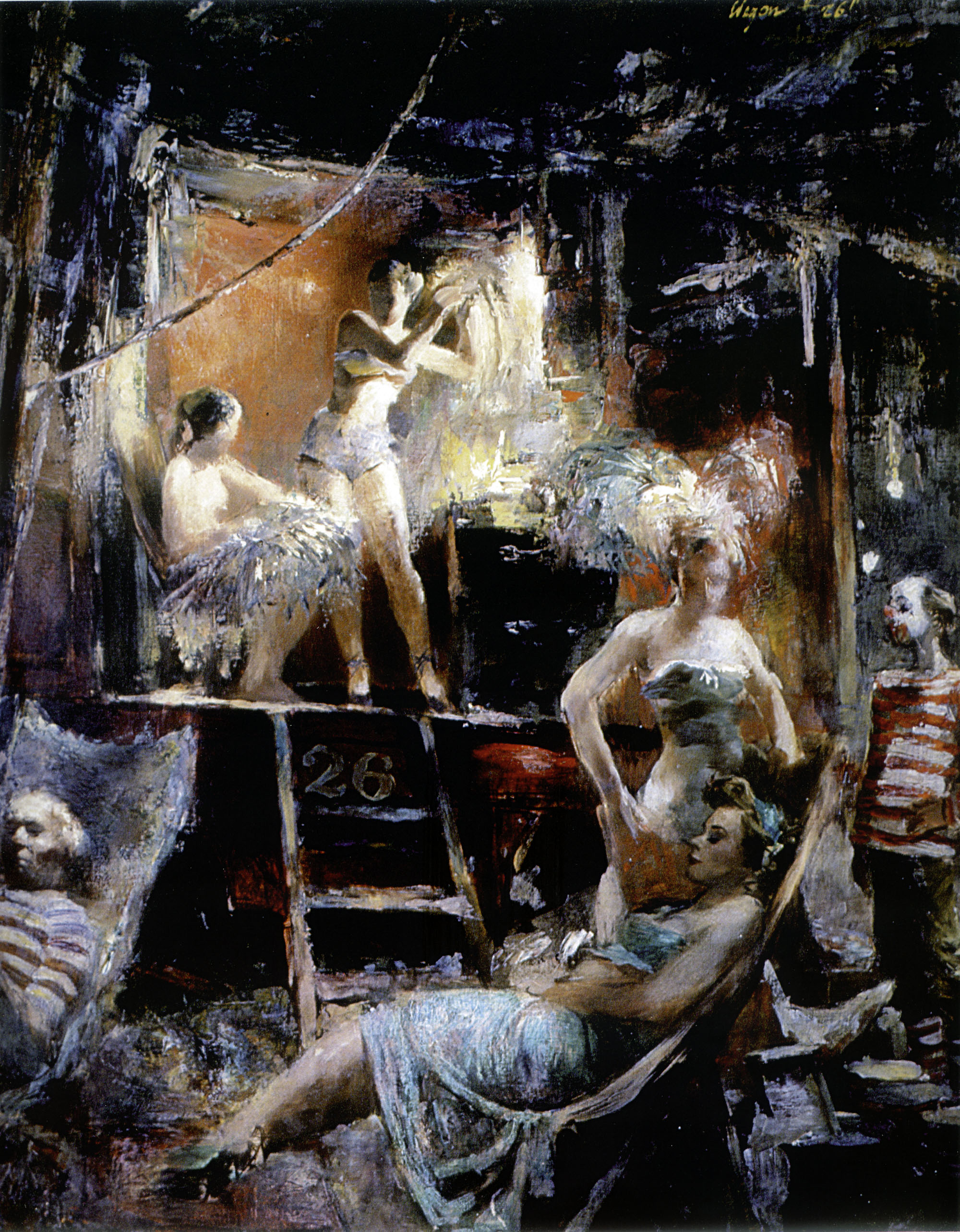
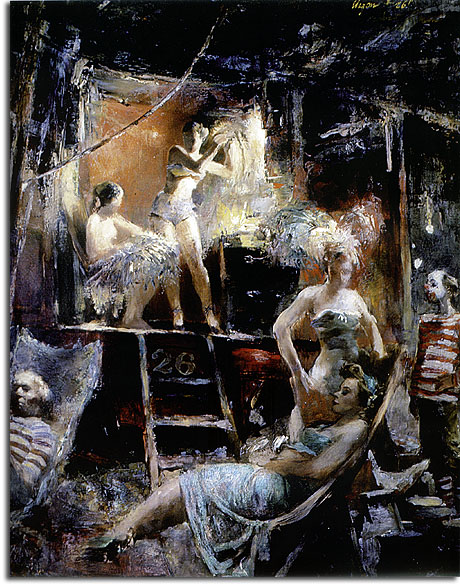 Wagon 26 Wagon 26 by Herbert Ryman, 1949 As hard as it is to remember an era when the circus held such a grip on the American consciousness, it’s even more of a disconnect to recall that clowns were once popular and enjoyed without apparent irony. Herb spent a lot of time with the clowns of the circus, living on “clown alley” most of the time he was on the road. This was an era when some clowns were actually famous in society at large, and Ryman became friends with the most famous of all time – Emmett Kelly. Kelly, an artist himself, appreciated Ryman’s efforts to capture the spirit of the circus on canvas. As he would later say, “Herb Ryman put the smell of sawdust into paint.”
 Emmett Kelly as Weary Willy Emmett Kelly as Weary Willy by Herb Ryman, 1949 In one of those amusing coincidences that so often appear in Ryman’s life, Emmett Kelly was a huge fan of Walt Disney. The two entertainers’ lives had mirrored each other in fascinating ways; the story of a young artist coming to Kansas City to become a cartoonist, and finding work making theatrical advertisements is familiar, but it’s little known that the story could also be about Emmett Kelly. In fact, Kelly was in Kansas City working in an animation studio across town at the exact same time that Walt was getting started at the Kansas City Film Ad company. It was here that Kelly would first start sketching the “Weary Willy” character that would eventually become his most famous routine.
Kelly and Walt’s paths diverged when Walt left for Los Angeles to become a film producer and Kelly eventually joined the circus; he worked in a number of roles before developing his clowning act. Although they had never met in Kansas City they were mutual fans; Kelly always wanted to be an animator, and Walt always wished he had run away with the circus. Their paths wouldn’t converge, though, until they both met Herb Ryman and he introduced them in 1950. It was a unique occasion, one of those very rare times when Walt himself was starstruck. As Eddie Sotto said in a recent comment here:
Walt loved the Circus and wished he had run away to join it. Herb Ryman said that was Walt admired Emmet Kelly more than anyone else and was proudest touring him around the studio. Kelly had wanted to become an animator so they mutually admired each other. Herbie had lots of Circus stories and Walt was even jealous that Herb had traveled with Ringling one year himself.
As Eddie added in a later posting, Herb complained that Walt would, on occasion, introduce him to people as “Herb Ryman, who traveled with the Circus.”
 Herb Ryman strikes a clownish pose for Emmett Kelly Ironically, these two huge circus fans – Ryman and Disney – would play a huge role in the demise of the circus as an entertainment institution. Times were already changing; Herb’s second stint with the circus in 1951 would mark the last time the Ringling Brothers circus would perform under the famous giant tents of the Big Top. A couple of years later, in 1953, Ryman would receive a phone call that would lead to a fundamental change of the American recreation landscape that made the spectacle of the circus pale in comparison.
Related Posts...
|
The Progress City Primer
 From the Progress City archives comes this collection of 33 tall tales and true from Disney history. Available in paperback, hardback, and ebook formats. |










Recent Comments