When one thinks about Imagineering, it’s most likely that the mind first runs to the artists. With fifty-five years of renderings, sketches, models, sculptures and amazing artwork, it’s perhaps no surprise that the fine artists have often become the public face of Disney’s creative workshop. Unfortunately this can do a disservice to the engineering side of Imagineering. While perhaps not as photogenic as an artist’s rendering, the concept and execution behind something as groundbreaking as the Enhanced Motion Vehicle or a trackless, solar-powered ride vehicle is just as impressive and worthy of attention.
We’ve previously discussed the work of Imagineer George McGinnis, and he recently put me in touch with one of the company’s long-time engineering greats. William “Bill” Watkins worked with Imagineering from 1966 until 1985, having come aboard as a project engineer after stints at Lockheed, Marqardt, and Honeywell. He worked on scores of well-known projects over the years, from the PeopleMovers and Autopia to Space Mountain and Big Thunder Mountain.
Bill has been working to record some of his thoughts and experiences from the design process, and along with George he’s been kind enough to share some of these with us. Specifically, we’re going to take a look at the process behind the creation of Space Mountain, which opened first at Walt Disney World in 1975. More than just a simple steel coaster, this new attraction broke barriers at the time by using the new technique of Computer Aided Design. It’s an interesting look into the difficult practicalities that Disney’s engineers face when the blue sky concepts of WDI’s creative teams meet the immutable restrictions of physics.
How Computers Influenced Roller Coaster Design
William M. Watkins, Former Disney Chief Mechanical Engineer
When I was a child, probably seven or eight years old, I went on my first roller coaster ride at Camden Park in Huntington, West Virginia where we were visiting relatives. I remember being very frightened before my father and I got on it, but being very exhilarated after we got off. After we returned home to Indiana I built my first coaster with a ladder, a board, and my little red wagon. This resulted in the first of three broken arms that I suffered before I was twelve. Little did I know that nearly thirty years later I would get involved in designing coasters and other theme park rides for a living after joining WED Enterprises (now Walt Disney Imagineering) in 1966 and later at my own company, Ride & Show Engineering, Inc. I have designed just three roller coasters (not counting that first one): Space Mountain, Walt Disney World; Space Mountain, Disneyland (CA); and Big Thunder Mountain Railroad, Disneyland (CA); but Space Mountain, Disneyland, has been duplicated at Tokyo Disneyland and Hong Kong Disneyland Park. Big Thunder Mountain Railroad also exists at Walt Disney World, Paris Disneyland, and Tokyo Disneyland, each with somewhat different names and configurations to adapt to the local terrain. There are many coasters throughout the world, over 600 in the US alone, and so there are many designers. Some of the old coasters were designed by people who had not had technical training and yet they served their purpose well, providing entertainment with safety. However, times have changed and so has coaster design.
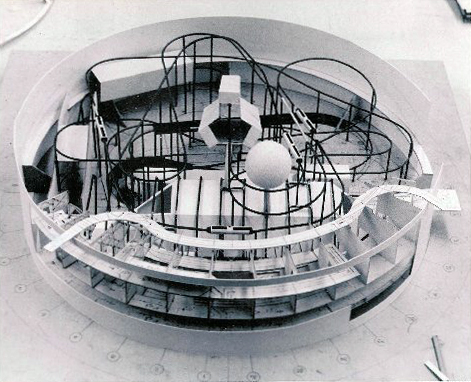 Final Disneyland Space Mountain engineering model
I will attempt to describe the approach that I developed for the design of gravity rides, an approach that would not have been possible without the advent of the digital computer because of the enormous number of calculations required. I recall a story by Ernest Gann, an engineer and novelist who wrote Fate is the Hunter. Many years ago he was in charge of a dirigible project and they were designing a large circular truss. They started by estimating the conditions at one point on the circle and a team of engineers spent an entire year calculating the stress in each member until they arrived back at the starting point where they found, as expected, that their original estimate was significantly off. So they re-estimated and started around again. Today, the whole analysis could be done in minutes if not seconds. The same thing applies to the designs of coasters today. That is not to say that a coaster can be designed in seconds. There are many programs to write, hundreds of decisions to make, testing to obtain data to plug into the computer, meetings with art directors, show designers, operations personnel, and shop managers. The whole design process took more than a year back in the 70’s, but the resultant design would have taken decades if it were not for the computer. Of course it would have opened on the same schedule, but would have been built to a lesser standard.
At the time that I began studying coaster design in 1968, computer use was just becoming more common. Disney was using computers for animation control and business applications but these computers were very slow and involved punch cards. For engineering applications, we tied into a main frame computer in Omaha via a dial-up modem with an electric typewriter. Though cumbersome by today’s standards, it was light-years ahead of what had gone on before.
My approach to coaster design was influenced by my experience as a race driver and a pilot. This may come as a surprise to those who are not familiar with racing, but the most important factor in driving a race car rapidly through a curve is the ability to minimize the lateral loads on the car by taking the proper path, maximizing the radius through the curve and to do it smoothly. Piloting technique is much the same. A good pilot banks the airplane smoothly and will coordinate his turns by applying the proper amount of rudder. Otherwise he puts undue stresses on the equipment and causes discomfort to his passengers.
 Imagineer William Watkins riding on single-seat test vehicle to evaluate banked curve geometry
It was my belief, especially in regard to Space Mountain, because the ride is in the dark, that the ride should be smooth and since there would be a lack of visual cues, the g forces should be limited. A brief explanation: g loading is expressed as a ratio of the force developed in changing speed or direction relative to the force felt due to the earth’s gravity. The smaller the curve radius and the higher the speed, the higher the g force. Thus, a 2g force on a 100 pound body causes it to to weigh 200 pounds. Race drivers in the Indianapolis 500 are subjected to more than 3g’s in the corners and there are loop coasters that subject passengers to as much as 5g’s. I decided that there should be a maximum of 2.5g’s for our coaster designs. I tested this premise by exposing myself to 3g’s in high banked (70.5 degrees) turns in an airplane. I felt that if 3g’s was OK for me, who’d had a disc removed from my back a couple of years earlier, then 2.5g’s should be safe for the vast majority of riders. So you might say; yes, but what about someone who is weaker than you? Two things: if all rides were geared to the weakest among the population, there would be no rides. The second point is that the operations personnel are charged with, through signage, informing people of the nature of the ride and denying boarding to people that they feel are not capable of withstanding the forces.
Not all g forces increase the weight of the passenger. As a vehicle goes over the top of a hill the load on the passenger becomes less than earth’s gravity and, in the extreme, could throw an unrestrained passenger out of the car. Some coasters do subject passengers to slightly negative g’s which cause them to raise off their seats and become “weightless” for a short period. And this is often touted as a desirable feature. However, in a dark ride such as Space Mountain, we felt that it would be best not to raise passengers off their seats because of the possibly of injury when they sit back down, especially when the g’s rapidly become positive. So the top of hills (negative vertical curves as we call them) are designed to lower the passenger’s weight by just 75%, leaving 25% of their weight still resting on the seat. Thus passenger loading varies from 0.25g’s to 2.5g’s as they travel through Space Mountain and Big Thunder Mountain Railroad.
The next issue is the direction of the g forces. There have been rides like the Wild Mouse which is a series of flat circular curves connected by straight sections. The g forces are all lateral, suddenly pressing the passengers against the side of the vehicle or against each other. These are rides that are usually found at carnivals and are relatively inexpensive and easy to set up. More sophisticated rides have banked turns. If the turns have 100% banking, then the g forces are directly into the seat with no lateral component. This could be considered ideal but is impossible to achieve for every vehicle because it is dependent on the speed of the vehicle and that varies due to several factors that will be explained later. Overbanking is to be avoided because that would cause the passenger to tend to fall toward the center of the curve. Underbanking is better because it causes the passenger to press against the outside of the car, but with much less force than with the unbanked turn. And people are used to experiencing forces toward the outside of turns when riding in automobiles on curvy roads. So curves were designed for 80% banking for the slowest vehicles to avoid the possibility of overbanking.
The next issue is how to gracefully transition from a “wings level” (as we say in flying) condition to a banked condition. Formulas for putting mechanical components, such as valves in an engine, into motion without inducing sudden impacts are well known in engineering and these same formulas can be applied to the change in bank angle when entering and departing a curve. The amount of banking increases inversely with curve radius, so during the transition phase where bank angles are smaller, the radii must be larger than the final curve, so this defines the shape of the total curve, i.e. turning gradually at first and tighter as the bank angle increases.
The next issue in curve design is establishing the line about which banking takes place. Visualize what happens when a high-wing fixed gear airplane banks. In a right turn you will see the wings moving to the right while the wheels move to the left. That means that somewhere in between is a point that does not move relative to your body. If those wheels were on a fixed track, the track would have to be moving up, swinging around that point. The best track design is one in which a point on the centerline, a few inches above the seat , will follow a smooth line into and out of a banked curve. By defining this line and swinging the track around it, the disturbance of the passenger is minimized. Contrast this with the usual practice in the old wooden coasters in which banking is achieved by raising the outer rail thus tossing the passengers toward the center of the curve.
 Raising the outside rail tosses the passenger toward the center of the curve. Swinging the track about an elevated line simulates flying in an airplane.
To design a ride such as Space Mountain to fit in a confined space, be smooth and have the capacity to accommodate a large number of passengers each day, it is necessary to accurately calculate speeds and timing. In order to avoid the possibility of collisions between vehicles, the track is divided into zones which are on shorter time intervals than that in which the cars are dispatched and each zone is protected by brakes. The speeds, and thus the timing of vehicles, is a function of changes in elevation, and the various drag factors that tend to slow the vehicle down. There is the rolling resistance of the wheels, friction in the bearings and seals, viscous drag of the wheel lubricants, scrubbing of the wheel treads due to minor misalignment, and the aerodynamic drag. Some of these factors are influenced by the weight of passengers carried, some are not. That is why heavy vehicles are faster than light ones. Although some of these factors may seem small, they are significant over the entire length of the track. As a matter of fact, it is the designers job to manage the drag so that most of the energy of raising the vehicle to the top of the lift is consumed by the drag while the vehicle is coasting down, converting that energy to heat.
So, as I said, It takes thousands of calculations and a lot of trial and error to arrive at a final design and, without a computer to do those computations, it would have taken much longer than Ernest Gann’s circular truss to design Space Mountain.
Many thanks to Mr. Watkins and to George McGinnis for putting together this look into what went in to designing this groundbreaking attraction.










Recent Comments