
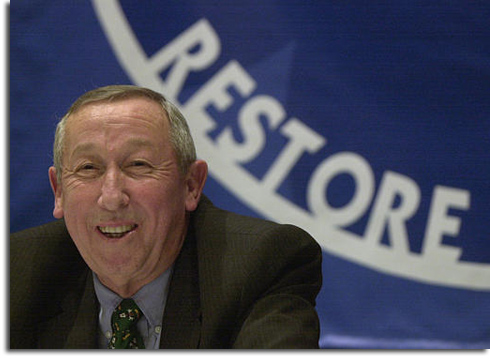
Roy Disney, smiling in Honolulu after completing the 43rd Transpacific Yacht Race on July 24, 2005. Disney and his crew aboard the Pyewacket finished second in the race. (AP Photo)
What’s weird is that I was thinking about Roy E. Disney just this morning.
I don’t remember why; my Disney-related reveries while I should be getting other work done are so common that they’re hard to trace back to a specific point. But I was thinking about Roy and I was concerned. There have been rumors for a while that he wasn’t in the best of health; I hadn’t heard anything specific, of course, but I became worried when he didn’t show up for D23, or the dedication of the Walt Disney Family Museum, or the publicity junkets for The Princess and the Frog.
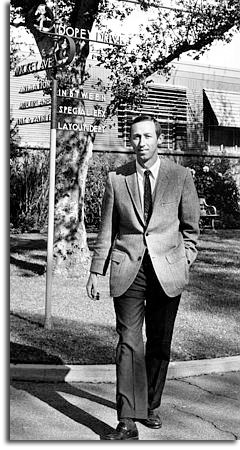 I had expected him to be present for each of these, and looked forward to his contributions to each. After all, considering everything he’s given the company it would be exciting to see him get a huge ovation at the D23 Expo or to be able to preside over the return of Disney animation. A lot of the good things going on with Disney are in many ways fruits of his efforts, and I had hoped that he would get to see how much we all appreciated it.
Lots has been said today about these contributions, of course, and much has been written over the last few decades about the changes Roy helped bring about at Disney. He came to the fore, of course, in 1984, when he helped bring about the ouster of his cousin-by-marriage Ron Miller from the management of Walt Disney Productions. By securing the company from hostile takeover attempts and bringing in new management in the form of Michael Eisner, Frank Wells and Jeffery Katzenberg, Disney changed the course of the company his father and uncle founded in 1923. Then things really got interesting.
The story of Roy “saving” Disney is far more complicated that most news stories today would have you think. I’m sure we don’t know a fraction of what really happened, and it’s hard to say what would have happened had he not acted to bring in new management. Most of Roy’s discontent with the company’s creative stagnation seemed rooted in the Walker years; Miller had only recently taken over and was making a push to revive the studio’s fortunes. Many of Eisner’s early successes came from continuing programs that Miller had put in place before his departure, but the end result of the turmoil in 1984 was that Eisner and Wells were seen as reviving a moribund company – and Roy was the prodigal son that had made it all happen and saved his family’s studio.

Happier times: Ron Miller, left, and Roy E. Disney discuss projects on the Disney Studios lot in Burbank on December 1st, 1967. (AP Photo)
Speculation aside, though, one thing is certain – Roy saved Disney animation.
Hardly anyone wanted to keep it going when Eisner arrived in 1984. The division had sort of trailed off, and although new talent tried to fill the shoes of the now-retired Nine Old Men, they received little guidance, support, or interest from management. The company’s attention had been devoted to the construction and opening of EPCOT Center in 1982, and the studio side of the business had fallen onto hard times. Eisner and Wells, along with Jeff Katzenberg, were devoted to turning Disney into a major film studio, but their plan didn’t include animation.
 Thankfully, Roy was there. Wells and Katzenberg wanted to close the animation studio. They knew that overseas animators could crank work out much, much cheaper, and in the mid-1980s no one cared if the hit animation on Saturday mornings was of any quality or not. Eisner, though, knew that he owed his new role as a movie mogul to Roy’s efforts and gave him his choice of assignments at the revived studio. Roy, of course, chose to oversee Disney feature animation.
This critical decision led Eisner to overrule Wells and Katzenberg, and Roy was soon upgrading and updating the animation studio in preparation for a string of hits that defined the Walt Disney Company in the 1990s. Without Roy, it’s not unreasonable to presume that the great tradition of Disney animation would have ended with The Black Cauldron in 1985. Would we have Pixar today? We certainly wouldn’t have Dreamworks. Without Disney around to prove that animated features could still hit big – something that was truly doubted in the 1980s! – would we still have an American animation industry?
One of my hopes when I began this blog was that maybe – maybe – it would be a way to reach out to those people whom I truly admired, and to maybe some day cross their paths so I could thank them for all that they have given the world through their work. I was skeptical that would ever happen, so in many ways it’s been far easier that I ever expected to speak to some of these people. Those wonderful people I met at the D23 Expo, and the kind Disney people past and present that I continue to cross paths with online, have allowed me a chance to express a bit of gratitude for their years of hard work.
Foremost among those people that I had wished to meet was Roy E. Disney. Sadly, now I never will. While his loss is obviously greater to the family who loved him and the company that he held dear, and my petty celebrity-stalking dreams don’t really matter in this equation, it would have been really nice to thank him. Fifty-six years with the Disney company, and taking no end of grief throughout – it’s a complicated story, I’m sure, but you can’t deny the efforts of someone who keeps coming back again and again to try and keep that flame alive no matter how many people try and put it out.
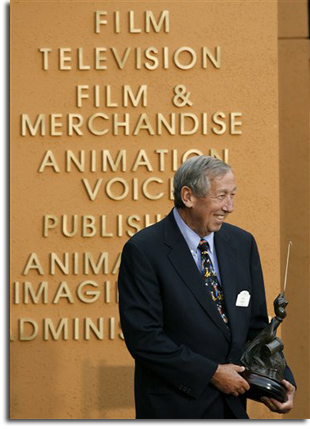
Disney Legend Roy E. Disney, 1998 (AP Photo)
Most everyone probably thought that Roy’s big contribution to the company would remain his 1984 coup against management, so it came as an ironic shock twenty years later when he staged another attempt at regime change – this time, against the man that he brought in to run Disney all those years ago. Roy’s “Save Disney” campaign to remove Michael Eisner from his role as Chairman and CEO came at an exceptionally low point for Disney fans, and revived the spirits of many who had lost hope.
The company had been in a slow decline since Frank Wells’s death in 1994, and seemed to have entered a freefall as Eisner loaded the executive ranks with incompetent cronies. The parks were at an all-time low, with new gates like California Adventure becoming synonymous with failure in the culture at large. The animation department, too, had fallen on hard times, and it looked like traditional animation had seen its last gasp. Like with The Black Cauldron in 1985, it now seemed that Disney animation would end ignominiously with Home on the Range.
But Roy rallied the troops, this time using the internet to speak directly to fans. His initial salvo – a blistering open letter addressed to Eisner – said publicly what so many fans had wanted to hear for so long. Roy called Eisner on the carpet for the decline of quality at the parks and in animation, and for the widely-held perception that the company was now a faceless corporation that could no longer control its greed. The fact that we were hearing these things said – in public – and on a national stage seemed miraculous.
Even more earthshaking was the result of Roy’s initial Save Disney efforts – at the Disney company shareholders’ meeting in 2004, an astonishing 45% of shares were voted against re-electing Eisner to the board. This fairly unprecedented rebuke led, within a year, to Eisner’s early departure from the company.
Whatever his motives, and whatever the outcome of those events, I will forever be grateful to Roy for giving voice to the hordes of fans who had been driven to despair over the state of the company. It was wonderful to know that someone else – someone who could do something about it – actually cared, and that it wasn’t completely futile to hope that Disney could once more aspire to some semblance of quality.
I guess the reason this all hits so hard, and why I was crushed when that headline came across my news ticker this afternoon, is that for my generation – those of us too young to remember Walt or Roy O. – Roy was our Disney. His physical resemblance to his uncle Walt is obvious, and for this generation he was the Disney family member that you could always expect to see pop up to represent the family. This was especially true in later years, as documentaries on television and DVD became more frequent and sought to tell the stories from the studio’s past. Roy was always there.
I can only hope that someone in the family – either from Walt’s side or Roy’s side – will take this as a call to step up to the plate. There always needs to be a Disney, scrapping away with the Disney company to make sure the ideals of its founders aren’t completely forgotten. If we hadn’t had a Disney there in 1984, or 2003, who knows how bad it would be now. Answer the call.
The company should also take this as a reminder of their roots in traditional animation, and redouble their efforts to restore that aspect of the company. One of the things I’m most grateful to Roy for is that he, more than anyone, pushed for years to get Fantasia 2000 made. It’s hard to imagine that happening again, but I hope against hope that someone will make it happen. It wasn’t so long ago that Fantasia 2006 was on the cards, and again we have Roy to thank for the fact that we now have the privilege of seeing Destino finished. We owe him big for all those things, but there’s so much left to do.
There’s so much more that could be said about Roy’s life; his sailing, his philanthropy… I’ve left out his enormous devotion to the company’s nature films; he cut his teeth on the True-Life Adventures, after all, and the DisneyNature brand is another direct descendant of his works. I’m so glad he lived to see that happen.
Anyway, Roy, it’s possible that we’ll never know all the ways that you quietly (and not-so-quietly) steered the course of the company over the last thirty or so years. But for the things that we do know, and for the legacy you worked so hard to keep alive, I thank you.
Related Posts...
 “Tin Soldiers Will Join Mickey Mouse and Pluto In Daily Magic Kingdom Holiday Parades”
 “Old-Fashioned Holiday Wreaths”
 “Gifts for Family and Friends Fill Walt Disney World’s Shops and Boutiques”
 “The Wonderland of Wax on Main Street is Full of Holiday Scents and Bright Colors”
 A Most “Contemporary” Christmas Tree”





Recent Comments