There was something I intended to write about upon my return from the D23 Expo, but it wound up gathering a bit of dust on the shelf along with about two dozen other stories I still need to tell from that time. This one is about Disney and labor relations; what would have otherwise been a brief mention of the Union protests outside the Anaheim Convention Center in September, which I found to be uniformly mild and inoffensive, now necessitates a full story for a couple of reasons.
First there’s the fact that the issue has continued to evolve since those protests, with a couple of widely-posted stories in the media. What really spurred me to talk about this, though, was a pretty high-profile Disney podcast I was listening to recently. It was one of the many post-D23 recap episodes that flooded the blogosphere after the Expo, and when the subject of the protests came up I was irritated to find that the commentators were being – you must pardon the expression, but it’s definitely apropos – incredibly dickish about the whole affair. In fact, I’ve seen a few instances since of Disney fandom being taken aback that anyone would dare protest against poor Mickey and the dream-filled wish-scape of Disney magic ™ in search of better working conditions.
Disney’s well-publicized conflicts with labor go back to 1941, when the animators’ strike tore the company in two. Despite the fact that both sides seem to have had reasonable grievances, outside agitators on both sides used the incident to further their own goals and escalate the conflict. It was one of the most significant turning points in Disney history, and changed the company and its animation department forever.
The current labor troubles stem from contract negotiations with the Disneyland Resort’s hotel union, Unite Here 11. The union covers most of the front-line staff at the hotels, from bellmen and housekeepers to cooks and dishwashers. The sticking point in the negotiations has been the very timely issue of health care. Currently, Disney pays into a trust that covers the cast members’ insurance costs. To cut costs, the company has transitioned the rest of Disneyland’s unions to a new plan, which requires employees to pay for a certain percentage of their premiums. The cost of these premiums would be automatically deducted from cast members’ paychecks. The hotel workers’ union is the last remaining holdout from the plan after nearly two years of negotiation.
Disney says that their plan, which phases in employee payments over a five-year period, would only cost new members around $60 a month. The union counters by pointing out that once the payments are fully phased in, cast members under the new plan could be stuck for as much as $500 a month.
The dispute now seems intractable, with neither side willing to concede further ground. The union doesn’t have to accept a new contract, and Disney will be forced to continue paying into their current insurance plan, but the workers will also be stuck with the pay scales from their previous agreement. Disney insists that the workers are missing out on pay increases that they would otherwise receive, but the union believes that any raises achieved under a new contract would be more than offset by new health care expenses.
As time passes, the situation becomes increasingly difficult for union members. In June, the amount that Disney pays into the insurance trust could not keep up with rising health care costs and the union was forced to cut the part of their plan that covered employees’ sick days. Left without a safety net should they become ill, and with their finances already stretched to the limit, cast members were forced to come in to work regardless of their condition. The result was a number of unflattering news stories about severely ill cast members working in the Disney hotels during the height of the H1N1 season.
Union members have stuck to their guns, though, rejecting the Disney proposal with a 92% majority in August elections. They’ve even upped the ante by staging their first walkout last Sunday morning. As of last report, there are no negotiations scheduled.
Labor negotiations are tricky by their very nature. One side usually asks too much at first, and the other side offers too little. It’s negotiation, after all, and a good negotiator won’t cede the field before talks begin (something certain people in Washington need to learn, but I digress). One thing that I can’t believe, though, is that Disney fans wouldn’t have a measure of sympathy for the people who work their tails off for next to nothing to make the “magic” that fanboys laud so rapturously. If your main source of income is an $8-an-hour job getting abused by tired tourists, you might not think it unreasonable that your health care be covered. You might also wonder why Disney can’t afford to take care of its hard-working cast members when they can shell out $4 billion for a few thousand comic book characters, most of which they’ll never use for anything.
Cast member compensation is something that has long concerned me, and that I’ve wanted to write about several times. It’s a big problem. You can’t expect to retain the best people when you pay lower than most other service-sector jobs in your area. Al Lutz has long written about this problem at Disneyland, where they’ve had many years of issues with retaining employees because kids can get better money working at McDonald’s than making Dole Whips in Adventureland. This is also the same reason we’ve had the College Program explosion at Walt Disney World, because aside from Disney die-hards, it’s hard to get someone to move to Florida to work for minimum wage and no benefits.
Walt, of course, was smart and had the solution figured out – EPCOT. By offering your employees subsidized housing in your city of the future, you’d be able to attract quality workers for long-term employment despite their modest wages. Even when his successors dropped the ball on EPCOT, Disney at least offered some other benefits to mitigate their rather low pay scale. But now cast members are overworked and underpaid as never before, and even the most loyal and hardworking Disney devotee can only take that for so long.
Obviously, Disney is never going to have a work environment like Google or SAS. But Disney owes it to their employees and to their customers to make some real reforms in this area, and it’s up to fans to hold them to that. At the very least, we can refrain from deriding union members who are trying to make their case in a peaceful and non-confrontational way.
Related Posts...
 “Wouldn’t you rather have your child watching cartoons than… than reading Elinor Glyn?” “What Elinor Glyn reads is her mother’s business!”
 From the New York Times, November 16th, 1930
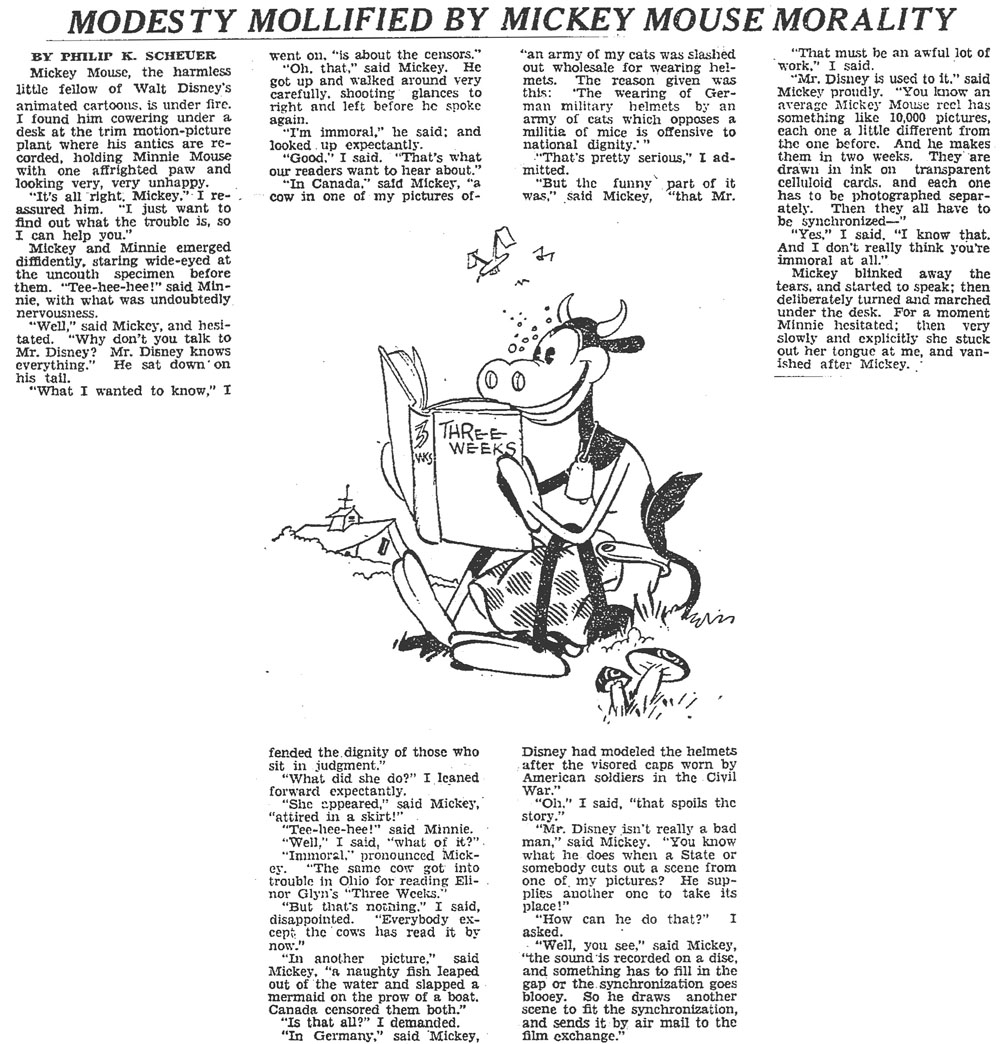 From the Los Angeles Times, November 23rd, 1930
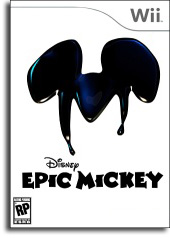 The subject of Mickey’s relevance as an entertainer has been a hot topic lately; this seems to happen at least once a decade. It happened in the 1980s after Michael Eisner’s arrival at Disney, and it happened in the 1990s with the release of Runaway Brain. We’ve also seen attempts at revivals with the Mickey Mouse Works and House of Mouse television anthologies. This time, the discussion accompanies the hype leading up to 2010’s release of Epic Mickey for the Wii gaming console. Designer Warren Spector had been reluctant to tackle a Mickey-related title, as the character has become so devoid of… character. Like many of the previous attempted revivals, Spector has looked to Mickey’s early work for inspiration. The early peeks have been intriguing, with many characters from Mickey’s early years and adventures in print popping up. Oswald the Lucky Rabbit and the Phantom Blot? Yes, please.
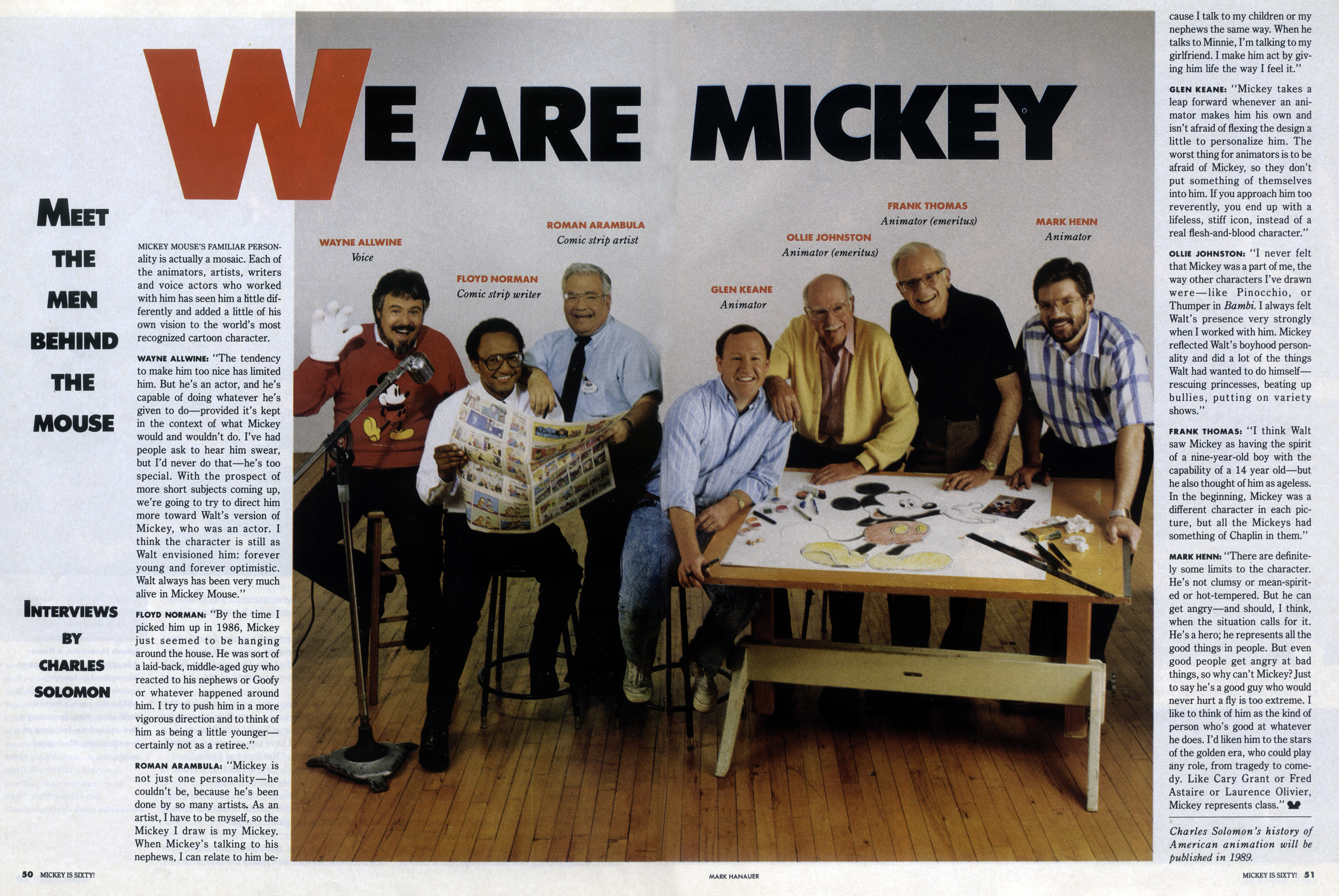 The men behind Mickey in 1988 and their thoughts about the character. From left to right: Wayne Allwine, Floyd Norman, Roman Arambula, Glen Keane, Ollie Johnston, Frank Thomas and Mark Henn.





Recent Comments