Contribute to Our Research |
By Michael - December 16th, 2010 
The third of the new documentary releases we’re reviewing, Waking Sleeping Beauty looks at the animation renaissance that occurred at Disney in the late 1980s and early 1990s. Directed by longtime Disney producer Don Hahn, the film is an absolute cannot-miss must-see treat for any fan of animation. The quality of the film itself is enhanced on home video with a slate of great extras that really flesh out the story presented in the film.
The Film
 The 1975 graduating class at CalArts helped pave the way for the Disney renaissance. Future animators of note in the class included John Lasseter, Brad Bird and Jon Musker In my original review of the film from its theatrical release, I said that it is rather remarkable that Waking Sleeping Beauty exists at all. The odds were against such a complicated story being told, especially with the willing and apparently forthright participation of the principal players in the saga. The fact that Hahn and producer Peter Schneider (himself the former Disney studio head) were able to corral Michael Eisner, Jeff Katzenberg and Roy Disney into telling their stories becomes even more astounding when you begin to realize the level of acrimony that slowly ratcheted up on the Disney lot even as the animation unit continued to reach new levels of success.
 Peter Schneider, Roy E. Disney and Jeffrey Katzenberg in the good ol’ days I have said that The Boys: The Sherman Brothers’ Story was the very definition of bittersweet, and for the devout animation fan a sense of melancholy pervades Waking Sleeping Beauty as well. This is odd, as the film itself is a tale of triumph, renewal, and success, but for those who know how it would all eventually end, it’s rather like watching all the pageantry at the Titanic’s christening. And yet the course of the film follows Disney animation from its historic low point, with The Black Cauldron getting beat out at the box office by The Care Bears Film, to its greatest triumph with The Lion King. The film ends around the time Katzenberg departed the studio in 1994 following the death of Frank Wells, which is really when the wheels started to come off. Still, the overall story of the film is of a young generation of filmmakers re-building an empire against the odds, and the tug of war they often played with Disney’s new and ambitious management team.
The film is narrated by Hahn, who does a great job and manages to draw credibility from his obvious place in Disney history without crossing the line into making the story about him entirely. His presence is welcome and affable and really gives the documentary a personal touch. Interviews with the surviving major players are included, and it’s rather remarkable to hear Katzenberg and Eisner speak so honestly. A metric ton of documentary audio, video, and photography is included, and the narration and audio interviews are integrated especially well considering that it’s done without relying on “talking head” setups. It must have been a bear getting clearances for this film, because rather than just hearing about events we’re often shown footage from the time, straight from contemporary news reports. As always, I continue to appreciate the Disney tradition of filming everything, because there is so much documentation of specific events and meetings that would otherwise be lost to time. The only drawback is that a lot of this was filmed on video; I hope there’s someone at Disney that’s backing up all this stuff digitally.
In any case, the film is stylish and classy from its opening frames straight through to the end credits, with production values that even carry over to the DVD menus.
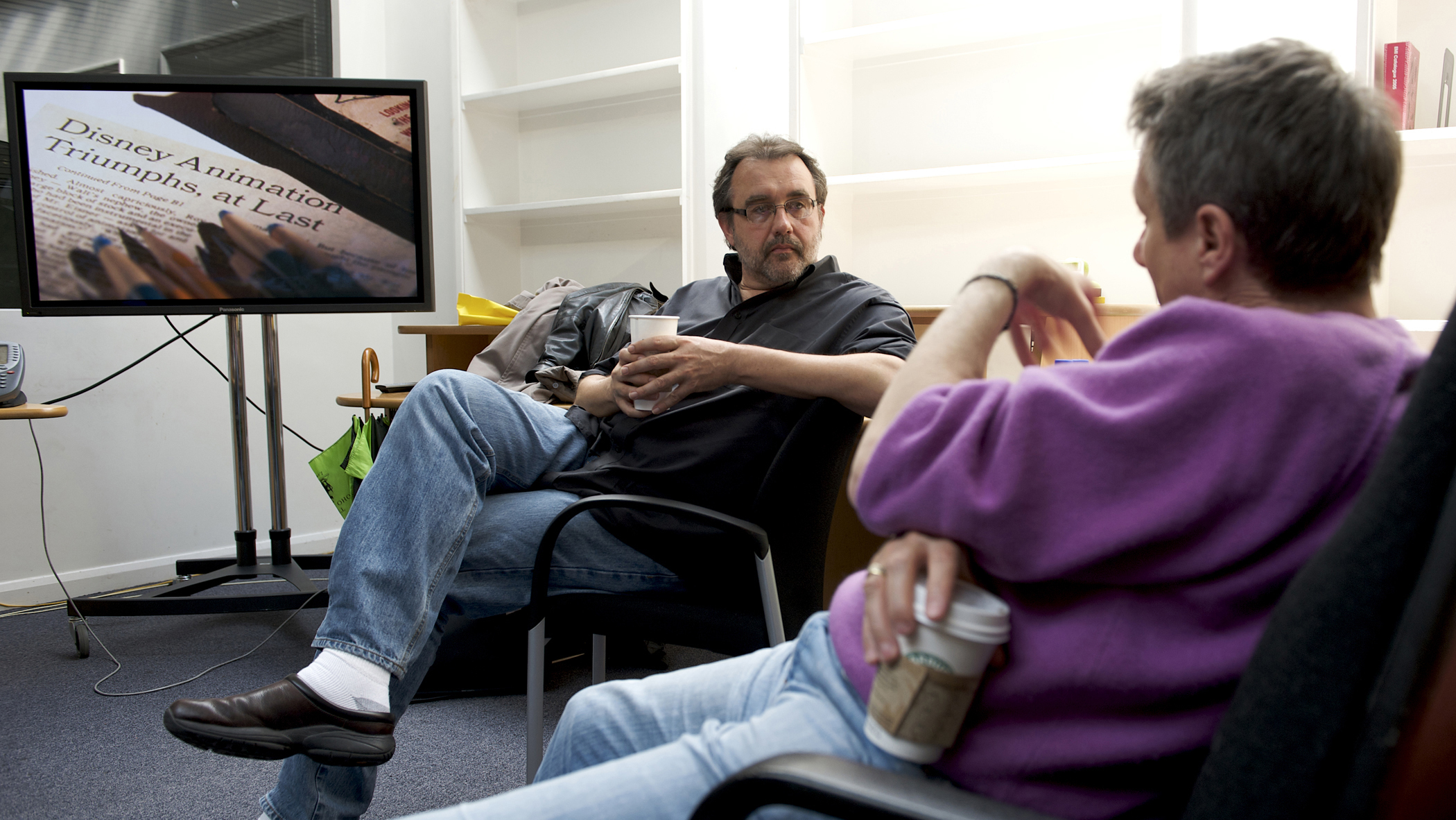
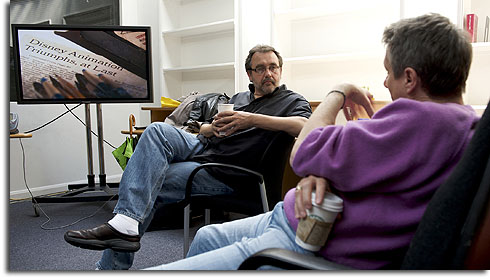 Director Don Hahn and producer Peter Schneider at an editing session for the film The film begins with animator Randy Cartwright’s home movies from the Disney lot in 1980 and 1983. It’s eerie to see the sleepy lot, with then-chief Ron Miller wandering the halls and a slew of future household names like John Lasseter, Tim Burton, Glen Keane, Ron Clements and John Musker wandering the halls looking for something to do. We’re walked through the process of Disney animation’s near-collapse, the uncertainty following the arrival of Michael Eisner and Frank Wells, and the slow, hard-fought return to greatness that followed. It wasn’t an easy process; the “new guys” knew nothing about animation and the culture clash was pronounced.
Perhaps the biggest revelation of the film concerns two rather unsung talents, and the scope of their contributions to the Disney resurgence. Everyone knows that Frank Wells was half of the executive team that is widely credited with reviving Disney in the 80s. But because he shied away from the limelight and did not seek credit, it really is hard to understand how fundamental a role he played in events until you hear people from that time talk about how much they loved and respected him, and about how he made real contributions to projects aside from just signing the checks. It makes one wish that more would be written about the guy.
Even more shocking is the discovery of lyricist Howard Ashman’s absolutely crucial contributions to the films that defined this era – The Little Mermaid, Beauty and the Beast, and Aladdin. It was obvious that the time that Ashman, and his songwriting partner Alan Menken, were extremely talented and a major part of the films’ success, but until now I never understood Ashman’s considerable story contributions and his larger role in shaping what the films became. It makes one really wonder what would have happened had he lived, and also makes one wish that more would be written about him as well.
I could just go through this film talking about each little bit, but in the end all I can do is strongly recommend you check it out yourself. As always, the highest compliment I could pay to a documentary is that I wish it was a 10-part miniseries, and I can only hope that some day we get another film to flesh out the time between the story of Waking Sleeping Beauty and the second collapse of Disney animation that is chronicled in Dream On, Silly Dreamer.
The DVD
Released November 30th, 2010 – Rated PG – 86 minutes – $29.99
Video & Audio
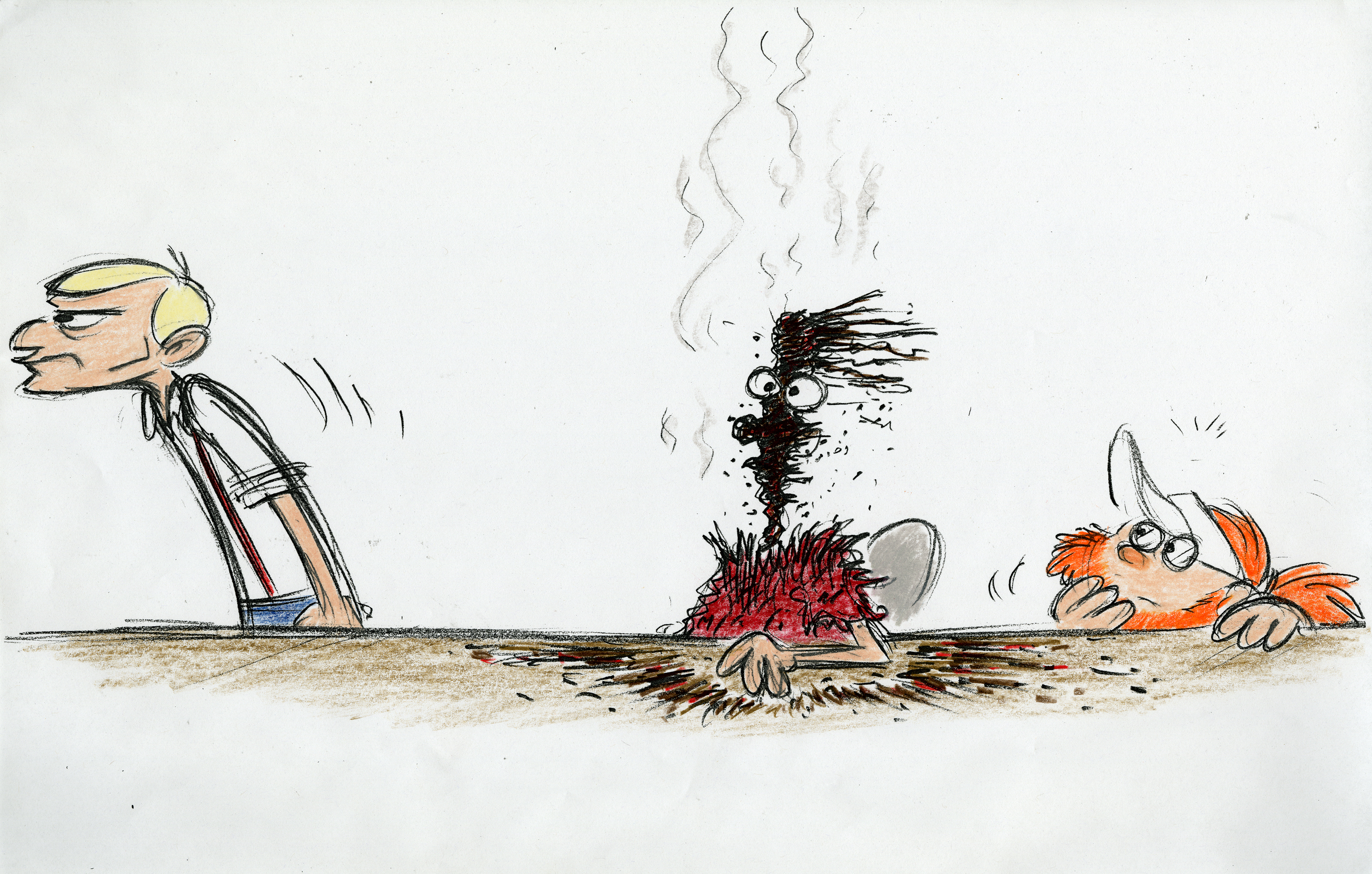
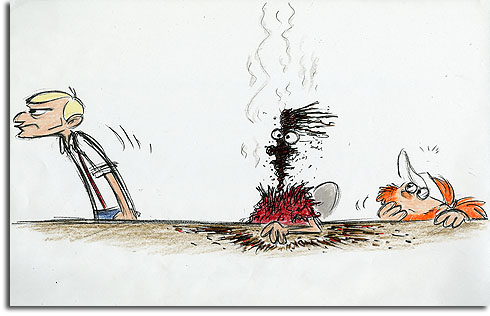 A sketch by Kirk Wise shows the aftermath of a contentious story meeting that he and co-director Gary Trousdale had with Howard Ashman during the production of Beauty and the BeastIt’s funny with documentaries, because you can have some that use materials from the 1930s that looks great – because it’s on film. Waking Sleeping Beauty draws a lot of its material from the 1980s and 90s, aka the godless era of videotape. The degraded video elements drawn from newscasts and internal Disney sources make one lament the generation of documentation that’s being lost as surely as nitrate film stock. The film draws from many different sources, presented in a number of ways, but overall it’s all assembled very well. It also wisely draws on the talents of the animators, who recorded and commemorated many events both funny and stressful in an endless stream of gag sketches.
The film is presented in 1.78:1 widescreen, and in Dolby Digital 5.1.
Bonus Materials
The bonuses on the disc contain a number of nice treats, many of which are longer cuts of videos that are excerpted in the film itself. We get Randy Cartwright’s three tours of the Disney animation building, some truly great footage of Howard Ashman (although I wish his full speeches were included!), and tributes to Wells, Ashman, Roy E. Disney, and storyman Joe Ranft.
Features
- Why Wake Sleeping Beauty? – Overview featurette
- Deleted Scenes – Black Friday, Howard’s Lecture, Losing Howard, Recording ‘Part of Your World’, Research Trips, To Sir With Love
- The Sailor, the Mountain Climber, the Artist and the Poet – Celebrating Roy Disney, Frank Wells, Joe Ranft and Howard Ashman
- Studio Tours – Personal video footage from animator Randy Cartwright documenting the Animation Studio in 1980, 1983 and 1990
- A Reunion – Rob Minkoff and Kirk Wise
- Walt – What would Walt do? A comparison of Walt’s era and the current era
- Audio Commentary – View the film with commentary by director Don Hahn and producer Peter Schneider
In Summary…
Waking Sleeping Beauty is really good. Really, really good. It’s an emotional and funny film full of historic goodies for any fan of Disney or animation. It makes one marvel at what was, what could have been, and what can happen when that unknowable alchemy of creation, artistry, and business takes place. It makes one hopeful that it could all happen again. Highly recommended.
Related Posts...
By Michael - December 15th, 2010 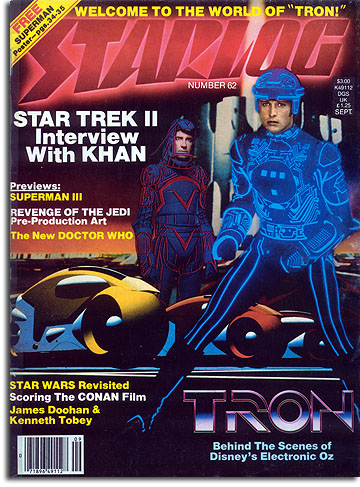
The summer of 1982 was about as exciting as it could get for sci-fi fans. Just take a look at the cover of STARLOG #62 from that September – Star Trek II! Revenge of the Jedi in pre-production! The year would see Blade Runner, E.T., and many others, including TRON. While TRON: Legacy, which arrives in theaters this week 28 years after the original film, is just another blockbuster film taking place in a virtual world, back in 1982 no one really knew what to expect from computer-generated effects. Aside from the brief Genesis Planet sequence in Star Trek: The Wrath of Khan (created by plucky new division of Lucasfilm that would eventually evolve into Pixar), cinemagoers hadn’t really experienced computer animation, and certainly nothing on the scale of TRON.
The scope of the effects work in TRON remains impressive today; many of the film’s effects weren’t computer generated, and were created with traditional tricks and techniques. The film’s otherworldly look came from this elaborate and very labor-intensive process, and laid the groundwork for much that came after.
This interesting article appeared in STARLOG and gives a hint of what roadblocks the filmmakers encountered during production. There are also some predictions of what this all means for filmmaking, many of which are quite prescient and all of which are entertaining.
 “By Combining Artists and Computers, Disney Sets New Rules for Reality” 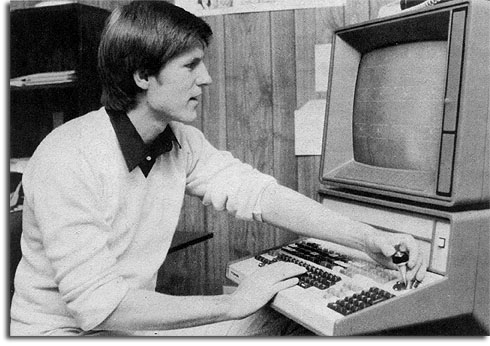 “Computer image choreographer Bill Kroyer helming the Chromatics terminal.”
By DAVID HUTCHISON
Take a moment to read the credits at the end of Disney’s TRON. TRON is the first feature film to employ computer graphics on a large scale. And with the new machines come new jobs and job titles for moviemakers. One of the more interesting sounding credits to be found at the end of TRON is “Computer Image Choreographer.” The two names listed are Bill Kroyer and Jerry Rees.
Back in May, before TRON was completed, STARLOG found Bill Kroyer behind a Chromatics computer monitor at the Disney studios. Kroyer joined the Disney studios with Pete’s Dragon and even animated a bit of Fox and the Hound. So what’s an animator doing sitting behind a computer terminal?
“I’m looking at a ‘pencil test’ for a sequence from TRON that is being sent over the phone lines from the computers at MAGI in Elmsford, N.Y.,” came the easy reply. “It’s my job or part of my job as computer image choreographer [C.I.C.].”
“Oh. And what is …. “
“… a computer image choreographer?” smiles Kroyer. “Well, it’s certainly the first time that credit will appear on the motion picture screen, because this is the first time this process has ever appeared on the screen on this scale.
“Computer generated imagery, what we call ‘scene simulation’ and which most people tend to call ‘computer animation,’ is really an up-and-coming fast-moving field. The basic idea is to generate pictures on the screen that are not drawn or painted by anyone, or built as models first. They are scenes that are completely constructed in the imaginary mind of the computer. Then the computer reads out that imagery on a piece of film, which is processed printed and projected as ordinary movie film.
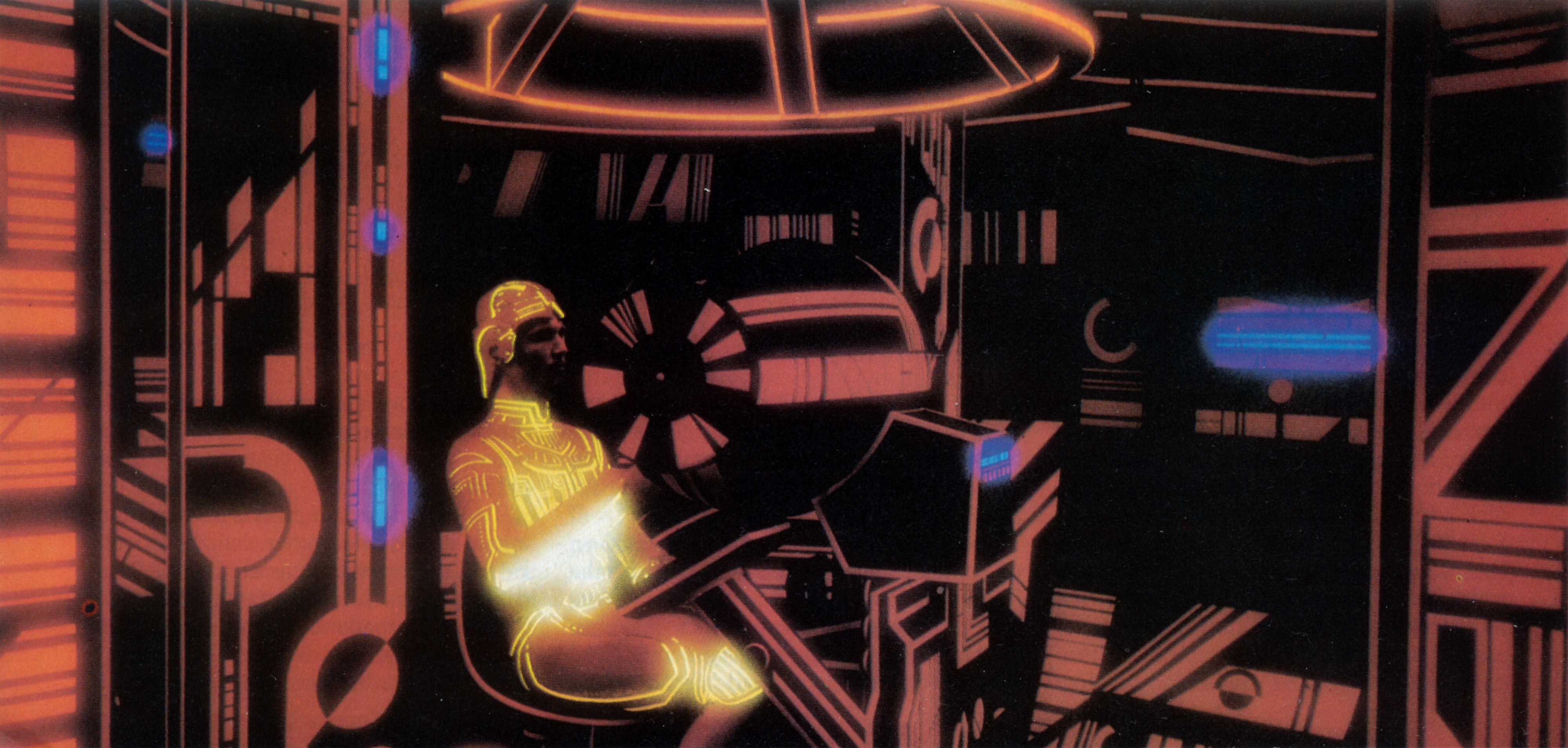
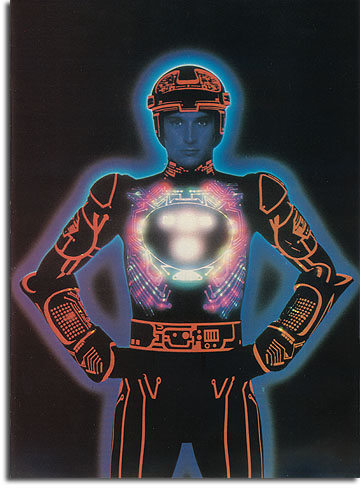 “Bruce Boxleitner as Tron glows with energy through the magic of bottom-lit mattes.”
“What Jerry and I do as computer image choreographers is to describe the imagery to the computer. We describe all of the geography and all of the hardware. Basically we use blueprints and maps that describe the ‘physical reality’ of a scene to the computer. Then we describe the action or choreography of those objects and the computer puts it all together into a scene. You might say it ‘visualizes’ it. Then the computer ‘reads-out’ that information onto movie film. Basically, we are creating a computer image and then we are choreographing the action of the image. Hence, the name – computer image choreographers.”
The TRON filmmakers are very excited by this new computer tool, since the images that are created are not tied down by the laws of reality. “The scenes we can visualize in our heads make it to the screen almost completely intact. There are very few limitations. At the moment the limitations are mostly technical according to the current state of the art and the amount of time and money that it takes to compute the complexity of the imagery desired. But once you adapt to working within your budget, you are pretty free to ask for just about any image you want and just about any kind of choreography you want. You can move the camera anywhere you want, there is no limitation; you can blow things up; you can move things at any speed; make 90-degree turns; you can have things completely disobey the laws of gravity or … anything. It’s a great feeling of power,” says Kroyer with obvious relish.
But the computers will not turn just anyone into an artist of the future: first the image must be in your own head. “You absolutely have to be able to visualize exactly what you want,” Kroyer warns. “You are not dealing with any sort of hard artwork, or models or actors that you can look at and manipulate … you are not dealing with anything. You have to describe to the computer exactly what you want to see. The computer will only give you what you describe and not one single bit more. If you describe it wrong, you get it wrong. The better you can visualize what you want, the more completely you can create it.”
The bulk of the picture’s computer graphics are being generated by MAGI (Mathematical Applications Group, Inc.) of Elmsford, NY and Information International Inc. (also known as Triple-I or just III) of Culver City, CA. Digital Effects of New York is also supplying computerized effects for the film.
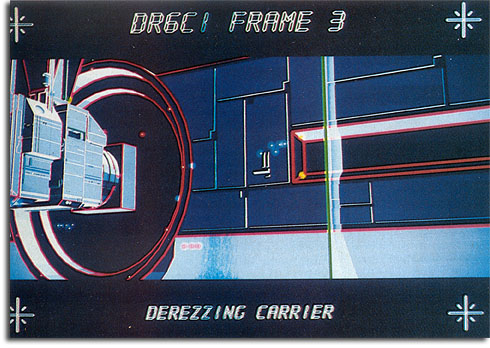 “Two samples of computer graphics from Triple-I, one of several companies supplying computer graphics for TRON. Sark’s carrier is being slowly de-rezzed as it approaches the MCP. Triple-I specializes in complex ‘organic shapes’ or objects which require complicated coloring.” 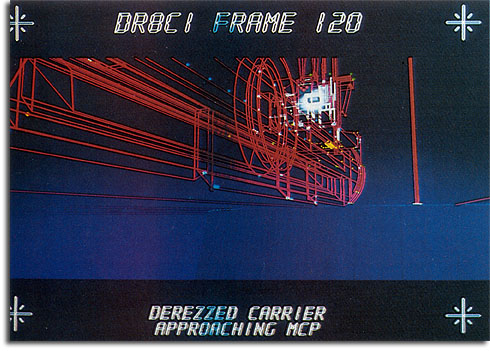
Talking to Computers
Each company has their own custom hardware and software systems that create imagery. Magi’s system is called Synthavision and Triple-I uses a system called ASAS (Actor/Scriptor Animation System). It’s not necessary for the computer image choreographer to be “conversant” with the different software systems nor is it practical, so the C.I.C. relays his instructions to the programmers at each of the respective companies. The programmers then translate the
C.I.C.’s requests into the language used by each computer system.
Kroyer explains how the system works by demonstrating with the scene with which he is currently working.
“The scene coming from the MAGI computers at the moment is from the Clu sequence at the beginning of the film. Clu blows up a Recognizer and the pieces smash into his tank, the tank veers out of control and smashes into a wall. One of the shots, for example, shows the exterior of the tank being hit by debris from the Recognizer and being knocked off center. To plan a scene like this, we first describe to the programmer the scene length, we give him diagrams and blueprints of the canyon where the scene takes place and then we draw diagrams of the path of action for the tank and notate the speed of the tank. The programmer already has a complete data base of the tank itself from the blueprints of the tank and they are already in the computer. Then we have to describe the angle and tilt of the tank in each frame of the shot; we have to describe when the debris hits and how the debris is falling, whether it is rotating or spinning and, well, basically we have to describe every last little thing that’s in the scene. The programmer will have to know and understand all of this so he can describe it in a numerical way to the computer.
“So, now he has a data base for the canyon, he has one for the tank, he describes the increments that the tank moves per frame, the degrees that it tilts and the degrees that it turns. He has to have a file for each piece of debris that falls and when the debris hits the tank there has to be a certain type of flare … and that has to be described.
“It’s like painting with numbers. Everything has a number – even all the colors have numbers, all the glow factors are described by numbers. You can see that by typing in numbers, eventually anything in the scene, the color, the light, the direction of the light, the direction and movement of the camera, the type of lens, etc. can be accurately specified. All of these things are given number codes; the computer understands these number codes and creates the scene. At MAGI all of this information for a given is stored on a magnetic disk. Using the disk the operator is able to change or modify any portion of the scene at will. When a scene is completely built up on the disk. The disk reads out the information into a low-resolution ‘pencil test.’
“This is the way our computer pencil tests work,” begins Kroyer. “The computer ‘reads-out’ the scene onto the screen of a high-res monitor. The screen is mounted inside a lightproof box. Pointing right down at the monitor screen is a 35mm camera. If you were to look at the screen during the filming all you would see is one tiny dot of light moving. The tests are photographed in black and white and in a low-res mode. We don’t need color and high resolution for a pencil test. It’s quicker and cheaper in black and white low-res. All we are doing is looking at the timing
and movement.
“Now this scene with the tank started with the tank rocking up on one tread and then it flops down on the other tread when it gets hit with some debris. The first pencil test showed the tank raised up at one angle for the first four frames of the scene and then all of a sudden it settled down on the other tread in three frames. I called the programmer at MAGI and explained that I didn’t think that this looked like a natural reaction to gravity. The tread should start falling with the first frame of the scene and accelerate according to the laws of gravity. So what I am getting now is the pencil test. I will view this test and if there is anything else on it that needs correction or tweaking, as we call it, I’ll call him back and he can compute the change in a matter of minutes. I can get two or three versions of this 29-frame scene before lunch today. The scene can be refined in just a matter of hours.”
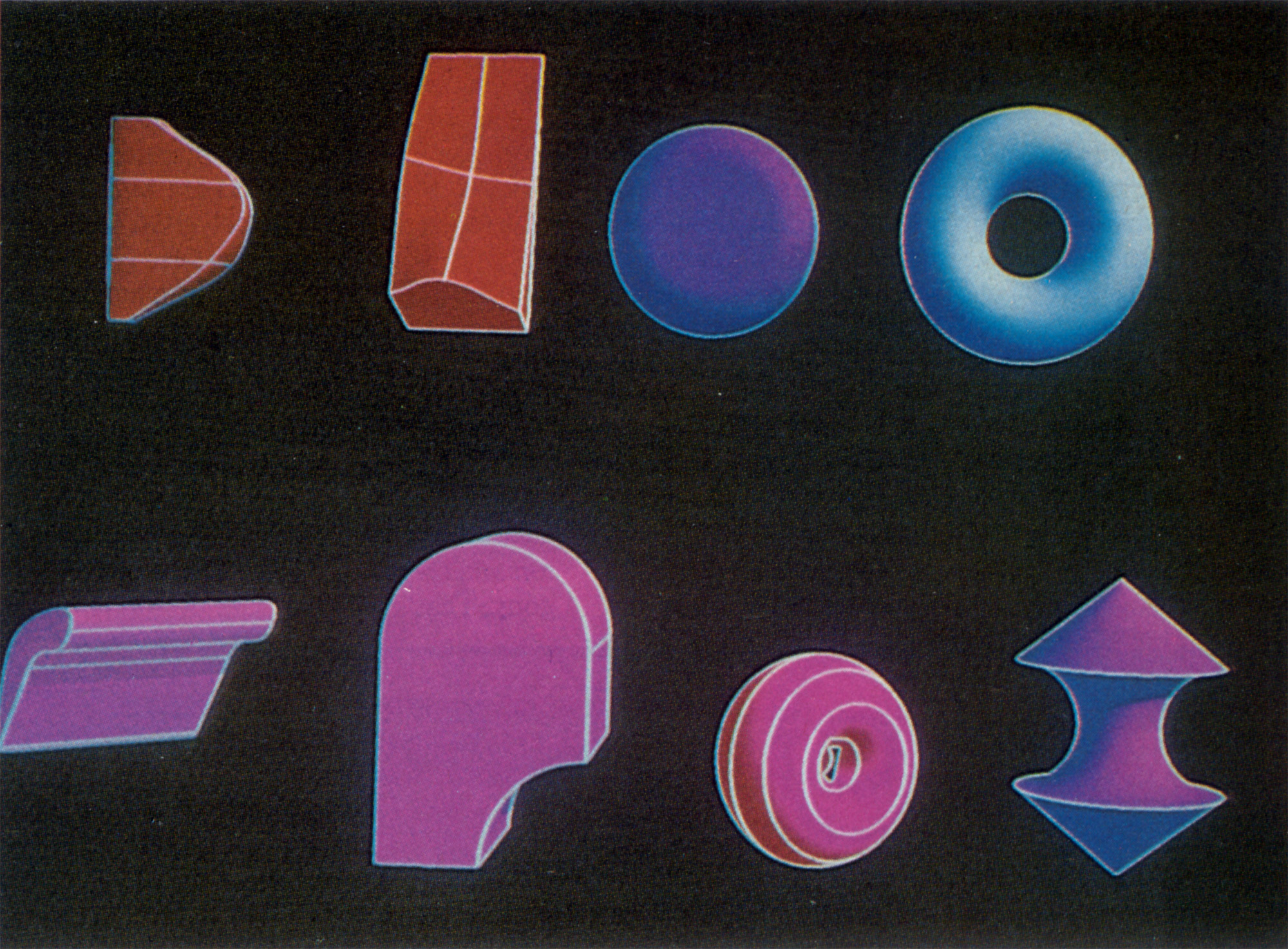
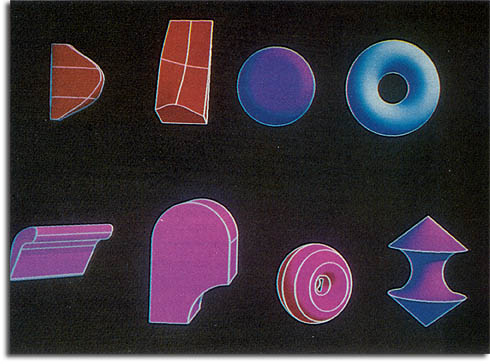 “MAGI builds their objects by assembling a library file of solid geometric shapes. Their Synthavision process has the capability to add and subtract these solids in order to create anything from lightcycles to tanks.” 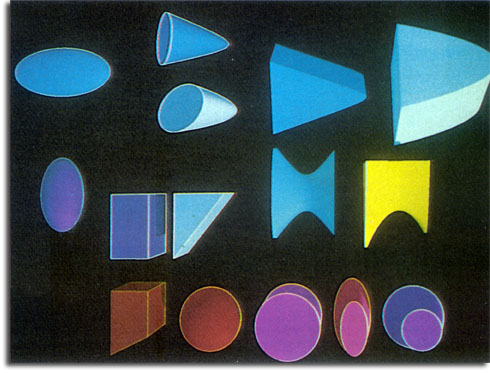
Computing the Scene
“If I can call back to him at lunch time today and say to him that the scene is now correct, he’ll put that completed disk into the computer which will produce a high resolution color version of the scene in a few hours – that’s what we call computing the scene,” Kroyer explains. “When the scene is computed it is transferred to tape for storage, the disk is erased and used to start a new scene. The tape becomes the permanent record of the scene. Eventually that tape is fed into a machine that transfers the image onto high-resolution color movie film, VistaVision format. The resolution is expressed in lines and we are running at about 2,000 lines, which, I am told, is higher resolution than the film stock we are using. Some of our scenes contain over one million pixels (picture elements).
“When we get our film in VistaVision we view it using a VistaVision projector. The film is rear-projected so we can stand right up to the screen to examine the quality of the image … and it’s sharp.”
For you hardware buffs, here is a rundown on some of the hardware used to create the images in TRON. MAGI operates with a Perkin Elmer System 3240 computer to make the calculations for each picture it generates. The system functions with two megabytes of MOS memory and two 80-megabyte disk drives, and talks to a Celco DFR 4000 computer, which is used to generate the pictures onto a monitor.
Triple-I’s main computer is a custom-built one-of-a-kind which they call the Foonley F-1. The pictures are generated on a PFR recorder, which is manufactured by the company, and programmers use a 40-inch by 60-inch Taylos encoding tablet to plot the vector lines for the various images.
“MAGI and III have very different methods of creating scene simulations,” says Kroyer. “MAGI uses a geometric system. They build their images out of solid geometry. They make objects by combining sets of geometric objects of shapes that are put together into whatever form they want. Of course, not only can they add geometric solids, but they can subtract solids as well. As a very simple example if we wanted a wheel, we might start with a sphere and start chopping off parts of it to get down to the shape we were looking for.
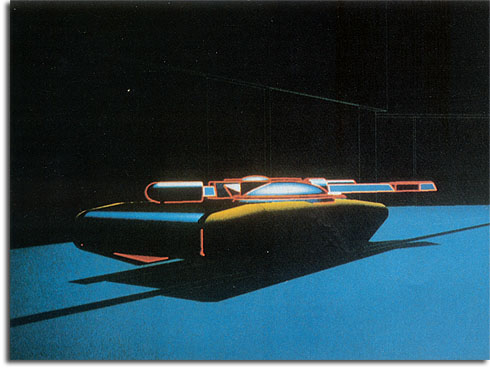 “A MAGI created tank on the prowl.” 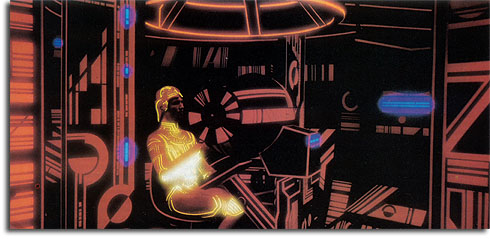 “The interior of that tank with Flynn’s alter-ego Clu aboard.”
“MAGI has created the lightcycles, the tanks, the Recognizers, etc. They constructed those objects by assembling a set of solid shapes. The entire object is constructed around a single center point. To animate the object, basically what we are doing is moving that center point and the constructed object moves along with it.
Triple-I’s system is completely different. They use a vector graphic method to create objects. All of the objects are built by constructing a shell out of polygons, instead of creating a solid object using solid geometries. Triple-I defines the points of a surface and they connect those points into a series of polygons. They have computer programs that smooth, shade and color the surface.
“Their method is much more suitable for complex organic shapes, because you don’t really have to rely on the existence of regular geometry. You can define points in any fashion and create any sort of shape out of polygons. That’s why they can do human faces, like the MCP [Master Control Program], or very organic-looking shapes like the Solar Sailer. Their system seems to be a bit more difficult to choreograph because they carry a much greater data base, so we tend to give III the simpler choreography, relying more on their visual beauty; MAGI tends to get the more difficult and complicated choreography, because their visuals tend to be a bit more simple. Both look beautiful and both companies do great choreography, so it’s just a matter of emphasis.”
Meet Bit
“Digital Effects in New York did an opening piece of a man forming out of energy and they also created a character called Bit. Bit is a little geometric object that flies around a bit like, well, Tinkerbell, I guess,” laughs Kroyer. “Bit changes shape to express its mood. When it’s angry or giving negative opinions, it becomes a brittle kind of pointy shape. When it’s in a pretty good mood and answering in the affirmative, he goes down to more of a soft-shaded look. Bit is Flynn’s mascot, in a way.”
It takes quite a lot of computer power to work effectively in computer graphics. Some of III’s graphics require 75,000,000 calculations to create one frame of computer animation. Multiply that by 1,240 frames needed to make one minute of film and the immensity of the task becomes apparent.
Four Hewlett-Packer 9826 computers are needed to calculate exposure control during the optical process which will give TRON‘s fantasy setting its unique “electric” look. A Cinetron 1100B is used for camera moves on cranes and motion control when required.
The “electric” look is achieved using the “candy-apple” look developed by Richard Taylor and Richard Edlund while they were working for Bob Abel’s company some years ago. (This technique was discussed in the TRON article in STARLOG #60.) Kroyer suggests that if there is ever a TRON II, this method of photo-rotoscoping and bottom lighting mattes to create the candy-apple look will be abandoned. Instead, the live-action footage will be completely digitized and manipulated within the computer itself. Once the film is digitized it can be manipulated any way the artists imagine. The live action can be colored, distorted, combined with other objects and, of course, completely without “matte lines” since there are no “mattes.” Even mohair or fur can be easily “matted.” Everything is combined inside the computer. The optical printer will be a museum relic, replaced by the digital printer.
But for the moment, TRON is pushing the technology of computer graphics along, even as the film is being made. “For example,” begins Kroyer, “in the early stages we had problem with scenes looking flat – they just didn’t look like they had any depth. We asked the people at MAGI to create for us an artificial atmosphere in the scenes that would make things appear to be dimmer or less distinct as they receded in the distance.
“They came up with a program called ‘depth-cluing’ that automatically made the pixels dim out at a geometric rate from the point that camera was supposed to be. This created the effect of an artificial atmosphere and added tremendous ‘depth’ to the scene. We came up with all sorts of little refinements that added interest and ‘reality’ to a scene: secondary light sources, different kinds of glows, diffusion programs, etc. We kept asking III and MAGI for more tools to work with and they would go back to their desks and conceive programs necessary to meet our demands which were growing more and more complicated.”
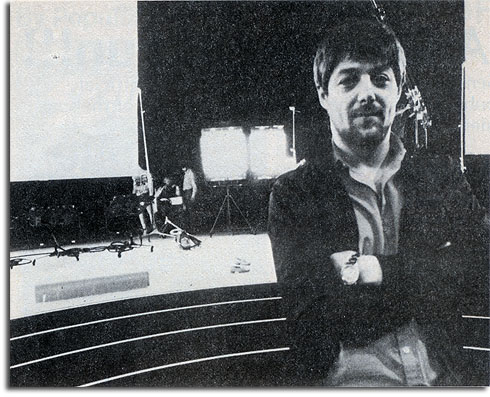 “ TRON writer/director Steven Lisberger.” 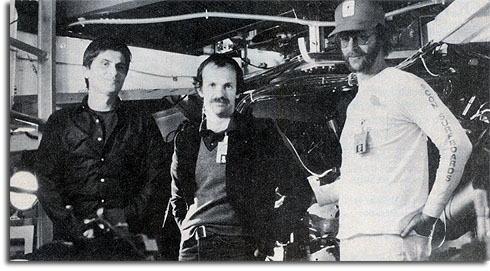 “Left to right: TRON producer Donald Kushner, associate producer & co-supervisor of SFX, Harrison Ellenshaw and co-supervisor of SFX Richard Taylor.
All this computer excitement has been spreading around the studio. Home computer enthusiasts have even been able to work some of TRON‘s graphics on their home computers. “I think there is someone here at the studio that has a Recognizer up on his Apple II and he can move it around using the Apple software,” says Kroyer.
“Now if you are going to ask me if I think computer animation will replace classic Disney animation, the answer is, ‘No.’ Computer animation will never replace the kind of character animation that made the Disney films great. What we are dealing with here is an entirely different kind of tool, it doesn’t replace anything. Computer animation opens up whole new areas for the artist; it’s another kind of tool, a new brush. The scenes we created on computer could not have been done by any other method. It would have taken 100 animators 10 years to do what we did.”
And what a powerful tool computers are for the artist. Richard Taylor of Triple-I sums it up with: “For objects simulated in a computer, there are no laws of physics. Each time you sit down to create a computer image, you are getting completely new rules for reality. That’s what TRON is all about.”
I think my favorite element of the article is the discussion of how the production pipeline will probably be much easier if they were to make a TRON II. They were right, of course, but I doubt that they were planning it for 2010. The points about digital compositing were well taken, as those techniques have indeed made optical printers obsolete.
So when you’re in the theater watching the new film, think about back in the day when the two animators on a film had to call New York to describe their scenes, and wait for the pencil tests to appear via a telephone link.
As to the crew from the article, they all went on to a variety of projects. Kroyer, despite his predictions, segued into a career in computer animation, although he did return to the hand-drawn world to direct Ferngully in 1993. He went on to a career in visual effects at Rhythm and Hues. Jerry Rees, the other animator on TRON, went on to direct the maddeningly under-rated The Brave Little Toaster in 1987. Aside from a number of non-Disney projects, he directed a number of theme park films and projects including the famous Back to Neverland with Walter Cronkite and Robin Williams, the live-action scenes for Cranium Command, and Cinemagique at Walt Disney Studios Paris.
MAGI went on to do the animation for John Lasseter’s demo of his proposed Where The Wild Things Are project at Disney in 1983; the company was bought out by another corporation a few years later. Triple-I got out of the movie business soon after TRON, but continued to develop technology in other fields until it merged with another company in 1996.
And here, as a final retro snapshot for the day, is an ad for TRON‘s soundtrack from the same issue of STARLOG. Includes a new Journey song!

Related Posts...
By Michael - December 15th, 2010 There are some things in this world that I love more than others, and many of those involve Disney, classic film, and Turner Classic Movies. So you might imagine my reaction to this bit of news:
TCM Classic Film Festival to Spotlight Disney’s Musical Legacy
Multi-Faceted Celebration Presented in Collaboration with D23, The Official Disney Fan Club
The musical legacy of The Walt Disney Studios will be celebrated at the 2011 edition of the TCM Classic Film Festival in Hollywood. Turner Classic Movies (TCM), in collaboration with D23, The Official Disney Fan Club, will host a multi-faceted celebration of the studio’s history of bringing music and film together. Presentations at TCM’s four-day festival in April 2011 will include a screening of the recently restored groundbreaking classic Fantasia (1940), which integrated great works of classical music with some of the most innovative animation ever put on film; a collection of Silly Symphonies animated shorts, curated and introduced by film historian Leonard Maltin; and a special tribute to Disney live-action musicals.
Are you kidding me? I mean, seriously? With all the other stuff that’s going on this year, and my paltry pocketbook, you drop this on me? Something that, if I do not attend, will gnaw at my innards for months? The press release goes on:
TCM will also be presenting a collection of animated Laugh-O-Grams. These shorts were created by Walt Disney made at the Laugh-O-Gram studios, which he founded in the 1920s and where he was inspired to ultimately create the Mickey Mouse character. These historically important films were recently discovered and restored by Museum of Modern Art (MoMA) and are being presented in partnership with The Walt Disney Family Museum, located in San Francisco.
The celebration of the musical world of Disney is part of the 2011 festival’s overall theme, Music and the Movies. Throughout the four days, the TCM Classic Film Festival will shine a spotlight on outstanding composers, great songwriters and the unique role music plays in the art of filmmaking.
“When it comes to the merging of music and motion pictures, no single studio has made as consistent and important contributions as Disney,” said TCM host Robert Osborne. “We are proud to join with Disney’s D23 fan club to celebrate that legacy as an important part of the festival. It is also a rare opportunity for everyone to experience the magic of Disney through beautifully restored feature films and rare shorts from the early days, shown on giant movie screens for the first time in years.”
Fine Bob, kick me while I’m down. Why not hold me down and let Maltin throw sand in my eyes?
The following is a rundown of the Disney celebration planned for the TCM Classic Film Festival:
Fantasia (1940) – Recently restored edition
This groundbreaking animated anthology, one of Walt Disney’s most astonishing achievements, combines classical music with animated imagery, from the abstract (“Toccata and Fugue in D Minor”) to the hilarious (“Dance of the Hours”) to the awe-inspiring (“Night on Bald Mountain” / “Ave Maria”). A commercial failure when it was first released, the film has since become a cultural treasure, thanks not only to the innovative recording and animation techniques, but also to Mickey Mouse’s memorable appearance as “The Sorcerer’s Apprentice.”
Silly Symphonies – Curated by Leonard Maltin
Film historian Leonard Maltin will curate and introduce this collection of memorable Silly Symphonies shorts. Walt Disney Productions created 75 of these music-filled animated shorts from 1929 to 1939. Many of the featured shorts (rarely theatrically screened) broke new ground in animation techniques, garnering seven Academy Awards® along the way.
A Special Tribute to Disney Live-Action Musicals
After establishing its artistic reputation through animated films, the Disney studio moved into the realm of live-action musicals. The TCM Classic Film Festival’s Disney celebration will include a special tribute to the Disney Live-Action Musicals.
Laugh-O-Grams – Newly discovered and restored shorts, presented in collaboration with The Walt Disney Family Museum and Museum of Modern Art
This collection of recently discovered and restored Laugh-O-Grams heralds the earliest days of Walt Disney’s career. Before he started the studio that would bear his name, Disney started the Laugh-O-Grams studio. Located on the second floor of a brick building in Kansas City, Mo., the Laugh-O-Gram studio became home to many of the pioneers of animation. The building, which still stands, is also said to have provided Disney with the inspiration for his most enduring character, Mickey Mouse
Flames. On the side of my face. How fantastic does that sound? These are a few of my favorite things.
Tickets are available now.
More information about the festival:
2011 TCM Classic Film Festival
Thursday, April 28 – Sunday, May 1, 2011, in Hollywood
The following are the events and screenings announced so far for the 2011 TCM Classic Film Festival:
Opening Night Event
An American in Paris (1951) – World premiere of new 60th Anniversary restoration – Thursday, April 28, at Grauman’s Chinese Theatre
This colorful musical stars Gene Kelly and Leslie Caron in the story of a painter finding art and romance in the City of Lights. The musical score is packed with Gershwin classics, and the dance sequences are among cinema’s most memorable. Directed by Vincente Minnelli, the film won six Oscars, including Best Picture.
Music and the Movies
Throughout the festival, TCM will celebrate cinema’s legacy of music, from great songwriters to outstanding composers.
Nice Work if You Can Get It: The Film Music of George and Ira Gershwin
TCM will celebrate the work of George and Ira Gershwin with a collection of films featuring their most memorable songs. Heading up the collection is the opening-night gala screening of An American in Paris (1951), which has been beautifully restored and remastered in time for its 60th anniversary.
Girl Crazy (1943) – Presented by Mickey Rooney
As part of the festival’s multi-film celebration of songwriters George & Ira Gerswhin, Hollywood legend Mickey Rooney will make a rare public appearance for a presentation of the Gershwin musical Girl Crazy, in which he starred with Judy Garland.
A Celebration of Bernard Herrmann
From Alfred Hitchcock to Orson Welles, composer Bernard Herrmann collaborated with some of Hollywood’s greatest film artists. His innovative and evocative scores continue to influence composers today. The festival will commemorate the 100th anniversary of Herrmann’s birth with several screenings, including the world premiere of a new restoration of Orson Welles’ groundbreaking Citizen Kane (1941), which celebrates its 70th anniversary in 2011.
Happy Trails: Roy Rogers
The festival will salute Roy Rogers, the “King of the Singing Cowboys.” The celebration will include several of the enormously popular performer’s hits, all restored in time for the 100th anniversary of Rogers’ birth.
The Silent Legacy
Silent films were never truly silent, and the festival will highlight the unique role that live music played during the pre-talking pictures era.
The Cameraman (1928) – featuring live musical accompaniment by Vince Giordano and the Nighthawks
Buster Keaton’s hilarious comedy features “The Great Stoneface” as a wannabe newsreel cameraman who is lovesick for a young woman. Marceline Day and Harold Goodwin co-star. This presentation will feature musical accompaniment by the popular jazz-music ensemble Vince Giordano and the Nighthawks. The group, which was formed in 1976, is renowned for performing music of the 1920s and 1930s. Vince Giordano and the Nighthawks have appeared in venues around the country and contributed to soundtracks for The Aviator, Revolutionary Road, Public Enemies and HBO’s Boardwalk Empire, among others.
Discoveries
The festival will be packed with a number of outstanding films that are primed to be rediscovered by film fans. Each film has been painstakingly restored and features work by well-known film personalities.
Went the Day Well? (1942) – North American premiere of new 35mm restoration
Presented in partnership with Rialto Pictures
This newly rediscovered masterwork by director Alberto Cavalcanti stars Leslie Banks and Elizabeth Allan in the story of a British village dealing with an invasion of German paratroopers during World War II. Although told in flashback as if the war is already over, the film was made several years before the outcome of the war would be known. The outstanding script is based on a story by Graham Greene.
Hoop-La (1933) – World premiere of new restoration
Presented in partnership with the Museum of Modern Art (MoMA)
This pre-Code romantic drama marks the final feature film of the “It” girl, Clara Bow, as she plays a carnival hula dancer out to seduce the carnival owner’s son. Although Bow was originally unenthusiastic about making the film and was only doing it so she could finish her studio contract and retire, her excellent performance lifts the material above the ordinary. Preston Foster and Richard Cromwell co-star under the direction of Frank Lloyd.
Night Flight (1942) – Re-emergence of long unseen film
Unseen since it was pulled from circulation in 1942, this all-star aerial drama re-emerges at the TCM Classic Film Festival. John Barrymore stars as the head of a South American airline who drives his pilots, including Clark Gable, to the brink of death as they deliver necessary supplies to remote regions. The outstanding cast includes Helen Hayes, Robert Montgomery, Myrna Loy and Lionel Barrymore, appearing onscreen with his brother for the fifth and last time.
Dodsworth (1936) – 75th anniversary premiere of new print
Walter Huston and Ruth Chatterton star in William Wyler’s underappreciated adaptation of Sinclair Lewis’ novel about a retired industrialist who takes his wife to Europe, only to find a surprising new life. This remarkably mature film features an intelligent script by Sydney Howard and Oscar-winning interior decoration by Richard Day.
To whomever cooked this up: Well done. Kudos to D23 for getting involved with this. Even though I hate you all, because this is going to drive me absolutely nuts.
Related Posts...
By Michael - December 15th, 2010  Rendering of Disney’s Vacation Club And Resort At Eagle Pines from 2001 It’s almost hard to conceive of a time that Michael Eisner elected not to build a Disney Vacation Club resort, but that’s just what happened in 2001 when Disney’s Vacation Club And Resort At Eagle Pines was announced only to slowly vanish into the mists of history afterward.
 Osprey Ridge (blue) and Eagle Pines (purple) in 2002. Sandwiched between Fort Wilderness (green) and Dixie Landings (red), the two courses were serviced by the clubhouse (yellow) which remains today. The years 2000 and 2001 were a very active time for DVC expansion, with timeshare wings being grafted onto many of Disney’s existing resorts. On July 23rd, 2001, the company announced that its seventh DVC property would be built on a 61-acre site adjacent to the Eagle Pines golf course. Comprising 600 units, the resort would feature ten four-story villa buildings with 48 units apiece and a main six-story Inn building with 120 units as well as check-in and guest facilities. Amenities included a restaurant and lounge, a 600 square foot feature pool, shops, an arcade, a common living room area and a health club. The resort would also feature two “quiet” pools, basketball and tennis courts, a playground, and a wetland boardwalk. The 270,000 square foot Inn and 800,000 square feet of Villa buildings would have comprised the largest Vacation Club resort at the time, and represented an estimated investment of $170 million.
 Site plan for Disney’s Vacation Club and Resort at Eagle Pines, laid over satellite imagery of the site from 2002  … And a closer look Designed by Graham Gund and the Gund Partnership, architects for the Coronado Springs Resort and Disney’s Vero Beach Resort, and with site planning by Glover Smith Bode, the new resort would be based on the iconic works of architect Addison Mizner in the early 20th century. Mizner defined the look of Florida resorts in that era, drawing on Spanish, Moorish, Romanesque and Gothic design to create extravagant retreats for the wealthy in southeast Florida. Disney’s Vacation Club And Resort At Eagle Pines would have thus echoed the Spanish Revival look of West Palm Beach and Boca Raton in their heyday. As Mariska Elia, spokeswoman for Disney Vacation Club, said at the time, “It adds a different flavor, a different atmosphere to our portfolio.” ((Disney Ready To Build 600-Unit Time Share, The Orlando Sentinel, July 24, 2001)) She sounded really excited!
 Elevation of the facade for the Inn at Disney’s Vacation Club and Resort at Eagle Pines  Site plan for the Inn building Rooms were to feature pool, golf course or forest views; the resort itself would have nestled amongst the wetlands and existing Eagle Pines golf course. Resort buildings were designed to “step down” in height as they neared the links, allowing for minimal visual intrusion for golfers.
 Rendering of the Inn building  Rendering of the Inn building from the courtyard by the feature pool The resort was designed to open in phases, with phase one consisting of 360 units. The Inn building and one Villa building would be the first to open in spring or summer of 2004, with four additional Villa buildings coming on-line throughout the rest of that year. Phase two, consisting of five Villa buildings containing 240 units, would open in spring or summer of 2005.
 Site plan for Disney’s Vacation Club and Resort at Eagle Pines from May 2001 So what happened? Well in the summer of 2001 DVC apparently needed room to breathe. Its membership was approaching 60,000, and as Elia said at the time, “We really need a big project. This is another anchor property with a lot of inventory.” But not long after the new resort was announced, the terrorist attacks of September 11th, 2001 occurred and the tourism market chilled considerably. It had already been a slow year for Disney; I remember that there had been a wave of extensive discounts throughout the year, which was unusual at the time. Disney spent the year reaping the bad publicity of California Adventure opening in Anaheim, and there wasn’t a lot new going into the Florida parks either. It was a slow period, and the terror attacks only made things worse for attendance. The Eagle Pines resort was never really spoken of again. By the time development picked back up, the company had given up on the Disney Institute and decided to redevelop that property instead of building at Eagle Pines. And so the Institute – formerly the Disney Village Resort – became the enormous Saratoga Springs DVC development.
 The former Eagle Pines site in May of 2010 In 2007, Disney announced that a luxury housing development and a new Four Seasons resort hotel would be built on the site of its Eagle Pines golf course. This project – now known as Golden Oak – marked the definitive end for an abandoned resort project that few even remembered. Eagle Pines has been wiped off the map as land is cleared for the new hotel and several dozen McMansions for millionaires. Eventually slated to include 450 homes and the 445-rooms of the Four Seasons hotel, the development will slowly roll out over the next few years.
Related Posts...
By Michael - December 14th, 2010 
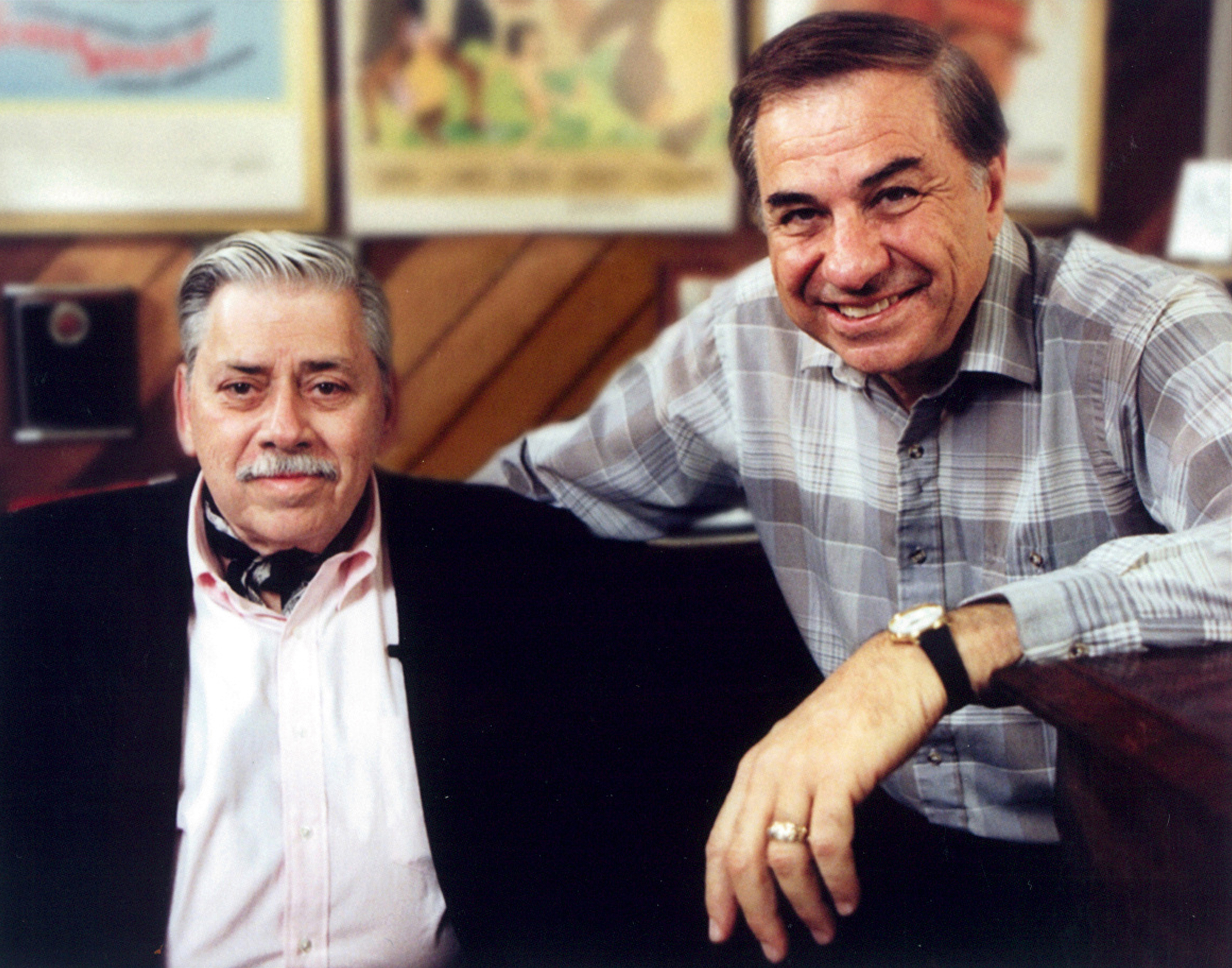
The Disney documentary train rolls on, with this rather remarkable look at Richard and Robert Sherman – longtime staff songwriters at Walt Disney Productions and composers of some of the best known ditties ever. Much like Walt & El Grupo, The Boys: The Sherman Brothers’ Story is a family affair. Cousins Gregory V. Sherman and Jeffrey C. Sherman have teamed up to tell the complicated and surprising story of their fathers’ lives, which is far from what even lifelong fans might suspect.
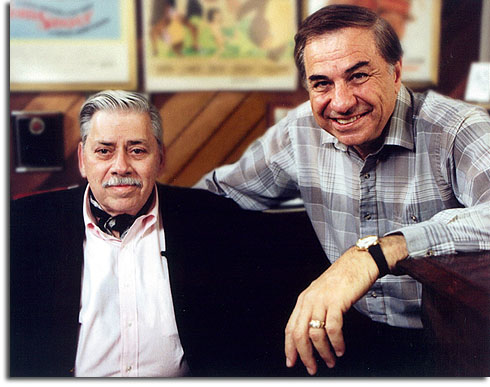 Robert and Richard Sherman The Film
Bittersweet is a word that tends toward overuse due to a lack of alternatives, but nevertheless if you looked it up in the dictionary you would more than likely find this film.
Any Disney fan word their salt knows the Shermans well; in fact, you’d probably be hard-pressed to find anyone anywhere in America that, even though they don’t know the Sherman name, doesn’t know one of their songs. Their body of work is so vast as to be absolutely absurd, and any collection of their music can only really begin to scratch the surface. The Shermans were the staff songwriters at the Disney studio during its most prolific decade – the 1960s – and in that time they wrote for animation, live-action film, theme parks and pop singles. Their career stretches from Tin Pan Alley standards to 21st century Broadway, and their names and faces have been a familiar and comfortably avuncular presence in Disney circles for fifty years. If the Shermans hadn’t existed, Walt would have had to invent them.
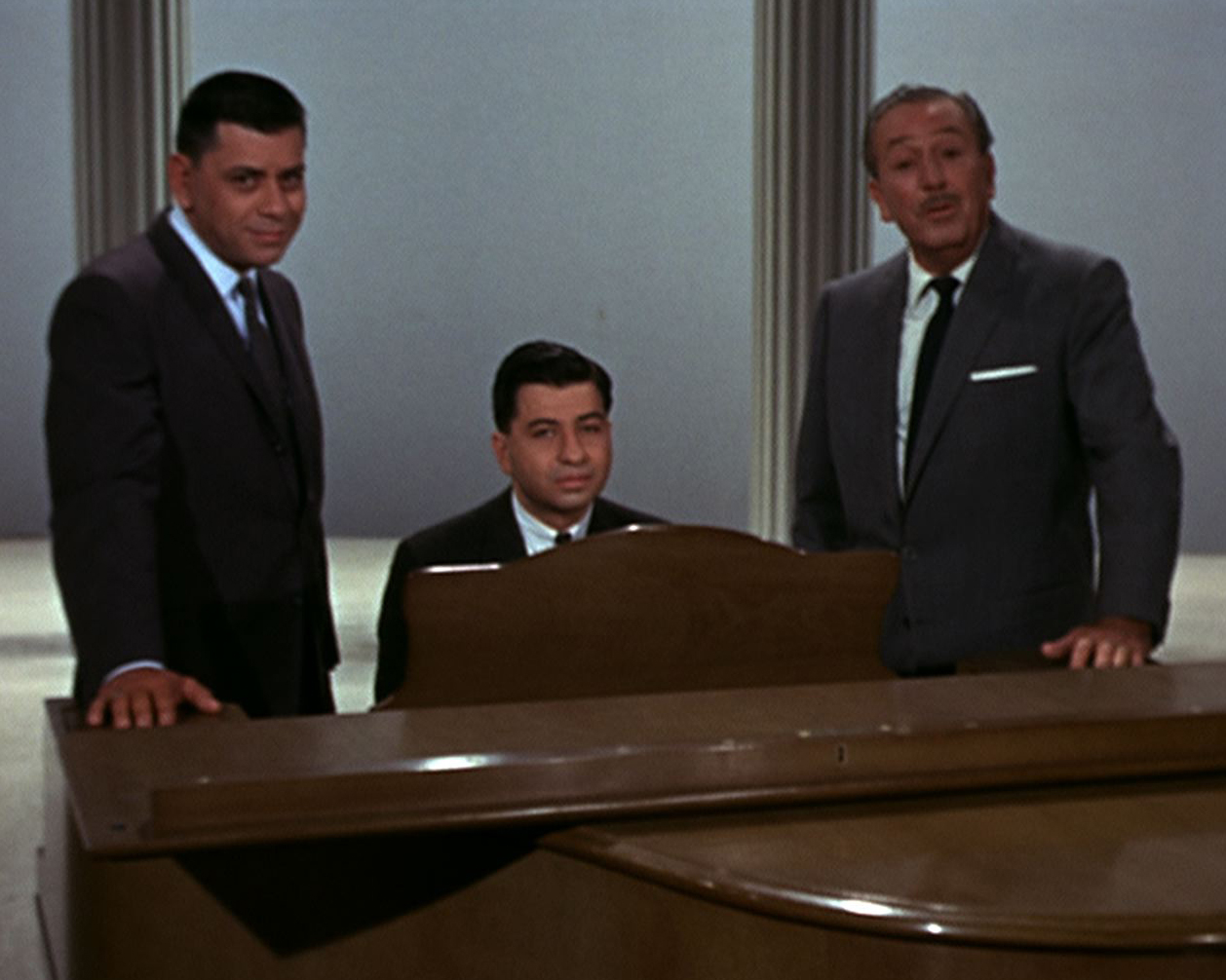
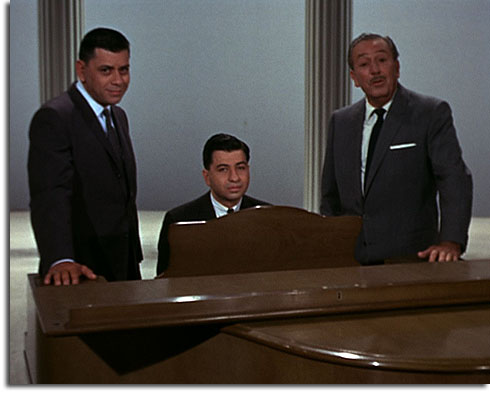 The Progress City Connection: In the studio with Walt, performing There’s A Great Big Beautiful TomorrowSo, after all these years of seeing the brothers pounding away at the keyboard together and crafting countless familiar melodies, it came as a shock to nearly everyone when this film emerged and disclosed a remarkable fact – not only did the brothers lead very different and separate lives, but for the last 40 years they have been almost completely estranged outside of their work.
This is astounding for many reasons, not the least of which is that they managed to successfully hide this fact from the public while remaining fan favorites throughout. Most remarkably, though, is that they managed to keep working together with a high quality of output while having precious little to do with each other. Living only a few blocks apart, their families remained rigidly separated in private and in public, and cousins Gregory and Jeffrey Sherman were only reunited as adults before they made this film.
The reasons for this separation are as complicated as they are vague, and if there’s a flaw in this film it stems from this issue. The brothers were always very different people, living separate lives, but it seems that even then there remained some level of contact between the two young families. Only after an event in the late 1960s, during which elder brother Robert Sherman took a break from the partnership – and, indeed, from his family for a few days – did the two households truly go their separate ways. This is obviously still a very painful subject for the participants – even the usually ebullient Richard Sherman – and we never really find out what actually happened and why it was so significant.
One could argue that this has nothing to do with the real reason we care about the Shermans – their wonderful music – and that any further interest is sheer gossipmongering. Nor is it reasonable to root for the filmmakers to aggressively pry for more painful details from the elderly brothers when they’re visibly upset; I certainly wouldn’t care to do it, and I’m not as close to the situation as the interviewers. But if the issue is to be made a part of the narrative, and it really is a point that the film hinges upon, than it would make sense for viewers to have a better idea of why those events cast such a long shadow.
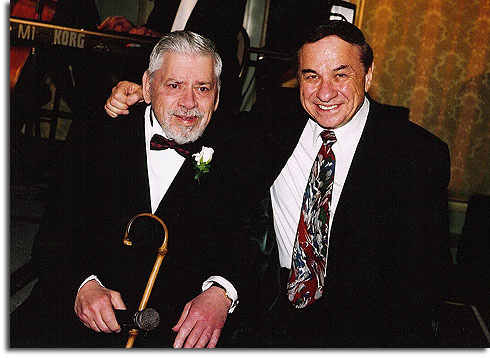 The brothers, in recent years As the term bittersweet would indicate, though, the Shermans’ story is far from tragic. Born into a musical family, the two brothers were showmen from an early age. Their father, Tin Pan Alley songwriter Al Sherman, was an extremely prolific and successful composer in the early 20th century. At first the brothers seemed destined for different paths; older brother Robert was far more serious and literary, with ambitions to write the great American novel. Younger brother Richard was the first to dabble in the musical realm, and unlike the more reserved Robert he remains a font of constant motion, thought, and activity. As commentator Bruce Gordon points out during the film, the only real analogue to the two could have been if Lennon and McCartney had themselves been brothers.
The film charts the early lives of the two, through youth and beyond as Robert joins the service and witnesses the horrors of war; the trauma of his injuries, and the sights he encountered while liberating Nazi death camps, are evident even today. Economic necessity eventually forced the brothers into sharing living quarters, and with the encouragement of their father they slowly began to embark on a life as songwriters. Success came fairly quickly, but when one of their songs, Tall Paul, became a hit single for Annette Funicello in 1959, it led to career-defining staff positions at the Disney studio.
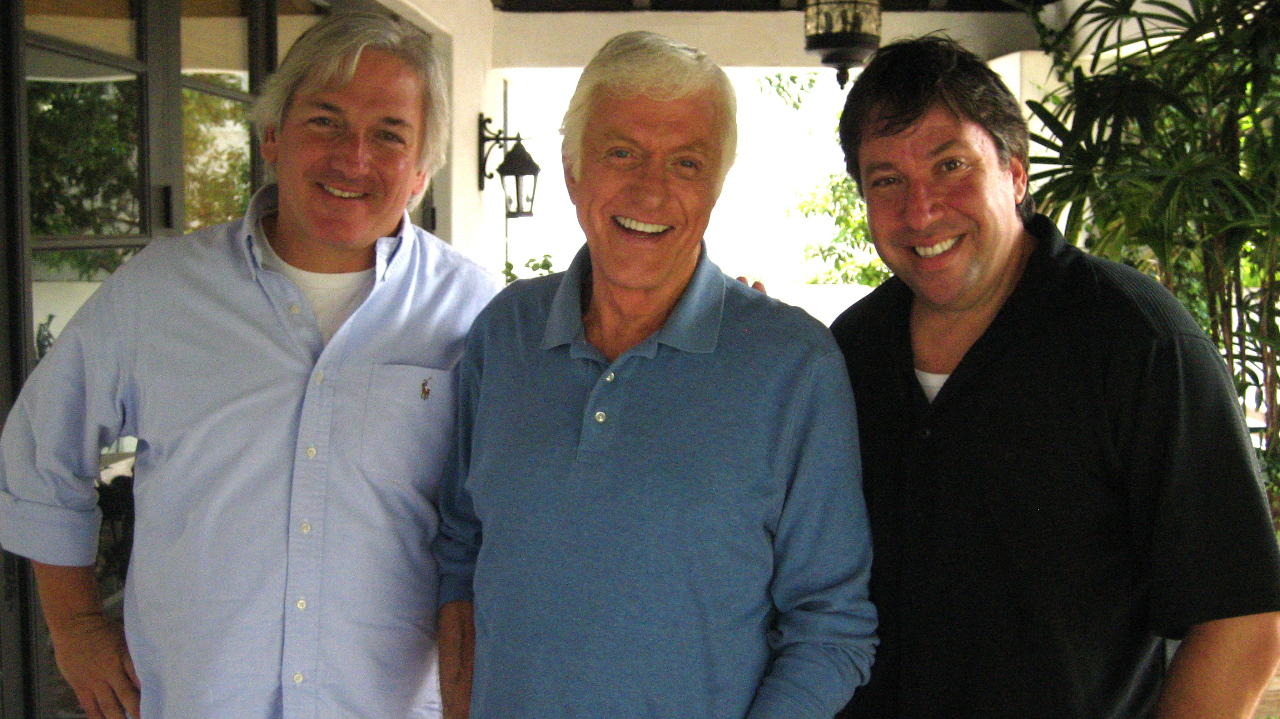
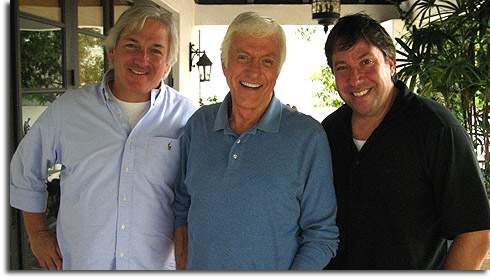 Directors Jeffrey Sherman (L) and Gregory Sherman (R) flank everyone’s favorite funnyman Dick Van Dyke I could go on at length recounting the tales of the Shermans, as this film really does seem like an endless stream of amusing or interesting anecdotes about the brothers and their work. As I always do with any good documentary, I feel like this could have been expanded into five different films and I would have been satisfied. An endless stream of commentators, historians, and participants appear to help tell the stories and discuss the music; off the top of my head, participants include Roy E. Disney, Julie Andrews, Dick Van Dyke, Jeff Kurtti, Bruce Gordon, Leonard Maltin, John Lasseter, Angela Lansbury, Hayley Mills, Leslie Ann Warren, John Davidson, Debbie Reynolds, Alan Menken, John Williams, Randy Newman, John Landis (!), Kenny Loggins (!!) and Ben Stiller (!!!). And that’s just off the top of my head.
The real joy of the film, of course, is seeing the brothers themselves, in both new interviews and a wealth of archival film. Richard remains as sunny and energetic as always, banging away on his piano in his stream-of-consciousness fashion. He also has a seemingly infinite recall of every number the brothers ever wrote. Robert, having moved to London after the death of his wife, remains pensive and at times almost haunted; he focuses now on his career as a painter. Still, despite their occasional barbs and bristles, the footage of the brothers working together remains endlessly entertaining and one gets a hint of the sheer creative energy that must have been a constant presence in the Disney studio of the 1960s.
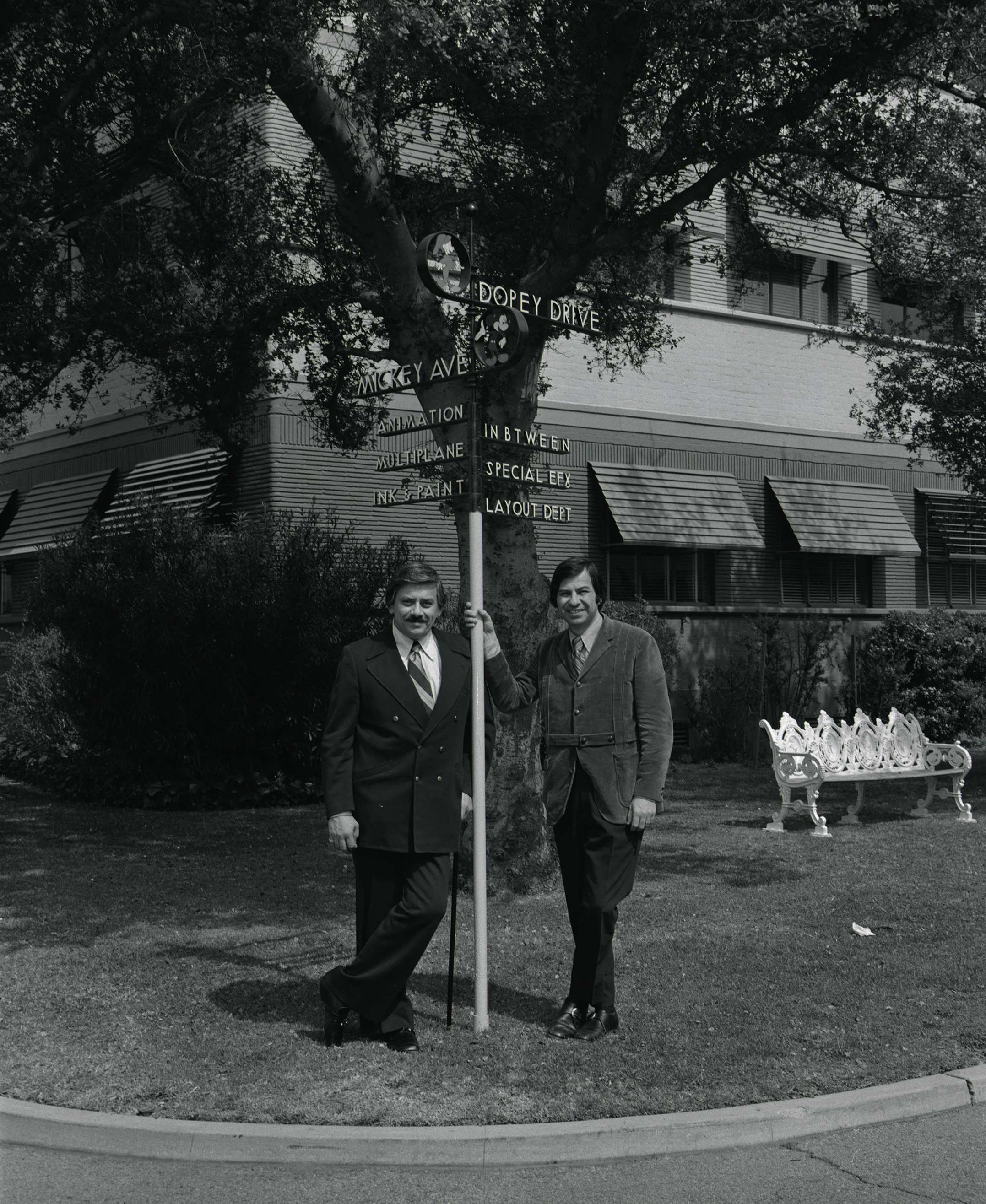
 The Shermans on the Disney lot in swankier times The DVD
Mercifully, the documentary hits DVD with a suite of interesting extras that flesh out the story of the film.
Video & Audio
Another documentary, another variety of source materials. The newly-filmed interviews consist mostly of “talking head” segments, but the film also extensively uses archival photo, film, and video to flesh out the tale. These are, naturally, of varying visual quality but everything looks pretty good except for elements that were obviously filmed on video in the 1980s.
The film is in the 1.78:1 aspect ratio, with audio in Dolby Digital 5.1 (English) and Dolby Digital 2.0 (Spanish).
Bonus Materials
The extras on this disc fall into two main segments. Eight extended segments focus on certain topics with more detail than in the film itself. Then there’s the “Sherman Brothers’ Jukebox”, which features eight individual segments focusing on specific songs. Of special note here is a collection of hilarious sketches that Disney storyman Roy Williams used to slip under the brothers’ office door to illustrate whatever the brothers were up to at the time.
Features
- Extra Scenes – Why They’re “The Boys”, Disney Studios in the 60’s, Casting Mary Poppins, The Process, Theme Parks, Roy Williams, Bob’s Art, Celebration
- Sherman Brothers’ Jukebox – Chim Chim Cher-ee, Feed the Birds, There’s A Great Big Beautiful Tomorrow, Jolly Holiday, Up, Down and Touch the Ground, A Spoonful of Sugar, Supercalifragilisticexpialidocious, Ugly Bug Ball
In Summary…
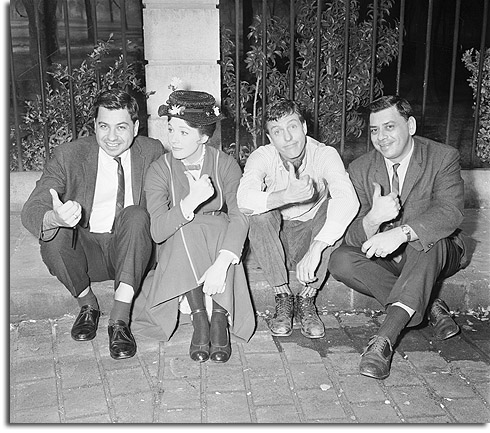 Clip-n-Save Drop Quote: “THUMB A RIDE WITH THE BOYS!! – ProgressCityUSA.com” The Boys: The Sherman Brothers’ Story would seem to be a natural for any Disney fan who has ever hummed a Sherman tune; that would be, well, pretty much all of you. Two very interesting and very different individuals managed to live separate lives while maintaining a public facade that cloaked their personal acrimony, but in this time they also achieved unheard of professional success; during their thirteen years on Disney staff alone they received four Oscar nominations for their more that 200 songs. All told, their work graced 27 Disney films and two dozen television productions, and their post-Disney work includes such family standards as Chitty Chitty Bang Bang and Charlotte’s Web. It’s a remarkable body of work by two remarkable people.
Related Posts...
|
The Progress City Primer
 From the Progress City archives comes this collection of 33 tall tales and true from Disney history. Available in paperback, hardback, and ebook formats. |
 The 1975 graduating class at CalArts helped pave the way for the Disney renaissance. Future animators of note in the class included John Lasseter, Brad Bird and Jon Musker
 Peter Schneider, Roy E. Disney and Jeffrey Katzenberg in the good ol’ days
 Director Don Hahn and producer Peter Schneider at an editing session for the film
 A sketch by Kirk Wise shows the aftermath of a contentious story meeting that he and co-director Gary Trousdale had with Howard Ashman during the production of Beauty and the Beast


























Recent Comments