Contribute to Our Research |
By Michael - July 27th, 2010 From the Disney Channel, in 1988:
It’s hard to believe that 1988 was the last time the Disney company publicly celebrated Mickey’s birthday – in this case, his 60th. Back in the 1980s and early 1990s, Disney park celebrations were often centered on specific anniversaries or events. In 1981 it was Walt Disney World’s “Tencennial”. In 1984 it was Donald Duck’s 50th birthday. Walt Disney World celebrated its 15th birthday in 1986, and 1987 marked the bicentennial of the United States Constitution. This approach gave the celebrations the feel of a real “event,” and the result was that they were far more distinctive than today’s “Celebrate Dreams”, “Celebrate Wishes”, and “Celebrate Celebrations” approach.
Despite this clip’s justification for the “Happy Birthday from Across the USA” theme of Mickey’s birthday parade, the actual reason for the theme was that it allowed for the re-purposing of 1987’s “All-American Parade.” Not that I can blame the company; this was a massive and lengthy parade with many elaborate floats and set pieces and it was re-used several times in the late 1980s.
Of course, the other in-park recognition of Mickey’s 60th was the all-new Mickey’s Birthdayland, a “temporary” attraction that would eventually turn into today’s Mickey’s Toontown Fair.
Related Posts...
By Michael - July 26th, 2010 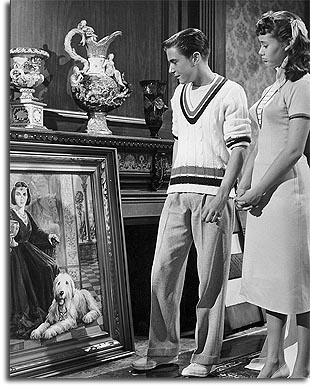 Oh Buzz, get over yourself… By 1959, Herb Ryman had been working on Disneyland projects at WED Enterprises for several years. Walt’s studio was always big on cross-pollination, though, and when the Studio side needed a fine art painting done for The Shaggy Dog they called Herb. The film was Disney’s first live-action comedy and I’ve been watching it for years without knowing that the famous painting of the sinister Lucrezia Borgia and her sheepdog was a Ryman work.
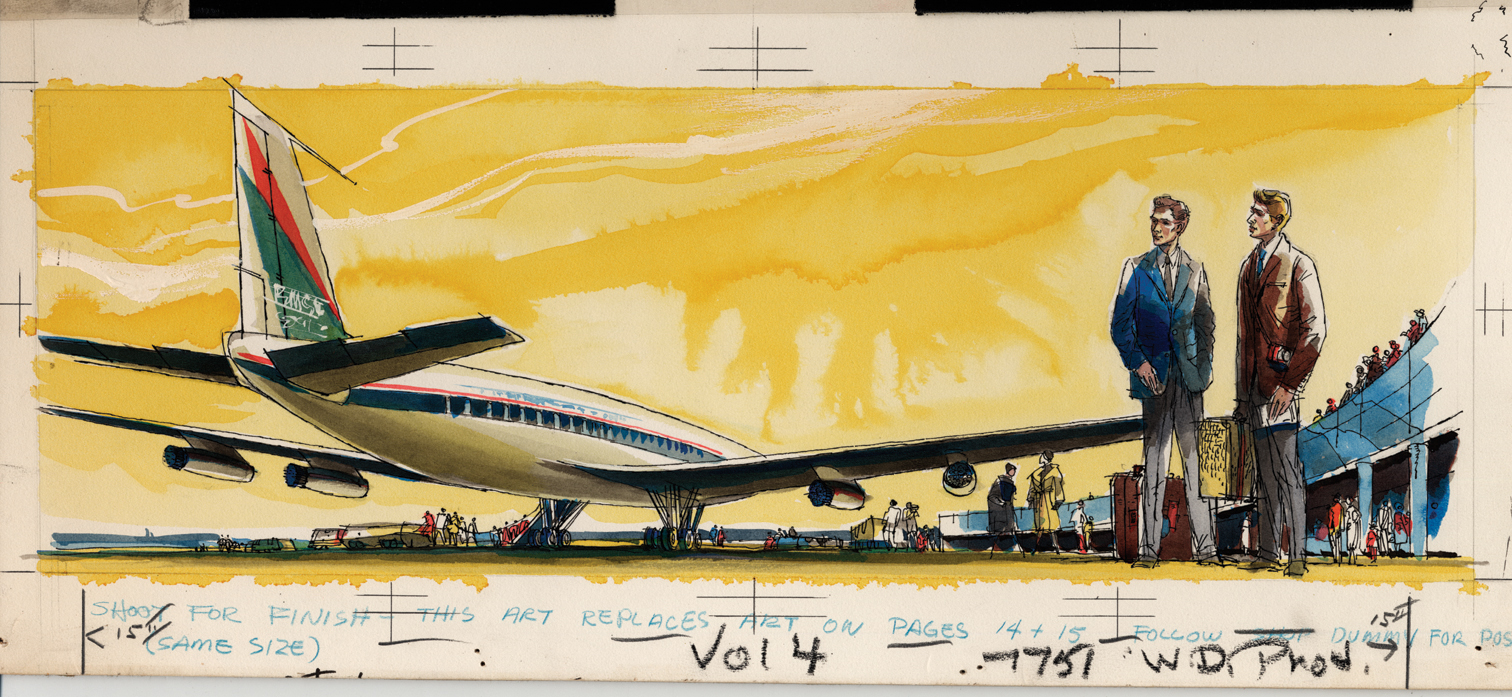
Another of Herb’s extracurricular projects in 1959 was the following illustration, posted by the great Kevin Kidney, from an issue of Walt Disney Magazine.
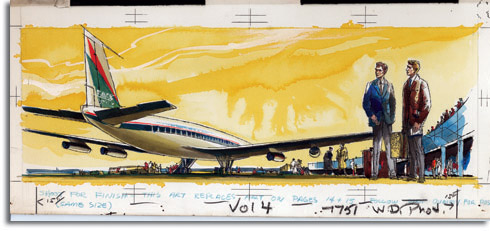 This 1959 illustration by Herb Ryman evokes an era when air travel was not only an adventure but an enjoyable one at that Walt Disney Magazine was a periodical for young readers with a variety of content related to Disney films and television shows. The above illustration was painted to accompany a story featuring Mickey Mouse Club serial stars “Spin & Marty.”
Related Posts...
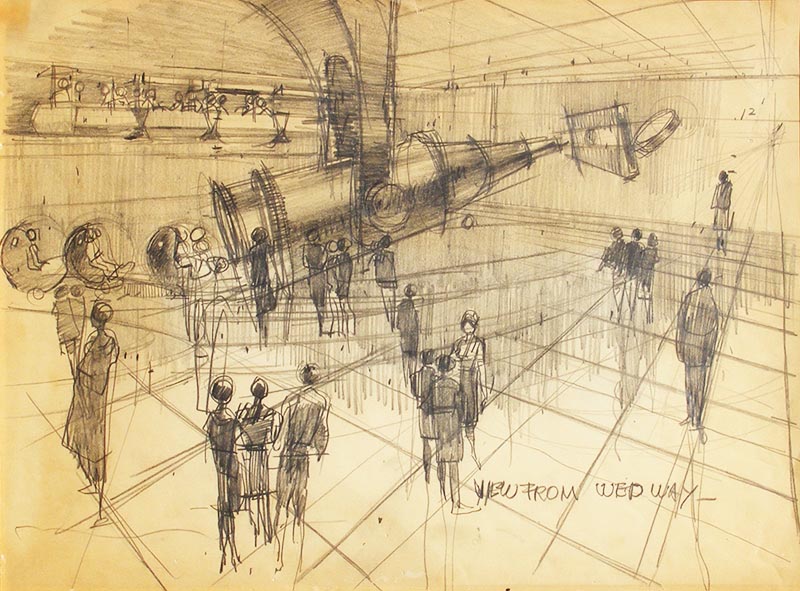
By Michael - July 25th, 2010  Ryman sketch for Adventures Thru Inner SpaceIn my most recent piece about Imagineer Herb Ryman, I mentioned how Ryman initially designed the “Mighty Microscope” of Monsanto’s Adventures Thru Inner Space to resemble an antique microscope that had belonged to his father. Ryman’s father, also named Herbert, had served as a local doctor before dying on the front in World War I. Another Imagineer who worked on the design of that famous giant microscope was George McGinnis, who sent in the following information:
Herb’s later concept of this antique brass microscope had portholes so the guest could see the shrunk AtomMobiles and people. I thought this was a great idea.
One day I was sketching an updated version on a napkin in the cafeteria. I wanted to have the idea “first reading” when the guest enters the load area. X. Atencio, (story director on the show) sat down to talk and he liked the idea and took my rough sketch to the model shop to have a model made.
This is an example of the close collaboration between the early team and the new kids on the block. It helped that WED Enterprises was at about 250 employees at the time. Only one small conference room and no executive cafeteria.
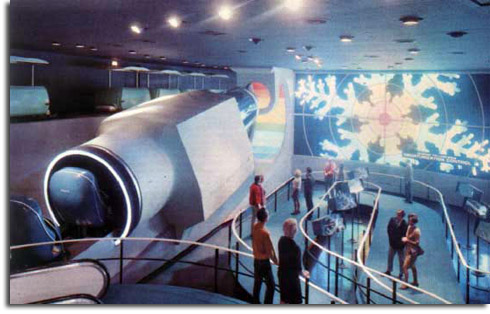 “The load area with the Mighty Microscope ‘swallowing’ the AtomMobiles…”  “…And what concerned those younger than five — being shrunk!” Related Posts...
By Michael - July 24th, 2010 The 1970s were a strange time. Much of the entertainment produced in that decade seems to have been created by aliens masquerading as humans; everything seems vaguely familiar, but enough small details are off just enough that the cumulative effect is decidedly creepy. So it is with this piece of video, Lady and the Tramp: A Lesson in Sharing Attention. The odd thing is that I found this by accident on a videotape full of recordings from the Disney Channel in 1988 – it was used as interstitial filler between programs. The Disney Channel didn’t interrupt their programming for commercials in those days, so if a film ran short the rest of its time slot would be filled with ads for other Disney Channel programming or various materials pulled from the company vaults. This was, of course, the era when the Disney Channel aired actual Disney-related material – this featurette was aired before a showing of The Reluctant Dragon – but I can’t imagine what inspired someone at the Channel to dig this deep into their archives.
It would be difficult for me to enumerate everything I find amusing or bizarre about this, so best to just watch it yourself. Note that it takes place in the familiar confines of Disney’s hallowed Golden Oak Ranch in California.
One hallmark of the alien-controlled media of the 1970s is that adults take freakishly inappropriate delight in “whimsical” things that are in actuality devoid of whimsy. Things like a child whirling around with a Peter Pan marionette, joylessly exhorting him to do Peter Pan-esque things. Simply put, did children of the 1970s actually enjoy playing alone in the wilderness by torturing marionettes, and did crusty but lovable neighbors enjoy standing there watching?
In the end, my absolute favorite thing about this film is the end credits, where the filmmakers go out of their way to label “Uncle Phil” as a “Friend and Neighbor.” Because, you know, it’s best to clear those things up if you’re trying to sell your film in certain markets. This begs many questions. Was Uncle Phil made a friend and neighbor in post-production? When Disney tried to sell the film to the Texas School Board? If they thought it important to make Uncle Phil not an actual uncle, then why call him Uncle Phil in the first place? Just make him Neighbor Bob or Reverend Steve or Councilman Lester. Why introduce the confusion caused by the Uncle Phil moniker in the first place?
It was this kind of mistake that led to the aliens tipping their hand and exposing themselves in 1977, leading to our liberation via the Star Wars; this, in turn, led to the eponymous film which you thought was fiction but which is actually a fairly accurate documentary. And that’s why kids don’t play with marionettes anymore.
Any questions?
Update: Whoa! Check out auteur Uncle Phil’s resume…
Related Posts...
By Michael - July 20th, 2010 It’s been a while since things went rather quiet at Walt Disney Animation Studios in the wake of several canceled projects, awkward renamings, and general confusion and lack of direction. All that remained on the studio’s animated slate were this year’s Tangled, next year’s Winnie-the-Pooh, and Reboot Ralph – the computer animated film that has mutated from ex-Disney artist Sam Levine’s Joe Jump. It left the animation community wondering… what’s next?
Word has started to emerge that the gears are turning at Disney once more. King of the Elves, a fantasy based on a story by Philip K. Dick, was originally scheduled for a 2012 release before development was scrapped. Happily, allegations have recently emerged that work has resumed on this project. Even better is the recurring rumor that the film has been retooled as a traditionally animated feature, giving Disney’s artists something meaty to work on after Pooh.
Animation fans were further intrigued recently when word emerged, most notably on the Animation Guild blog, that a new project had been greenlighted for development. Note that this is only a go for development, not production, and that innumerable projects have traveled that road without making it to theaters. But if this is a project new to development, and not a revived concept like Elves or the still-dormant Snow Queen, what could it be?
Would you believe… Jack and the Beanstalk? That’s what I’m hearing, at least. As part of Disney marketing’s panicked flight from all things female in the wake of Princess and the Frog‘s underperformance, the next animated film to go into development at Disney is a “boy” film.
Haven’t we seen that before? Some dude with mouse ears? In Fun and Fancy Free? Ah, well.
You should consider this information ultra-dicey at the moment, but some rumors are too good not to share. And remember – while I definitely trust my source, things change on the ground all the time. Is that CYA? You bet, but it’s also true.
Have you heard anything about Jack and the Beanstalk? If so, shoot me an email…
UPDATE: This is apparently director Chris Buck’s new project, following the cancellation of Snow Queen. Again, please remember that being greenlighted for development is not the same as getting the go-ahead for production.
UPDATE THE SECOND: Sources report that Chris Williams (Bolt) is now in the director’s seat for the revived King of the Elves. Also, I have some doubt as to the earlier rumors that it would be traditionally animated; it’s looking more likely that it will be another CG production. This leaves only Winnie the Pooh on the hand-drawn slate, although Ron Clements and John Musker are said to have a few new proposals in the pipeline.
Related Posts...
|
The Progress City Primer
 From the Progress City archives comes this collection of 33 tall tales and true from Disney history. Available in paperback, hardback, and ebook formats. |







Recent Comments