For those of us in the lowly demographic called “fandom”, true insight is only gained through extreme displays of excess and obsessiveness. This especially holds true when researching older Imagineering projects, and most particularly projects that were somehow altered or never came to be. So little artwork or information escapes from Fortress Disney, that each ancient rendering or photograph that turns up must be dissected on an angstrom-by-angstrom level. Old park models tend to appear only in one or two glossy promotional photos that have been reprinted endlessly over the years, but these images rarely give up the level of detail that we desire.
Images of the EPCOT Center model from 1978 are fairly common. It was the year that Disney re-announced their commitment to the project, and their intention to proceed with planning and design. It was the year that the park really started to resemble the facility that we know today, with a single row of themed international showcases around the lagoon and the core Future World pavilions decided on. But most images of this model are from a single angle, obscuring World Showcase, and they’re rarely reprinted in an adequate size. It would be so helpful to have a new angle on the situation…
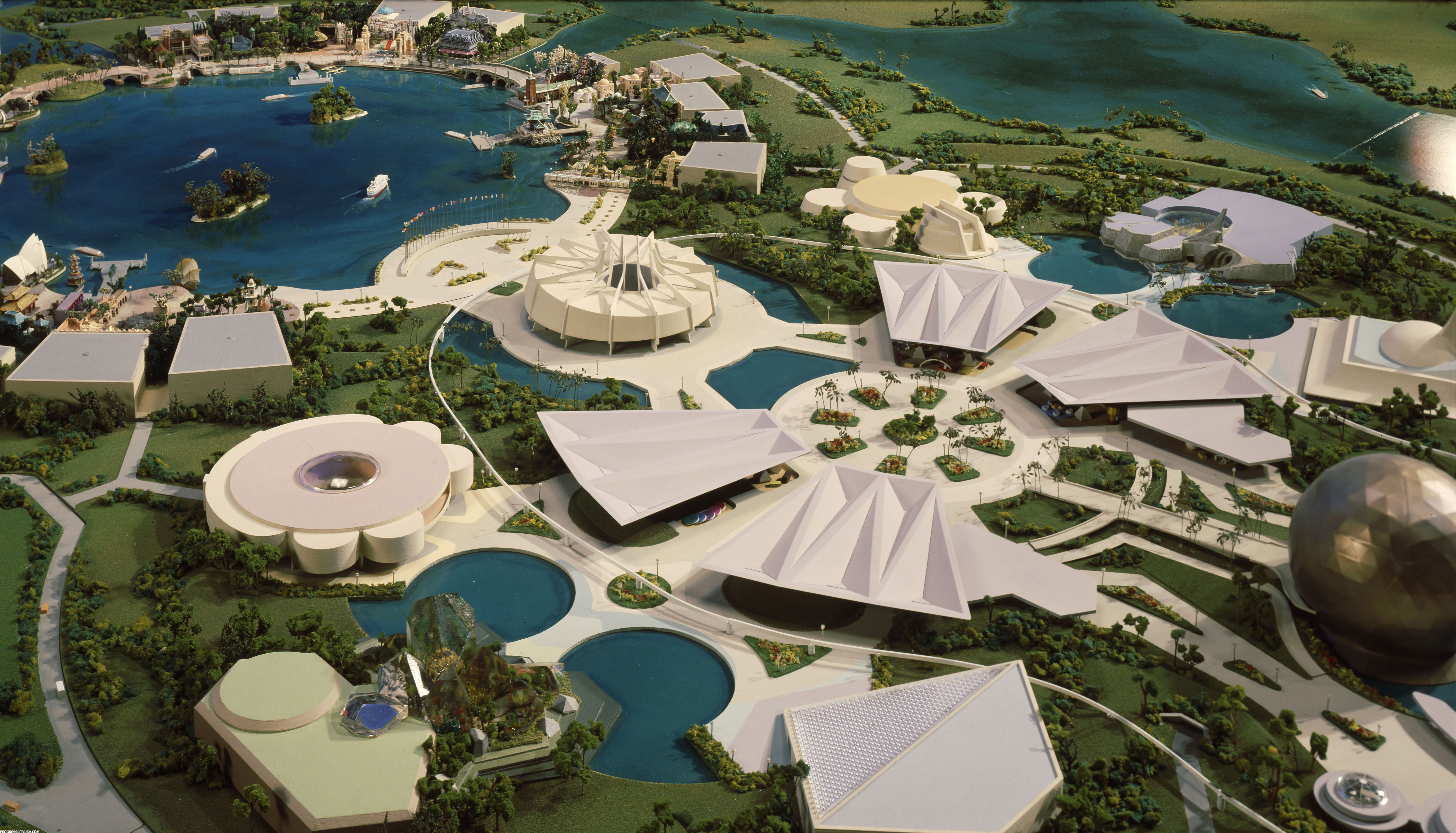
Oh look! It’s a new angle on the situation:

The 21st century begins!
This image is undated, but I believe it to date, roughly, to mid 1978. While this is the model pictured when Card Walker re-announced the project in October of that year, other pictures of the model from 1978 show more evolved versions of the Space and Health pavilions so I believe that this model precedes those. One can see the familiar pavilions of Future World, as they were planned at that time. Spaceship Earth isn’t yet a full geosphere, and the CommuniCore buildings were still giant, looming, V-shaped spaceframes. Zooming in to the picture, one can see the various exhibits sitting in the open air.
Universe of Energy shows, once again, that it was the first pavilion to reach its final design; you’ll notice, however, that there was no fountain in front of the building – instead, Future World East was to have large, shallow lagoons much like Future World West. These would never appear in the final design, and Future World East became the “dry” side of the park. Clockwise from Energy, we find Tony Baxter’s first take on The Land – the “ecology” pavilion that was later scuttled when Kraft signed on as sponsor and demanded a more farming-focused attraction. Then comes the Transportation pavilion, which would soon get rounded out and become the World of Motion. In the area between Future World and World Showcase is the American Adventure, in its elevated, modern structure. Sitting where Journey into Imagination would later emerge is an early version of the Life and Health pavilion, and where The Land would later reside is an early and more elaborate take on The Seas. In the last spot, partially cut off in this picture, is what I believe to be an early, placeholder version of the Space pavilion. Other EPCOT models from 1978 show the more familiar, detailed Space pavilion sitting in this spot.
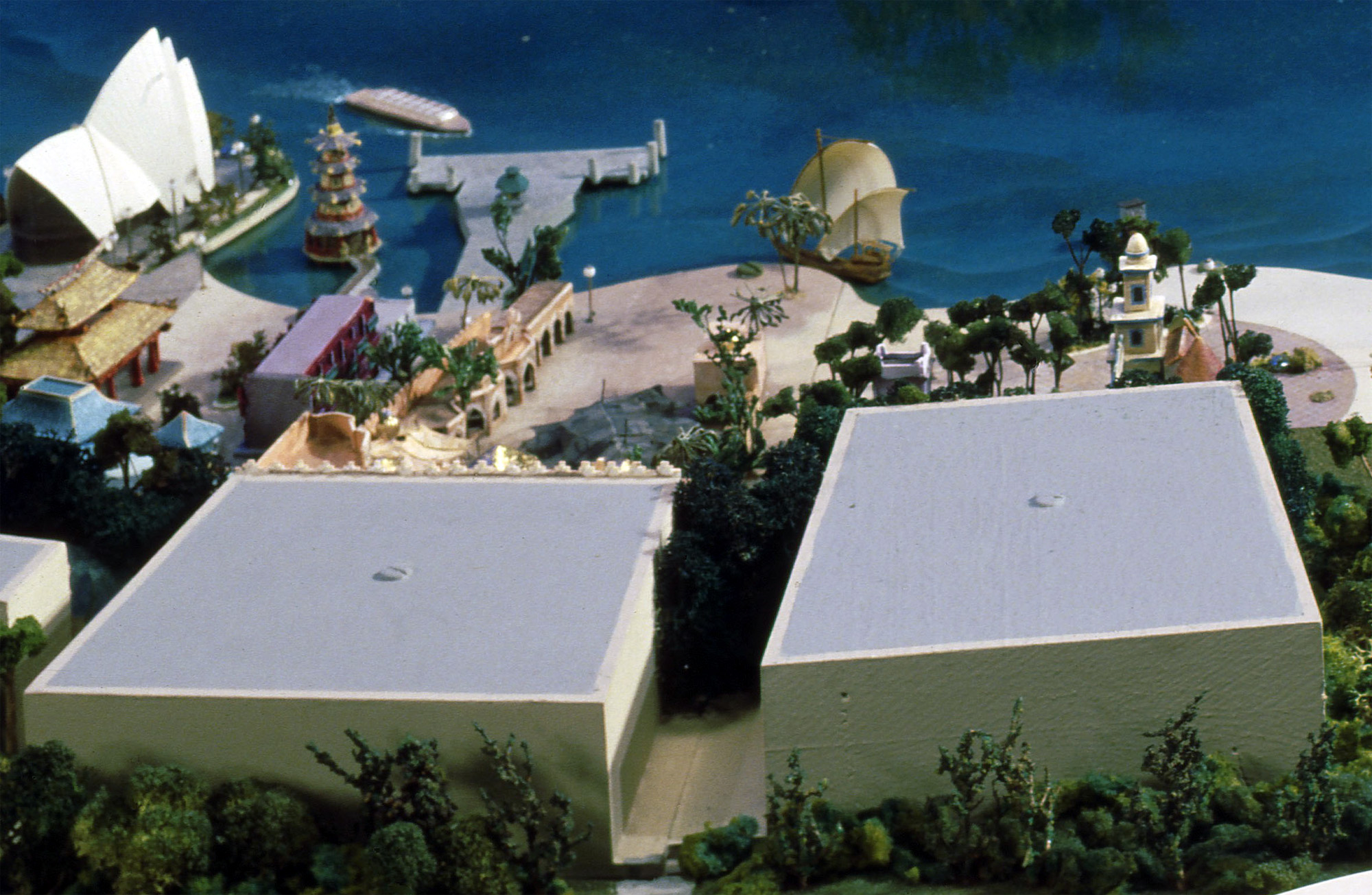
The great appeal of this photograph, however, is that it provides us a rather rare look at the pavilions lining World Showcase. The model dates from a time when Disney anticipated between twenty and thirty national showcases, and so the shores of the model lagoon are far more bustling than they are in real life. It can be difficult to make out the identities of the individual pavilions without obvious landmarks or flags, but we can take a few cues from this site plan, which also dates to 1978 and shows a layout for the area very similar to what we see in the model:
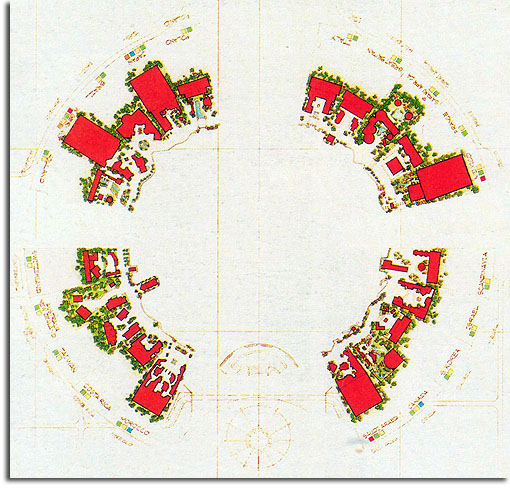
Proposed layout for World Showcase from 1978
The model and the diagram don’t match exactly, but the site plan does give us an idea as to what Disney had in mind for its client nations, and we can match the pavilion footprints in the illustration to the building shapes in the model.

From left to right: Scandinavia, Israel, South Korea, Canada and Mexico
Starting where we find Canada in the park today, we see the familiar greenery-draped pyramid of Mexico. This early version features an aqueduct that extends to the lagoon, and there appears to also be a canal on the far side of the pavilion that extends inwards under the promenade.
Nestled amongst the trees is an early concept for the Canada pavilion, which features a wooden tower and pathways amongst the tall pines. You can see the top of the French Canadian hotel, with its Québécois flag, and a Circlevision show building.
Traveling onwards, we encounter what seems to be a South Korea pavilion, with its shallow show building and temple situated on the lagoon. This is followed by what appears to be the Israel pavilion, and then what is labeled on the site plan as a Scandinavia pavilion. The Scandinavia pavilion has a long and tortured history, being at times themed to Denmark or Scandinavia in general before finally evolving into today’s Norway pavilion. I find it interesting, though, that in this picture it’s flying only the flag of Sweden.

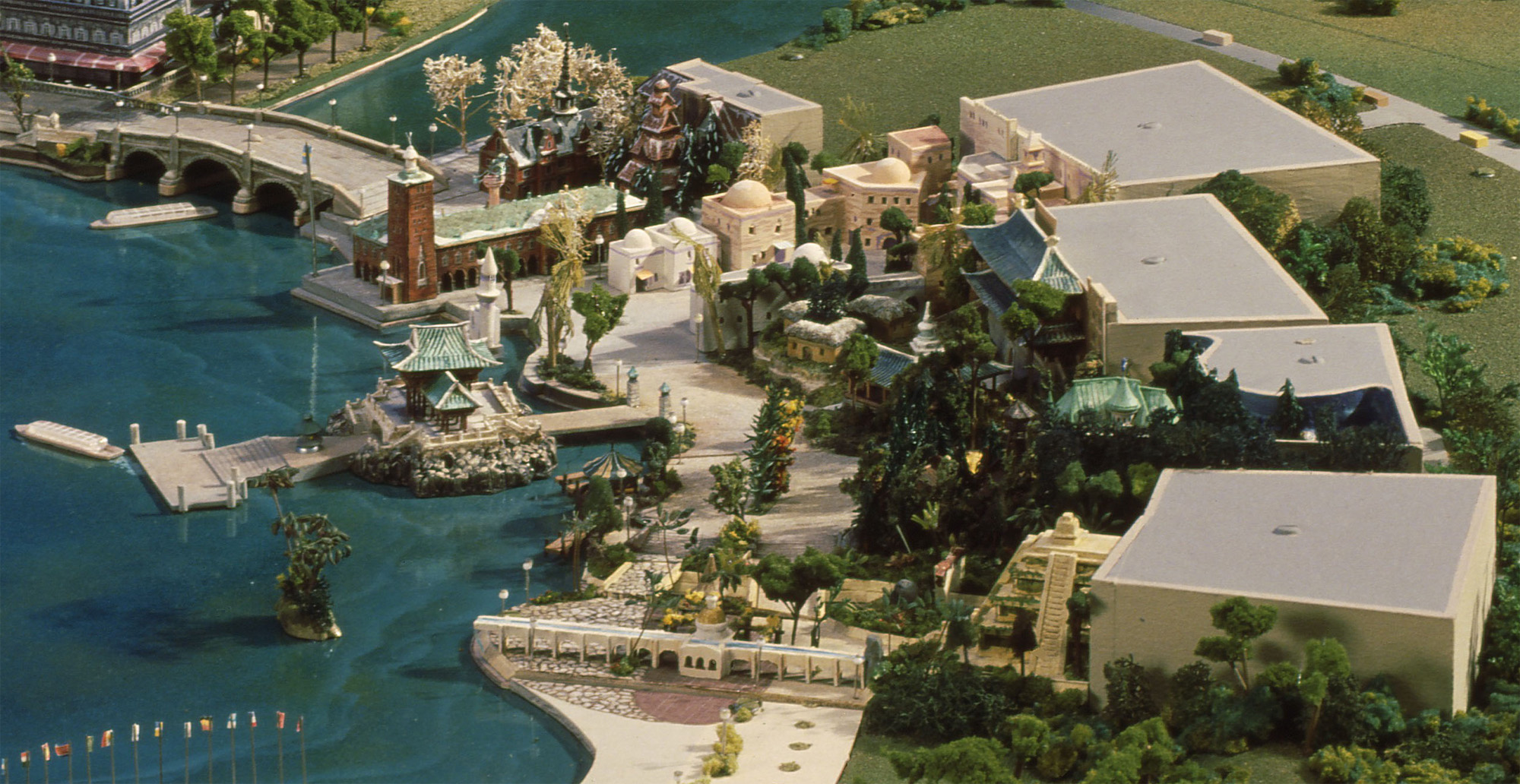
From left to right: Italy, United Kingdom, Africa, Saudi Arabia, France
The France showcase finds itself relatively close to its real-world location, although today’s Eiffel Tower has been replaced in the model by the bohemian cityscape of Monmartre and the spires of the Basilique du Sacré-Cœur, complete with its iconic stairs. Next door is a pavilion that I believe to be Saudi Arabia, although at the time Disney was in negotiations with a variety of Arab nations (including the United Arab Emirates) and the possibility of an “Arabic Nations” pavilion was occasionally invoked.
Tucked away in the trees is an early attempt at an Africa pavilion, which would later evolve into the designed-but-not-built Equatorial Africa showcase. I’m unsure whether, at this point, this was intended to represent a single African nation or, like its successors, it was to be sponsored by a coalition of sub-Saharan governments.
Continuing on, we find what seems to be the United Kingdom pavilion, although it differs greatly from the concept that was eventually built. Instead of a meandering high street, we have a large castle looming in the forest, concealing a large show building. There’s a low-slung building – possibly a pub? – and some sort of turret of Tudor design.
Finally, there’s Italy, which appears to draw from similar northern Italian traditions as the actual pavilion does today.
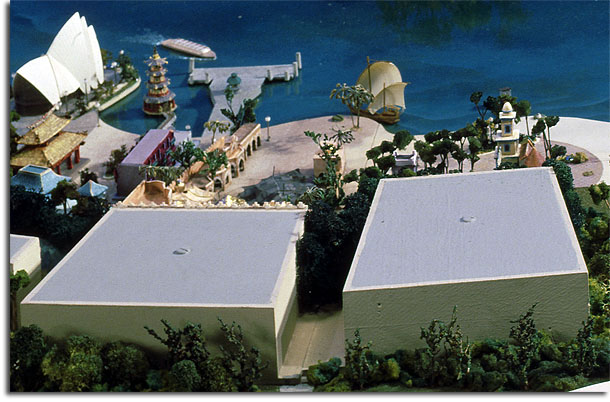
From left to right: Australia & New Zealand, Taiwan, and what is possibly Morocco and Costa Rica
The final pavilions appearing here are more difficult to identify, as we can see very little of their actual themed areas. The showcase representing Australia and New Zealand is easy to spy, with its replica of the Sydney Opera House sitting on the lagoon. Next is Taiwan, with its colorful shrines. The final two pavilions are less obvious; the site plan suggests that these are Morocco and Costa Rica. If so, this Costa Rica pavilion appears to differ greatly from the better-known proposal to represent this nation with a giant glass-enclosed botanical gardens.
What’s most amazing is that, as detailed as these models are, they represent only a brief moment in time at WED Enterprises. The only constant during Epcot’s development was change, and pavilions were getting shuffled in and out of these models on a continuous basis. Remember, also, that they were just as important for advertising purposes as they were for design needs – after all, Disney was hustling as much as they could to get corporations and foreign nations to sign on to this crazy new project. Design work was done on a daily basis, only to be completely discarded when sponsorship deals fell through, or the priorities of management shifted. It was a wild time!
Hopefully, some day we’ll be able to get a glimpse of the rest of this model…
Special thanks to John Donaldson for sharing the image!
Related Posts...











Recent Comments