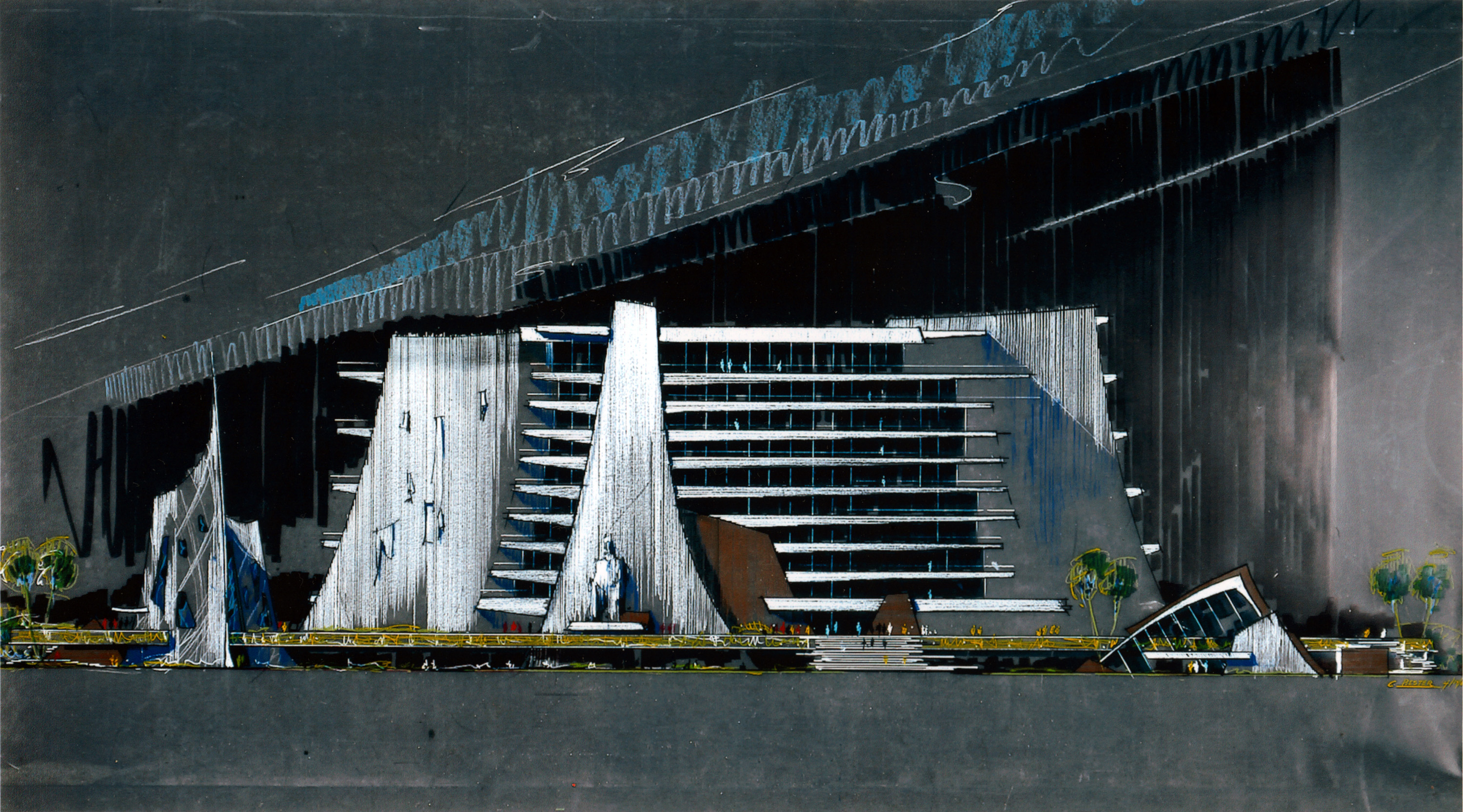
Today’s story on Progress City is somewhat unique and calls for a different kind of introduction. This, as you may recognize, is the Contemporary Resort Hotel – or is it? And if so, from when? And why?
"My name is Ozymandias, King of Kings: Look on my hotel, ye mighty, and despair!"
For many years now, I’ve been trying to dig for information on this peculiar rendering by architect George Rester, an individual who did much design work for Walt’s original EPCOT city and the Walt Disney World resort. Sadly, the date has been cut off in my copy of the artwork, but the piece seems to depict an early concept for the Contemporary Resort Hotel – a concept that looks to be far more fanciful in its futurism.
I’m especially intrigued by the colossal statue sitting outside the hotel’s entrance, reminiscent as it is of the seated statues of Ramesses II at Abu Simbel. Who would have the statue been based on? Colossal Walt? Abe Lincoln? President GARCO? Who knows.
It’s interesting that this early concept – again, assuming it’s the Contemporary; it couldn’t be an idea for EPCOT city, could it? – actually looks far more “futuristic” today than the hotel’s final design. The swooping lines of the balconies, the mixture of curved and angular lines, and the various layers of recessed surfaces much more resemble Disney’s current take on futurism than the straight, mid-century lines of the actual Contemporary. In addition, the glassy, curvilinear outbuildings remind me of features of the early renderings for the Journey into Imagination pavilion.
One strike against this design, though – there’s no monorail!
It’d be interesting to see how this design fit into the evolution of the Contemporary. Unlike its counterpart the Polynesian, we’ve really only ever seen artwork for the Contemporary that shows it as it was eventually realized. It had to come from somewhere, right? Hopefully some day we’ll see more renderings released that will show just how early Walt Disney World development progressed.
And, strangely, if Disney ever wanted to build another futuristic hotel somewhere, they could look back more than forty years to Rester’s early designs.
We recently showed a picture of the Epcot model from 1978, which included the “Transportation” pavilion that would later become World of Motion. I’ve come across this rendering of that same pavilion, which I believe to be by Imagineering artist Collin Campbell, and I thought it would help to shed a little light on that earlier design for the attraction.
The Transportation pavilion was the first of the Future World attractions to find a sponsor, and it was the backing of General Motors that helped give Disney C.E.O. Card Walker the confidence to move forward with the Epcot project in October of 1978. Early concepts for the show building mirror the eventual attraction’s cylindrical shape, but you can see in this early rendering that the original concept was for there to be semi-circular “bumps” extending from the perimeter of the building. The atrium at the building’s core was, for a time, meant to be enclosed by a glass wall, and you can see that the ride’s omnimover vehicles were to pass in and out of this atrium several times. In the final attraction, of course, vehicles would make a single loop through an outdoor atrium before entering the show building.
Hopefully, we can find out more about this interesting early take on Transportation in the future…
Yesterday, Foxx from Passport To Dreams Old & New tweeted a link to this great cartoon from the 1962 Beany and Cecil animated program. The Beany and Cecil characters were invented by former Warner Brothers animator Bob Clampett, and were originally featured in a televised puppet show called Time for Beany which ran from 1949-1954. They were revived for this animated program nearly a decade later.
What’s fun about this clip is that it’s a very early parody of Disneyland, full of truly over-the-top puns and in-jokes. I can imagine the confused east-coast kids watching this episode, since so much of the silly wordplay and references depend of a working knowledge of Disneyland. And the gag about the submarine presages Walt Disney World’s conversion of the “Submarine Voyage” into 20,000 Leagues Under the Sea!
So while the satire may bite a bit at times, it’s clear that this piece is based in extensive Disneyland experience. Which shouldn’t be a surprise; Wikipedia’s list of the show’s creative staff features many, many individuals who once worked at the Disney studio – some of whom would do double-duty as Imagineers!
Here’s the cartoon, and among all the references and gags note another thing: just how much Clampett’s work has been ripped off by pretty much every “hip” children’s animated program in the last twenty years.
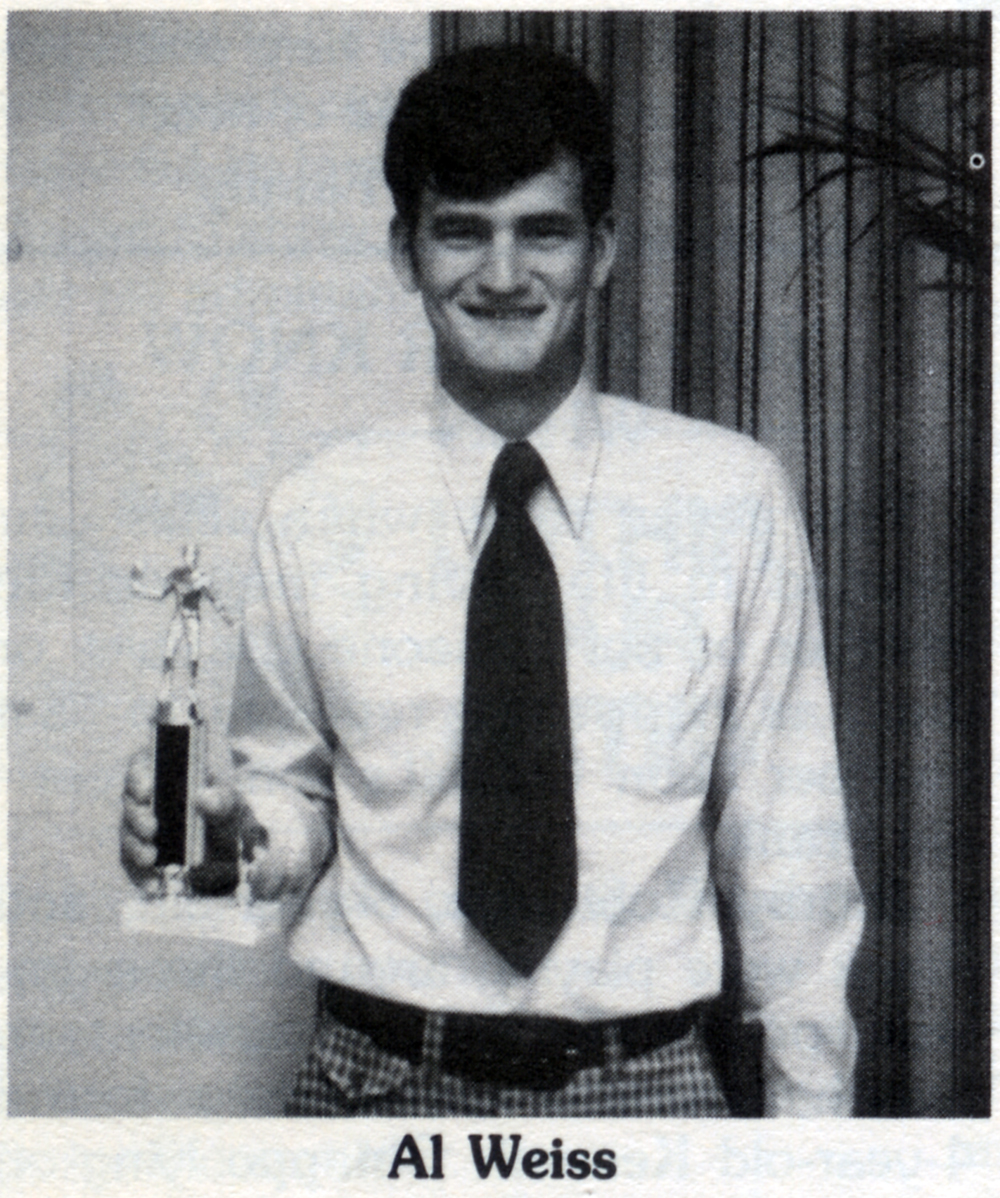
Disney released a statement today that Al Weiss, the President of Worldwide Operations for Walt Disney Parks and Resorts, is stepping down from that post which he has held since 2005. According to the Orlando Sentinel, Weiss’s resignation will be effective immediately although he will officially remain employed with the company until November 1st.
Weiss, who is only 57, has been employed with Disney for 39 years. Most of us on the east coast know Weiss from Walt Disney World, where he was that resort’s president during its long decline from 1994-2005.
What’s intriguing is that Weiss will not be replaced. The Sentinel reports that his position is being eliminated and, according to Disney Parks Chairman Tom Staggs, the parks operations division will receive a new operating structure in the upcoming weeks. This is rather big news, and I look forward to seeing what they have in mind. It’s obvious that there’s some driftwood in the operations structure from the top to the bottom, and a housecleaning would certainly be welcomed by many fans (assuming, of course, that the new structure is staffed with capable people). It’s a shame that former Disney executive Matt Ouimet was announced as the new head of Cedar Fair Entertainment Co. just two days ago; Ouimet is frequently hailed as “the man who saved Disneyland”, and many fans have long hoped that he would return to the fold.
So what does this all mean? Time will tell. I’m very interested to see what this new organizational structure is.
One thing that’s often forgotten nowadays is the fact that in Walt’s heyday – the golden age of Walt Disney Productions – the studio was a favorite of intellectuals and “serious” artists the world over. In recent decades Disney is often derided by cultural commentators, who view it as a vast hegemonic and homogenizing corporate force, and its products are (with certain exceptions) typically dismissed by self-appointed guardians of the culture.
Way back when, though, things were different. In the period between Steamboat Willy and, roughly, the time of the bitter animators’ strike in 1941, Disney’s films were darlings of the elite. And this was an age when the elite truly were elite. Mickey’s fans ranged from Charlie Chaplin to Sergei Eisenstein and René Clair; Salvador Dalí famously worked with the Disney studio, as did, briefly, Oskar Fishinger. And the “star” of the first Disney live-action film, The Reluctant Dragon, was Algonquin wit Robert Benchley.
One could debate the reasons that upper-crust perceptions of Disney changed after World War II, although a second wave of thinkers would eventually embrace the Disney theme parks when they later emerged (think James Rouse, or Ray Bradbury). Or, perhaps, society as a whole was different – after the war, the role of noted columnists, essayists, “wits”, or radio pontificators changed as well.
This piece, however, comes from the time when Walt was still the talk of intellectuals on both coasts, and it comes from one of the most hallowed of them all – author and essayist James Thurber. Writing in The Nation on March 28, 1934, Thurber penned this paean to Disney’s creations and made some suggestions for the studio’s future projects. Could Thurber’s piece have been slightly tongue-in-cheek? It’s possible, and considering that it’s Thurber writing that possibly can’t be discounted. But, more than likely, the essay reflects a sincere appreciation of Disney’s work.
And, let’s face it, of all the fans who have tried to send in their ideas for proposed projects to Disney over the years, I’ll bet Thurber’s didn’t get sent back unread by a pack of vicious lawyers.
Here’s the piece, in its entirety:
The “Odyssey” of Disney
I HAVE never particularly cared for the “Odyssey” of Homer. The edition we used in high school – I forget the editors’ names, but let us call it Bwumba and Bwam’s edition – was too small to hide a livelier book behind, and it was cold and gray in style and in content. All the amorous goings on of the story were judiciously left out. We pupils might, at that age, have taken a greater interest in T. E. Shaw’s recent rendering, the twenty-eighth, by his count, in English; for bang-off in Book I the third sentence reads: “She craved him for her bed-mate: while he was longing for his house and wife.” But there wasn’t any such sentence in old Bwumba and Bwam. It was a pretty dull book to read. No matter how thin Mr. Shaw has sliced it, it is still, it seems to me, a pretty dull book to read.
The fact that the “Odyssey” is the “oldest book worth reading for its story and the first novel of modern Europe” makes it no more lively – to me, anyway – than does the turning of it into what Mr. Shaw’s publishers call “vital, modern, poetic prose.” There are too many dreary hours between this rosy-fingered dawn and that rosy-fingered dawn. The menaces in ancient Jeopardy were too far apart, the hazards prowled at too great distances, the gods maundered and were repetitious. Ulysses himself is not a hero to whom a young man’s fancy turns in any season. The comedy of the “Odyssey” is thought by some students to be unintentional and by others to be intentional, and there must not be any uncertainty about comedy. But whatever may be said about it, the “Odyssey” will always keep bobbing up, in our years and in the years to follow them. The brazen entry into the United States of Mr. Joyce’s “Ulysses” has most recently brought the “Odyssey” again into view; as the magazine Time points out to its surprised readers, “almost every detail of the ‘Odyssey’s’ action can be found in disguised form in ‘Ulysses.'” So, many a reader might naturally enough ask, what? So nothing – that is, nothing of real importance in so far as the “Odyssey” or “Ulysses” itself is concerned. The ancient story just happened to make a point of departure for Mr. Joyce. He might equally well have taken for a pattern Sherman’s campaign in Georgia. Nevertheless, here is the old tale before us again not quite two years after Mr. Shaw went over the whole ground for the twenty-eighth time in English.
My purpose in this essay is no such meager and footless one as to suggest that it is high time for some other ancient tale to be brought up in place of the “Odyssey” – although, if urged, I would say the “Morte d’Arthur.” My purpose is to put forward in all sincerity and all arrogance the conviction that the right “Odyssey” has yet to be done, and to name as the man to do it no less a genius than Walt Disney. A year or two ago Mr. Disney made a Silly Symphony, as he too lightly called this masterpiece, entitled “Neptune.” Those who missed seeing it missed a lusty, fearsome, beautiful thing. Here was a god and here were sea adventures in the ancient manner as nobody else has given them to us. The thing cannot be described; it can be rendered into no English. But it was only a hint of what Mr. Disney, let loose in the “Odyssey,” could make of it.
The dark magic of Circe’s isle, the crossing between Scylla and Charybdis, the slaying of the suitors are just by the way; and so are dozens of other transfigurations, mythical feats of strength, and godly interventions. Mr. Disney could toss these away by the dozen and keep only a select few. For one: Ulysses and his men in the cave of the Cyclops. That would be that scene as I should like my daughter to know it first, when she gets ready for the “Odyssey,” or when she is grimly made ready for it – I presume one still has to read it in school as I did, along with “The Talisman” and “Julius Caesar.” Picture Mr. Disney’s version of the overcoming of the giant, the escape tied to the sheep, the rage of Polyphemus as he hurls the tops of mountains at the fleeing ship of Ulysses and his men!
But I think my favorite scene will be (I’m sure Mr. Disney will do the “Odyssey” if we all ask him please) that scene wherein Menelaus and his followers wrestle with the wily Proteus on the island of Pharos. You know: the Old Man of the Sea comes up out of the dark waters at noon to count his droves of precious seals all stretched out on the beach. In his innocence of treachery or of any change in the daily routine, he unwittingly counts Menelaus and his three men, who are curled up among the seals trying to look as much like seals as possible. It doesn’t come out, by the way, in any rendering I’ve read, and I’ve read two, just what the Old Man thought when he found he had four seals too many. Anyway, at the proper moment Menelaus and his followers jump upon Proteus. In the terrific struggle that ensues the Old Man changes into – here I follow the Shaw version – “a hairy lion: then a dragon: then a leopard: then a mighty boar. He became a film of water, and afterwards a high-branched tree.”
How only for Walt Disney’s hand and his peculiar medium was that battle fought! His “Odyssey” can be, I am sure, a far, far greater thing than even his epic of the three little pigs. Let’s all write to him about it, or to Roosevelt.
James Thurber
OK, so maybe Thurber was having a bit of sport, but you never know.
This was, of course, three years before Snow White and the Seven Dwarfs debuted, so Thurber had hardly seen Disney at the full extent of his powers. It’s amusing, though, to think of a time when the only place you could see spectacles of the sort that Thurber outlines was in a Disney film. In a way, Disney was the Industrial Light and Magic of the day; such a perspective really does help one understand why Walt’s films caused the sensation that they did.
Here’s the Silly Symphony that so inflamed Thurber’s imagination:
From the Progress City archives comes this collection of 33 tall tales and true from Disney history. Available in paperback, hardback, and ebook formats.







Recent Comments