
Doh!
As 2009 finds new and fascinating ways to stick it to me, news has just emerged that the impending release of the 5-disc CD set, Walt Disney and the 1964 World’s Fair
Buy hey, after nine years, what’s five weeks?
|
Doh! As 2009 finds new and fascinating ways to stick it to me, news has just emerged that the impending release of the 5-disc CD set, Walt Disney and the 1964 World’s Fair Buy hey, after nine years, what’s five weeks? Related Posts...
It is, perhaps, reasonable to assume the nature of anything internet-related – or especially blog-related – to be ephemeral. Here, one would typically cite the percentage of blogs that never make it past their first post (I’ll let you Google that yourself). Some online writers sign off when they’re planning to take a break, but apparently my tendency is to disappear for months without a word. This is primarily because, even though things have been very quiet here since the early fall, the hiatus was never planned. While part of this is due to the fact that time seems to be moving exceedingly speedily in my reference frame, the main reason that I stopped popping in every couple of days to sound off was that there was nothing that sprang to mind that I could be bothered to write about. It wasn’t completely for lack of topics; I missed the major holidays and even the first anniversary of this blog. There was news coming out of Burbank, Glendale, Anaheim and Orlando – it was just mostly depressing. I spent some of my time off-line doing a bit of research about Walt Disney World for a couple of projects I’d like to work on, but even historical research can lead to an enthusiasm deficiency. Studying the the Florida project, and uncovering the sheer complexity and intricacy of design that went into its creation, makes its current state seem even more troubling. 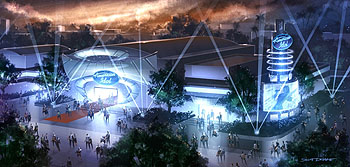 What could be causing my writer’s block… Let… me… see… What could be causing my writer’s block… Let… me… see…While I’ve never shied away from criticising Team Burbank when I think they’ve got it wrong about something, I’m not immune to fatigue from poisoned-pen writers with nothing but vitriol for corporate. In fact, criticism is even more difficult for me these days because as much as I disagree with some of the decisions that are being made, I’m convinced that large segments of the current management have their hearts in the right place. It’s easy to place blame for unfortunate park-related decisions on someone like parks chief Jay Rasulo, who has no business holding the position he currently occupies, but what of those Pixar folk who currently wield some influence? I’d be surprised to hear anyone say that John Lasseter doesn’t mean well for WDI, and yet since his return to Disney I’ve seen precious little change in several disturbing trends in the design of the parks. In fact, many issues have grown in scope and complexity. While previously we might have complained about an attraction being poorly-themed or under-funded, we’re starting to see well-funded, highly-themed attractions that just happen to be completely inappropriately themed to their surroundings. This is a real poser for park fans – what if we get a wonderful new E-ticket, with the only drawback being that it clashes thematically and aesthetically with its carefully crafted environment? 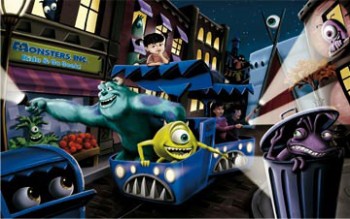 Tomorrowland TomorrowlandA vista into a world of wondrous ideas, signifying man’s achievements… a step into the future, with predictions of constructive things to come. Tomorrow offers new frontiers in science, adventure, and ideals: the atomic age… the challenge of space… and the hope for a peaceful and unified world. This problem can be seen with Tokyo Disneyland’s soon-to-open Monsters, Inc. attraction. A typically lavish product of the Oriental Land Company’s largesse, the attraction sweeps away many of the concerns that Disney fans had during the Eisner-Pressler years. It’s well-themed, with a massive budget and a huge array of interactive animatronics. It sounds like a real crowd-pleaser, and something that will actually be fun for kids and adults. The problem? It’s smack-dab at the entrance of Tomorrowland in their Magic Kingdom. Does this matter? Well, to theme park visitors who just want to ride cool rides, no. But to those who care deeply about themed design, things like this are a real concern. Yes, it might seem like petty nit-picking. And yes, there are certainly more important problems in this modern world with which to be concerned. But whether one realizes it or not, one of the key reasons that anyone cares about theme parks at all – the reason that we have approximately eleventy jillion Disney-related webpages, and the reason that you are here reading my self-important diatribes – is that in 1955, Walt Disney put together a group of elite artists and designers who did care about these things. These Imagineers knew how these elements affected people, even on a subconscious level, and they used them with great effect and subsequently altered the entire face of the amusement park industry. The Disney organization didn’t just wake up one day and suddenly become the most popular purveyor of family recreation and themed entertainment in the history of history. They didn’t just flip a coin with the Knotts Berry Farm people to see who would become a global parks franchise. It took years of work, expense, and the innate ability of Walt and the WDI staff to provide their guests with what they wanted before the guests themselves even knew that they wanted it. It took the obsessive, and occasionally irritating, attention to detail and insistence on perfection that many of us bloggers think of when we’re griping that the Carousel of Progress has broken down again. Someone posted an incredibly insightful piece on a messageboard recently that encapsulated, I think, the problem facing the Disney parks today. Disney parks, the writer posited, are no longer intended to be intricatedly themed environments, in which guests take part in adventures from our culture’s history and popular mythology. Instead, the parks are mere containers for a variety of franchise-based experiences – attractions based on whatever is new and trendy, or whatever it is that the Home Video or Merchandising divisions are trying to sell at the moment. In this way they are becoming, essentially, what Universal Studios is. Not that I sneer at Universal, actually – many of their attractions are quite enjoyable. But they aren’t Disney. The problem is, Disney is rarely Disney anymore either. 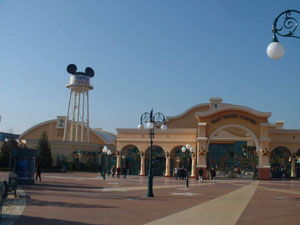 Disney Studios Paris or Home Depot parking lot? You be the judge! Disney Studios Paris or Home Depot parking lot? You be the judge!The comparison between Universal and “Disney’s Hollywood Studios” is obvious. Franchise-based big box attractions surrounded with minimal theming (a few exceptions exist in both parks, yet this theming is limited to the area directly around the attraction itself). Yet look at Florida’s Tomorrowland – Monsters, Inc. is there too, as well as cartoon Stitch across the plaza from the Carousel of Progress. Buzz Lightyear is here, but he’s also in Paris’s Discoveryland – an area supposedly themed to gilded-age science-fiction and to the writings of Verne and Wells. In Adventureland, we have Arabian flying carpets circling in front of a Polynesian facade, and Toy Story Mania takes us through a carnival shooting gallery in the middle of a supposed movie studio. At the Living Seas, where once the focus was on the seas themselves, we’re now treated to an exact re-telling of the plot of Finding Nemo with no attempt to meld the storyline to its surroundings. It might be – no, actually, it is – foolish to attempt this type of analysis in a park which ends a gingerbread-trimmed Victorian Main Street with a gothic French fairy-tale castle. But these are the types of things that WDI should be thinking about, because eventually the cognitive dissonance adds up, and that indefinable spark that separates Disney from Universal and the rest will disappear. A brand name will do a lot for you, but it won’t last forever and it won’t work miracles. Just ask Superstar Limo. 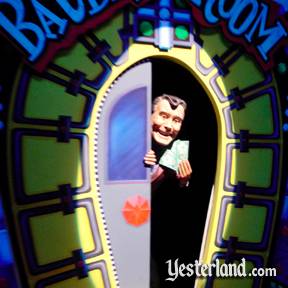 Just… no. Just… no.Anyway, this is an absurd way to announce my return yet there it is. I hope to post more regularly, and there’s certainly been a bit more news starting to trickle out from Team Disney to discuss. The economy seems to have put a damper on a lot of projects, but there’s hope they’ll make it to the parks eventually. There’s no doubt that things are better off now for the parks than in the dark days of Pressler, but that doesn’t mean we can take our eyes off the ball. At this time in the company’s history it would be good for the people at both corporate and WDI to take a moment and think about what they do and why. The Disney park juggernaut has been plowing along for 54 years now, and in such an amount of time it’s easy to “lose the thread”, so to speak. It’s time to take a breath, clear the mind, and then get back to the drawing board. There’s work to do. Related Posts... Concept rendering for Horizons post-show. Click to enlarge. Concept rendering for Horizons post-show. Click to enlarge.Happy New Year, everyone. For my first substantive post of 2009 I have something really special to share – a piece of never-before-seen concept art for the defunct yet beloved EPCOT Center attraction Horizons. The rendering dates to 1980, when the attraction was still known under its working title, Century III. The sketch depicts the proposed post-show exhibit area that was originally slated to be built adjacent to the attraction’s unload area. The exhibits were designed to spotlight the various technologies then being marketed by General Electric, who was the original sponsor of the Horizons pavilion. The technologies would overlap thematically with the scenes within the ride, which depicted future life on land, under sea, and in space. Highlights included: – Medical Systems: Diagnostic Imaging, Patient Monitoring, Demonstrate CT Scanner & Data Camera – “International Theater” (Inverted Dome Theater): Helicopter views of Mining, Hydropower, G.E. Powered Ships, Construction Operations – “Free Enterprise” & “Community”: Puppet or film shows that travel with the guest as he steps on circular moving sidewalk – traveling sound overhead – G.E. Information Services: Mark III Computer Network, Mobile Radio Operations (Guest quizzes voice-activated data bank) – Guest operated “Magnetic Levitation Vehicle” – “Kaleidoscope Theater” (Film projection framed with angled mirrors creates giant sphere): Science & technology presented with kaleidoscopic views of computer chips, crystal growth, man-made diamonds, etc. – “Simulators”: High speed vehicle experience – race car, helicopter, boat – Research & Development: Aircraft Engines, New Materials, Energy Systems, Plastics While the post show concept, dubbed “FutureFair” by Imagineers, was eventually scuttled, a couple of these concepts still saw the light of day. The “Kaleidoscope Theater” was retained by Imagineers and used in the queue area to highlight some of the attraction’s fantastic conceptual art by painter Robert McCall, and the moving theater concept for the “Free Enterprise” and “Community” segments was incorporated into the attraction itself as the show’s finale.  One of Robert McCall’s Horizons renderings, used as part of the “Kaleidoscope Theater” in the attraction’s queue One of Robert McCall’s Horizons renderings, used as part of the “Kaleidoscope Theater” in the attraction’s queueWhy then was this exhibit not part of the final attraction? You might be surprised. When Imagineers were presenting the attraction’s designs to G.E. management, the company’s then-C.E.O. Jack Welch rejected the post-show as – brace yourselves – “too commercial”. No kidding. Wrap your brain around that one, and then imagine some executive today saying that. These days we’d be lucky to get the post-show and no attraction. What’s interesting is that, although the post-show was commercial and the ride benefited from its absence, it would have been a really cool exhibit in CommuniCore. It certainly wouldn’t have seemed out of place. Also notable is that many of the concepts and issues explored in the exhibits are still very relevant today. The above sketch comes courtesy of George McGinnis, former Imagineer and one of WDI’s greats. George came to Disney in 1966 and subsequently worked on, among other attractions, Adventures Thru Inner Space, Space Mountain and the WEDway PeopleMover. For EPCOT Center, he designed SMRT-1 and the Astuter Computer Revue for CommuniCore, and served as Show Designer for Horizons. George retired from Disney in 1995, having worked on attractions for Tokyo Disneyland and Animal Kingdom, but continued to serve as a consultant to the company afterwards. I’d like to thank him for sharing the fascinating piece of EPCOT history. Related Posts...
Beacon Joe here, sitting on the banks of the Rivers of America…. or at least I wish I was. I’ve got the Kingdom on the brain, here’s a couple of photos (some poor, some better) of some of my favorite places I wish I was.
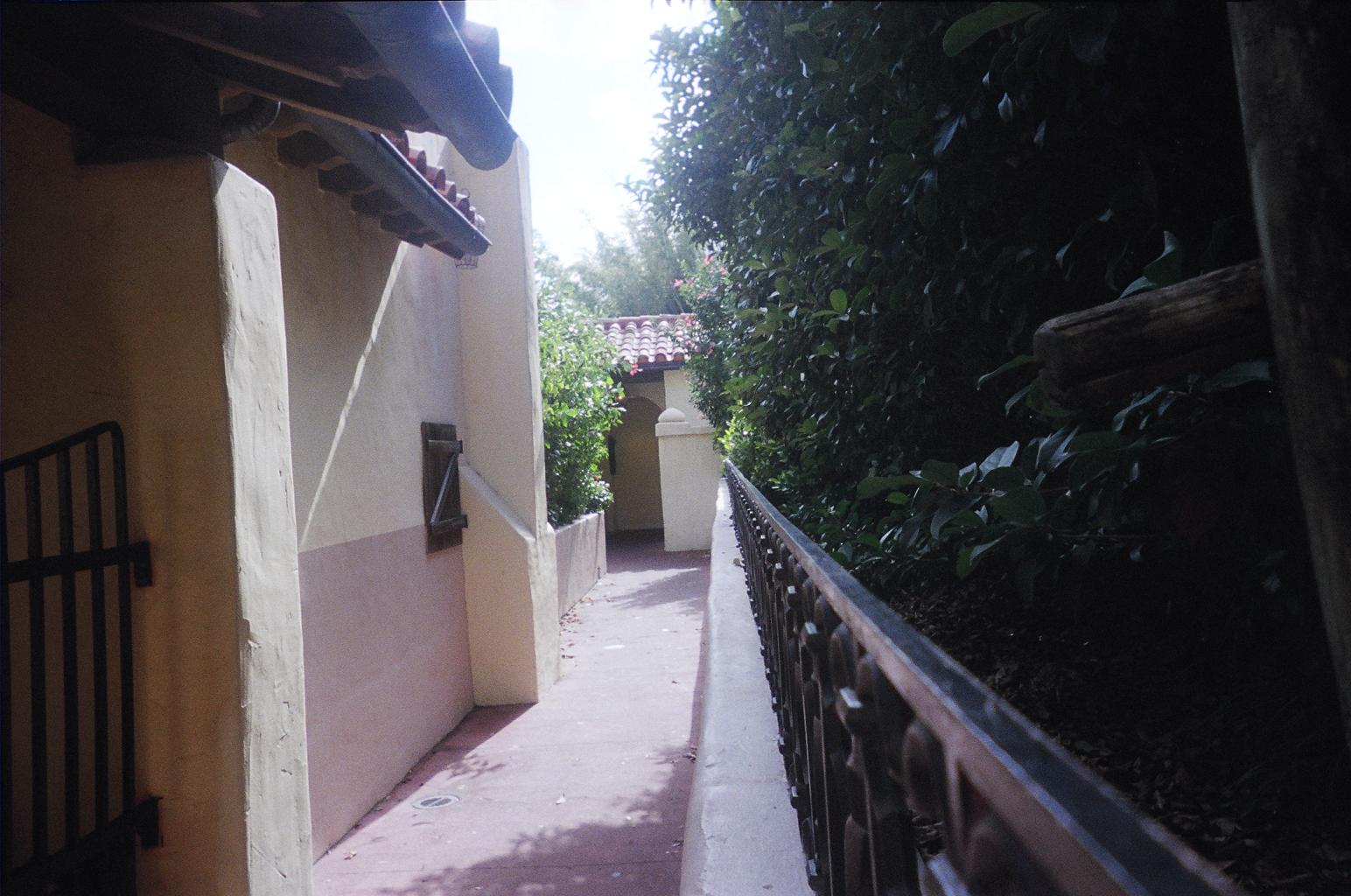
Little path behind Pirates….. most isolated place in the Magic Kingdom
My friend Michal at Harmony Barbershop is always ready to chop some hair…. it was better on Center Street, but this version suffices…
The Enchanted Grove (not to be confused with the Minute Maid stand of the same name) … One of my favorites to be sho. Related Posts...
Greetings, all. I hope everyone had a good holiday season and are having an adequate new year so far. Pickings have obviously been sparse around here recently, but we look forward to gearing back up fairly soon. Despite the fact that most of the news from Orlando is gloomy and uninteresting of late, I have a few story ideas kicking around that should revive things a bit. In the interim, however, I thought it important to direct as many eyes as possible to the Universe of Energy Companion Site, which will go dark later today unless it receives a small donation to renew its hosting. The webmaster only needs around $20 to keep it going, so that should be easily achieved, but everyone should be sure and examine the site itself which is, I believe, the single best online reference for any individual park attraction. “Gary7” and “NRG guy” have done a fantastic job in creating this resource, which is a rare mixture of content and appealing design, and it would be a shame to let it dissove into the aether. There’s a link to donate on the main page, and you can also help by ordering G7’s Disney photo CDs from his main site. Thanks, and see you soon. UPDATE: Thanks to some generous donations, the site has been saved. Be sure and drop by to learn a little about the Universe of Energy. Also note that G7’s photo cd is still for sale. Related Posts... |





 From the Progress City archives comes this collection of 33 tall tales and true from Disney history. Available in paperback, hardback, and ebook formats.  |
|
|
Copyright © 2007-2026 - Subscribe to Entries (RSS) and Comments (RSS). Read our Privacy Policy and Legal Page. This website is unaffiliated with The Walt Disney Company or its subsidiaries. Powered by WordPress & Atahualpa |
||




Recent Comments