Archives

Contribute to Our Research

Neverworlds – The World City Model

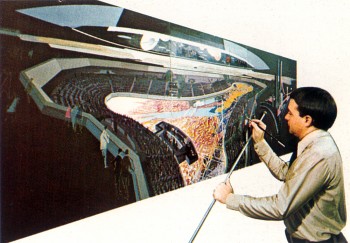
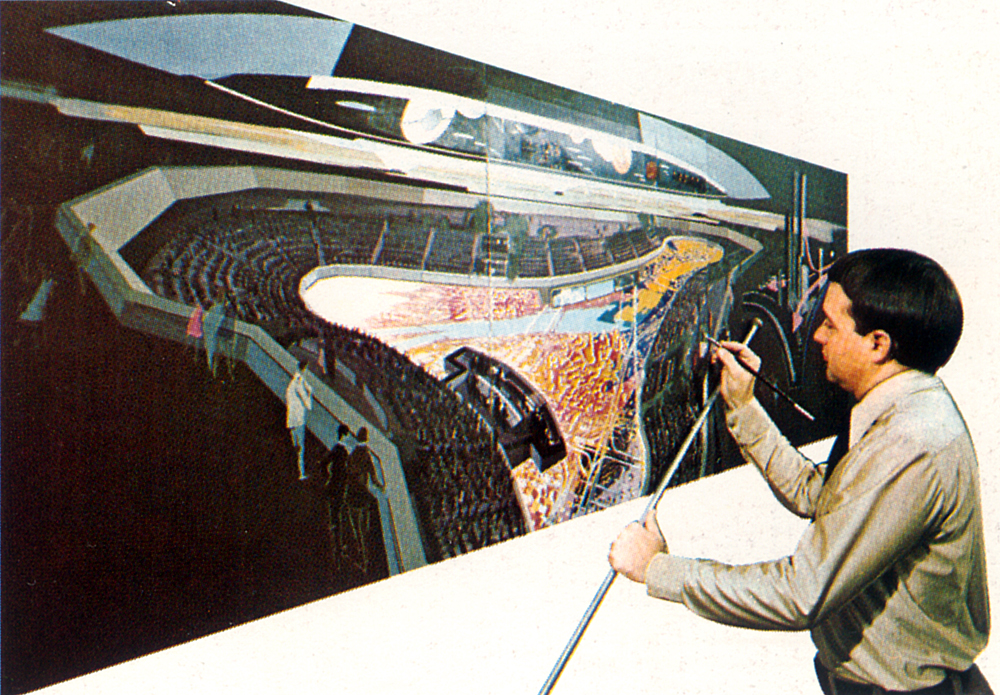
The World City Model, EPCOT 1975THE “WORLD CITY” MODEL: Project designer John DeCuir completes an initial concept for the World City model, an amphitheater depicting a future community in the process of grown and adaptation.
– Walt Disney Productions, 1975

In 1975, EPCOT Center was a far different creature than the park that debuted in 1982. Known then by the unwieldy moniker “EPCOT Future World Theme Center”, the park had yet to be mated with its counterpart, the World Showcase, which was still intended for a site across the Seven Seas Lagoon from the Magic Kingdom.

At the center of the parks layout, shown below, was the “World City” model. This would be part of the park’s Communications Corridor, or “Communicore”, which would act as the park’s Main Street area and extend from the park’s entrance through to where the Fountain of Nations is today.

EPCOT Future World Theme Center layout, 1975EPCOT as conceived in 1975 – The EPCOT Future World Theme Center. The World City model is at the center of the layout, with the Communicore extending from the the park’s entrance at the bottom of the image.

The World City model was described in the 1975 Walt Disney Productions annual report:

– The World City model, which would combine advanced entertainment techniques – miniaturization, video projection, animation and computer-driven simulations and displays – to trace the evolution of the major cities of the world, and to portray a model community of the future in the process of growth and adaptation.

The artist in the image at the top of the article is John DeCuir Jr., long-time Disney Imagineer. His father, John DeCuir Sr., also worked for Disney while also having a long career as a prominent Hollywood production designer and art director. His credits included Hello, Dolly! and Cleopatra, among many others, and relevant to our discussion he worked on the original Space pavilion intended for EPCOT Center.

The younger DeCuir has a long list of Disney design credits, including the Hall of Presidents, the Contemporary and Polynesian resorts, World Showcase, Spaceship Earth and later MuppetVision 3-D and Alien Encounter. He has continued to work on film and television projects to this day.

Related Posts...

Breaking News…

Disney to reorganize parks. Details in the L.A. Times.

More to come soon…

Related Posts...

  • No Related Posts

We’re Moving!

Houston airport WEDway station

For everyone with RSS subscriptions and links – Progress City is moving to a new URL at https://progresscityusa.com. Please adjust your links and subscriptions accordingly!

UPDATE: OK, it looks like things worked. WordPress is so wacky, and both the old and new directories are both feeding off of the same database, but it looks like everything is managing to redirect to the new URL. If anyone finds anything missing, or find themselves stuck somewhere with the old URL, let me know. Otherwise, welcome to the future of the future!

UPDATE x2: For serious this time. Now not only does the site redirect but you can see all the pretty pictures too, which is kinda useful now and again. It’s all fixed and it only required me to learn SQL on a Sunday night. I am so smart…. SMRT… I mean, SMART… Anyway I wouldn’t clue my dear readers into behind-the-scenes drama save for the fact that I request constant vigilance against bugs – let me know if anything weird happens.

Related Posts...

TouchDreamStoneWorks

Dreamworks and Touchstone logos

As you’ve no doubt seen by now, the reports were true and, last Monday, Walt Disney Pictures signed a deal with Steven Spielberg’s DreamWorks studio to distribute at least thirty films over the next five years. The first six films are slated to be released in 2010, and will be distributed through Disney’s Touchstone banner.

The Touchstone label had almost disappeared in recent years, due to new Disney CEO Bob Iger’s strategy of paring down the release schedule to focus on family-friendly and ultra-marketable franchise films for the Walt Disney Pictures brand. This reduction of new product left a great deal of unused capacity (and thus wasted overhead) in Disney’s distribution pipelines, which include not only theatrical release but pay-television (due to their long-term contract with Starz!) and home video. Six pictures a year from DreamWorks will help fill empty distribution slots and increase profits.

As part of the deal, Disney paid DreamWorks between $150-250 million (the amount varies among reports) to stabilize their finances and will receive a distribution fee of between 8-10% of each film’s gross.

Unfortunately, while DreamWorks is free to license its film properties to Disney for new park attractions, Spielberg’s existing contract with Universal prevents him from personally consulting on Disney theme parks. Spielberg’s deal with Universal, which dates back to the 1980s, earns him 2% of their parks’ annual earnings – reported to amount to as much at $50 million. While Nikki Finke recently reported that Universal raised Spielberg’s ire in recent negotiations when they expressed the desire to reduce that percentage, the deal stands for now and I doubt that Disney would care to make an equivalent offer.

It’s also important to underscore again that this deal does not include DreamWorks Animation, which is a separately traded company and which continues to distribute its films through Paramount.

DreamWorks already has a number of films in development; Jim Hill has reported that the first of their films under the Disney deal might be Spielberg’s long-anticipated Abraham Lincoln biopic starring Liam Neeson as the Great Emancipator. Hill claims that Imagineers are making plans to re-open Disneyland’s Great Moments with Mr. Lincoln in 2010 with a newly-recorded narration starring Neeson. Other media sources mention in-development DreamWorks projects like the Aaron Sorkin-scripted The Trial Of The Chicago 7, Steve Carell comedy Dinner With Schmucks, an action film based on the Secret Service called Motorcade, and an adaptation of the children’s fantasy book series The 39 Clues.

Read more:

New York Times
Variety
Hollywood Reporter
– Variety’s Peter Bart interviews Spielberg

Related Posts...

Ten Wishes for the New Year: #9

The story so far: For the start of the new year, I had hoped to do one of those “top ten” lists of things I’d like to see happen in the Disney parks – and especially Walt Disney World – in 2009. Not that I would deem any of my wishes likely to be fulfilled, but as a fan of lists and unsolicited criticism I can’t help myself.

Here’s the next item that I’d like to see at the Disney parks in 2009:

#9 – Rethink the Resorts

Pop Century ResortHmm… where to begin…

Originally the topic for this slot was going to be narrower in scope, but I’ve realized that I could address those issues (see below) while also tackling a more pressing subject that’s bothered me over the last decade or so.

The Disney resorts aren’t a topic that receives a lot of analysis here or elsewhere around the web. While the resorts are a frequent topic of discussion online, those conversations usually reside only in the realm of “which building is closest to the food court” or “how can I best profit from the collectible mug policy?” While it’s no doubt useful to dissect how to best encourage the housekeeping staff to fold your washcloths into wombats and so forth, it might be useful to occasionally step back and examine the resorts as a whole, and to think about why they’re there and how well they’re serving their purpose.

Polynesian Resort with MonorailFor historically-oriented Disney fans like me, the mention of Disney resorts tends to draw the mind’s focus to the Seven Seas Lagoon and the brace of resorts that were created for opening day in 1971. While the Polynesian and Contemporary Resorts have been joined by many other properties since that day, there’s something about those monorail-adjacent, lagoon-circling resorts that remain so appealing despite the later emergence of fancier and even more elaborately themed facilities.

Although these two original hotels represent only a fraction of the rooms on property today, we must look to them in order to contextualize all the other resorts that followed. After all, these were the only two resorts in whose creation Walt played a part; they are a rare remaining link to the original intent and purpose of the Walt Disney World development.

Walt Disney had wanted to build a hotel property at Disneyland upon its opening in 1955, but had funneled every available cent into the park itself and could raise no further funding. Instead, he convinced his friend Jack Wrather to build the Disneyland Hotel to serve the park’s visitors. Soon the park was hemmed in by outside development, and Wrather’s refusal to sell his hotel to Walt ensured that Disney was shut out of the resort business in Anaheim.

Groundbreaking of the Disneyland HotelJack Wrather, his wife Bonita Granville, and Anaheim mayor Charles Pearson break ground for the Disneyland Hotel on March 18, 1955. Photo found here.

This was to change in Orlando. It’s well known that Walt bought such an expansive parcel of land in Florida in order to shut out intrusions from commercial sprawl and outside developers. Walt Disney World was intended to be a complete resort – the “Vacation Kingdom of the World”. Part and parcel of this was the inclusion of themed resort hotels, a first for the company and indeed unique for the theme park industry of the time.

Walt Disney World Preview Edition

“The hotels have been called “theme resorts,” because everything from interior décor to employees’ costumes and dining room menus will be an expression of the same overall theme”
– 1969 WDP Annual Report

So new was the concept of the themed resort that a great deal of Walt Disney World’s pre-opening publicity focused on highlighting the hotels and their associated amenities. It’s almost bizarre to the modern eye to see that the Magic Kingdom was only promoted as one part of the complete resort experience – the hotels were integral to Disney’s strategy to become a travel destination.

Walt Disney World ad, 19721972 advertisement

The relevance of this trip down memory lane comes when you compare the resorts today to those first resorts in 1971. Not necessarily the resorts themselves, but their comparative positions in the travel industry.

By bringing their experience in design and customer service gained from years of theme park operations, Disney hoped to revolutionize the hotel experience. Ironically, though, they seemed unsure at first about how to deal with the hotels. New to the field of hotel management, the company planned to slowly dip their toe into the field by having Westin and Marriott operate the Contemporary and Polynesian resorts until Disney personnel felt that they had learned enough to take over. This plan was abandoned when Disney decided that only they could manage the hotels up to their standards.

Financial necessity then led to the creation of a peculiar arrangement with U.S. Steel, who had been responsible for the construction of the hotels. U.S. Steel set up a new division which would actually own the hotels; the properties would then be leased back to Disney for them to manage themselves. This deal didn’t last long, and by December of 1971, Disney had purchased U.S. Steel’s ownership of the hotel properties and was at last owner and operator of its own resorts.

Contemporary Resort under constructionThe Contemporary Resort under construction (AP photo)

Disney’s resorts were unique at the time. Obviously, high-end hotels already existed around the world, but Disney’s resorts featured levels of theming, customer service, and amenities that were rare if not unheard of among family vacation destinations.

The problem is, the world eventually caught up with the World. As Walt Disney World approaches its 40th anniversary, the tourism landscape is completely different from that of 1971. Disney might have invented the wheel, so to speak, but other corporations have spent the last four decades trying their best to copy it for their own use.

Highly themed environments aren’t rare anymore; you can find them at numerous vacation destinations or run-of-the-mill franchised restaurants. Disney still does it the best, but one look at Las Vegas, the Universal resorts, or even the Gaylord-owned Opryland hotels shows that the competition is catching up fast.

Portofino Bay HotelUniversal Orlando’s Portofino Bay Hotel

Where Disney has really fallen behind is that indefinable level of service that once set them apart. Over the years, as Disney added more and more rooms to property at different price levels, amenities began to slowly be stripped away. Disney guests used to wake up to a newspaper on their doorstep; this was later reserved for only the “deluxe” resorts. Also reserved for the lodging elite was the formerly-ballyhooed benefit of in-room package delivery. With the slow paring away of amenities, and the constant construction of new nearby off-property hotels with free park transportation, it’s slowly emerged that the only difference between Disney and their competitors is that the Disney resorts are far more expensive.

What’s more unsettling are the areas in which the rest of the industry has not only caught up with Disney but surpassed them. These days, pretty much any run-of-the-mill chain motel has free wi-fi, or at least internet service. Not only does internet access at Disney require calling room service for an Ethernet cable, but using the service costs the guest ten dollars per room, per day. This blatant price gouge puts Disney not only behind its high-end competition, but also far behind even its most lowly lodging competitors. It might seem like small potatoes, but considered in the light of the resort’s once-unparalleled level of service it looks shabby at best.

Looking at the so-called “moderate” and “value” resorts show how far Disney has fallen behind from a price-to-value perspective. The “value” resorts consist of the most bare-bones type of motel room, but are priced at a premium compared to their off-property competition. This is especially glaring when you consider the rise of the “family suite” concept in outside resorts, which allows a large group of people to stay in a well-appointed suite for a very reasonable price. When faced with the decision to book a family in a couple of small, spartan rooms at Pop Century or a larger, nicer, and much cheaper suite elsewhere, you start to wonder what the “Disney difference” really is. To be fair, Disney has toyed with the idea of family suites by converting some rooms at the All-Star Music hotel, but it remains to be see whether they’ll continue to expand on this concept.

All-Star Music Resort family suiteDisney publicity photo of a family suite at the All-Star Music Resort

This, at last, brings me to the All-Stars. The original title for this post was simply, “Re-theme the Value Resorts”. This was admittedly a narrow topic, fueled by my general antipathy towards the “value” resorts – the three “All-Star” hotels and the Pop Century resort. While there’s a difference of opinion in the fan communities about this – the resorts actually do have a number of devoted fans – to me they’re little more than a Motel 6 with an ambitious fiberglass budget.

While there’s an argument to be had for “fun” design and monolithic pop art (whether ginormous Coke cups and cell phones count is debatable), I believe the design of these resorts really, really miss the mark of acceptability for a Disney property. The embarrassing plywood catch phrases slapped on the side of Pop Century (“Mommy, are we staying in the “DUH” longhouse or the “DON’T HAVE A COW” lodge?”) send a shiver up my spine, as do the extremely cheap-looking cutouts of dancing silhouettes. The All-Star Movies resort actually has an entire building themed to – think of this! – The Mighty Ducks. It’s like a bad fever dream after reading one of Michael Eisner’s mid-1990s annual report letters.

All-Star Movies Resort Mighty Ducks buildingRelive cherished childhood dreams of… uh… hmm (Photo from AllEars.Net)

Now some might say that these low-end hotels just need to keep the kiddies happy and give guests a place to crash for the night. But while it might be easy to just forget about these ghastly, poorly-located hotels and leave them as a convenient oubliette for noisome Pop Warner teams or cheerleading squads, if I were running the show I’d pick up my crowbar and get to work.

Ground zero for this re-theming should be the Pop Century resort. Ironically, after I had decided to write about this issue, Jim Hill reported that Disney already plans to complete the unfinished “Legendary Years” section of the resort as family suites and to change the theme of the entire resort to “Disney’s Animation Inn & Suites”. Hill’s articles report that I’m not alone in my distain for the resort as it is – occupancy at the hotel has lagged behind that of the other value resorts. The animation theme, if done well, could be suitable for the already character-heavy resort, and hopefully if Disney goes ahead with the project they’ll execute it with a little more taste and detail than the current design.

Pop Century Resort 50s poolFail.

If they don’t follow this path, the resort is still in desperate need of a facelift. If management insists on sticking to the decade-specific concept, why not actually theme the buildings appropriately? Why not have a 1950s building with the same level of detail and atmosphere as the 50’s Prime Time Café at the Hollywood Studios park? An 1980s building designed like the cubic, mirrored-glass corporate skyscrapers of the era? Or ditch the 20th century theme and use the resort’s proximity to EPCOT as an excuse to theme the different buildings to the various nations of World Showcase. Just sell the giant cans of Play-Doh on eBay and get to work.

And what, then, of the All-Stars? If the Animation Inn becomes reality it could pointlessly duplicate the animated characters of the All-Star Movies resort. And does anyone ever call CRO and ask for a room in the Mighty Ducks building? Re-theme the buildings to various genres of film, not specific films themselves. Westerns, science-fiction, action-adventure… there are lots of possibilities for interesting resort designs. Of course one might argue that Disney resorts as a whole were originally intended to use tools and tricks gleaned from experience in production design to put people “inside” movies of their own, but if we’re going to have a hotel themed to “movies” why not make it count?

As for the Sports and Music hotels, just expand the concept. The All-Star Sports should actually feature some of the sporty facilities and amenities that were so highly promoted when Walt Disney World first opened. Maybe they could theme the buildings themselves to famous ballparks or stadia. The Music resort, if they choose to keep that theme, could be more visually themed to various musical genres. This should not just include generic iconography but specific themes. The Jazz area could be Depression-era Chicago, while the Classical building could be a Parisian concert hall. The Country hotel could draw from Nashville styles and the Rock & Roll building could be 1950s Los Angeles or 1960s London.

All-Star Music ResortNo.

The key is to do something more interesting than just corny cut-outs of musical notes and clip art stars. The buildings as they are now look like very basic, boxy motels with some cheap decorations slapped on – even if they retained their silly current themes, much more could be done to make them worthy of their heritage.

So that’s my proposal for the resorts – basically, take a look around at what the competition is doing and try to get Disney back as far ahead of other resorts as they used to be. Don’t skimp on the extra services or amenities, and don’t overlook the value resorts just because they’re at the bottom of the food chain. And for heavens sake, remodel those value resorts. I’m sure the Mighty Ducks fans will understand.

Jonny Duck

UPDATE: A thoughtful response to this article has been posted at Web Watch, and although I don’t seem to be able to reply there, I did want to provide a link and a reply here. The response makes a good point about my complaints about Disney’s in-room internet service, and underscores to me the dangers of basing a statement not on research but my own anecdotal evidence.

A more in-depth look at the level of internet service in off-property hotels shows an initially counter-intuitive fact: mid-range hotels, aimed at the business traveler, are more likely to have free internet access while high-price hotels in resort areas are more likely to charge for service. Then again, maybe it’s not so counter-intuitive after all. In any case, it still seems odd to me that the inexpensive Fairfield Inn down the street from your house will have free wi-fi while very pricey destination resorts don’t. This is the disconnect that led to my complaint – surfing the net for free at a cheap hotel in an out-of-the-way town has made me wonder, why the $10 a day at Disney?

In any case, it appears that my claims of extreme price gouging at Disney aren’t quite fair when considering the local resort competition. However, if you consider my original thesis – that Disney needs to return to that level of supreme and inclusive service that they aspired to in 1971 – then this shouldn’t be an issue. Even if the fancy off-property hotels are charging $10-$20 a day for internet access, it should be part of the package at the Vacation Kingdom of the World.

Related Posts...