Those of you who are new to Progress City – and there are many! – can catch up with previous entries in this series here.
#3 – Overhaul Resort Transportation
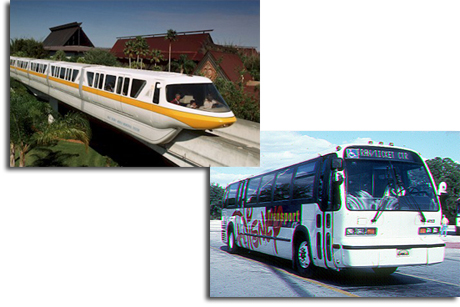 Guess which one transfixed me as a child with its awesomeness? Go ahead, guess.
Criticism – even loving, constructive criticism like the kind your friends craft here at Progress City – can be a difficult thing to pull off. One always wants to cover their flank, and hope that there’s no gaping hole in your logic to render your argument easily dismissible. The hardest counter-argument to overcome, and one that comes up most frequently in (loving, constructive) criticism of Disney is the “if it ain’t broke” school of thought. If attendance at the Magic Kingdom is sky-high, why fork out the millions for a new E-ticket? If the kids are lining up for the zoom-zoom at Test Track, why try to aim any higher conceptually?
Thus the critic can relax a bit when the subject matter presents a nice, slow, sloppy pitch right across the center of the plate. When “if it ain’t broke, don’t fix it” doesn’t apply. For Walt Disney World, one of those areas is resort transportation. Long neglected by management, it most definitely is broken. The only solution, if I may venture a suggestion, is to fix it!
Transportation has always been a key element of Disney’s themed attractions; in fact, the entire idea of a Disney-designed park sprang from Walt wanting a place to showcase his scale-model trains. Walt’s locomotive collaborations with animators Ward Kimball and Ollie Johnston led at first to his backyard layout, the Carolwood Pacific, but soon Walt wanted to share his trains with the public. From Walt’s first idea for a “Mickey Mouse Park” in Burbank to the opening of Disneyland in 1955, the only constant in Walt’s vision was the presence of a train.
Each of the Magic Kingdoms built since has had a train route, but Walt didn’t stop there. He debuted the first daily-service monorail route in the Western Hemisphere in 1959 with Disneyland’s ALWEG monorail, and introduced a new concept for intra-city transport in 1967 with the creation of the WEDway Peoplemover. All this was a mere prelude to Walt’s plans for Florida, which would use all the technology that WED Enterprises had pioneered in Disneyland’s themed attractions to build a city of the future.
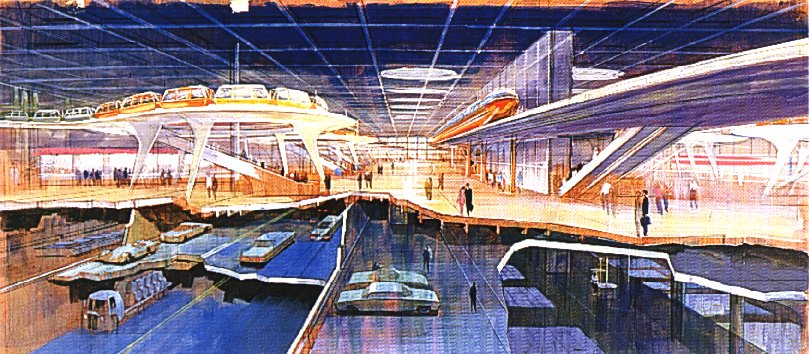 The city of EPCOT’s underground transportation hub
EPCOT – the city – was designed specifically to embrace new concepts in inter and intra-city transportation. Of all the possible changes in the social or technological forces that shape new cities, Walt elected to put a special emphasis on the innovative transportation infrastructure that would determine the layout and structure of EPCOT. EPCOT would be defined by its transportation systems, all designed to mitigate the unfortunate effects that a postwar boom in car ownership had inflicted on the highways and city streets of America. Seeing the blight that traffic had brought to the Southern California freeways, Walt had pushed for a Los Angeles to build its own monorail system. Sadly, the plan was rebuffed by city officials. The Florida project was instigated to give Walt the creative freedom that he could never have in California; no longer handcuffed by short-sighted bureaucrats thanks to the creation of the Reedy Creek Improvement District, Walt could do as he pleased. He could test these new systems in a real-world setting and thus prove their utility to outside skeptics.
The dreams of EPCOT city essentially died along with Walt in 1966, but many of the underlying tenets and philosophies of its design were retained during the creation of Walt Disney World’s Phase One. Key to this was the reliance on mass-transportation and the elimination of auto traffic for transportation within the resort itself. Hubs of activity within the resort would be connected by transportation that would be as entertaining as it was efficient; “getting there” would, for once, actually prove to be half the fun. Most importantly, though, was the idea that guests would no longer have to use their cars after they arrived at the resort. In fact, management originally asked that none of the resort hotels be designed with parking lots; all guests would leave their cars at a central transportation area and reach their hotels via internal transportation. This plan was scuttled due to the obvious objections by hotel managers, but it was clear that cars still weren’t part of the plan for Walt Disney World.
 An attraction in its own right – the Osceola-class steamships. PS: BRING BACK THE OSCEOLA-CLASS STEAMSHIPS!
In its early years, Walt Disney World was promoted as much more than a collection of theme parks. It was presented as a fully-integrated resort experience, and key to that image was its internal transportation. Much of the space in those original guidebooks or promotional materials was devoted to the fleet of monorails, watercraft, ferries or trains that kept guests moving within the resort. Again, the transportation was presented as not a utility but an attraction unto itself. And who can argue with that? Sleek monorails gliding through the Contemporary’s lobby, sunset launches on the Seven Seas Lagoon, or Fort Wilderness’s steam trains – these were amenities few other vacation destinations could match.
All this came to an end with Michael Eisner’s arrival at Disney. The Walt Disney World resort began an unprecedented period of expansion and growth under Eisner’s leadership, but the transportation infrastructure did not grow accordingly. Buses became the default transportation option for the new resort hotels that were springing up nearly every year, and the monorail line was not extended to the new theme and water parks. A bus depot was added to the Magic Kingdom, bypassing the TTC altogether and removing the element of theatrical reveal provided by the trip across the Seven Seas Lagoon. This was necessitated by the thousands of guests pouring in from the new hotels, with buses as their only means of transportation within the resort.
That is where the situation still stands today. Dozens upon dozens of buses queue up outside the parks, belching diesel exhaust into the air and crowding the roads of the resort. They’re loud and overcrowded; no matter how many times Disney redesigns the buses to allow for more guests to be crammed in each individual vehicle, guests at peak ridership times wind up packed in like sardines. There’s nothing like walking all day in the parks, then standing during a long ride back to your resort while stuffed in with dozens of other sweaty guests while several babies scream all around you. That’s Disney magic ™ at work.
What’s ultimately the most frustrating is not the current situation in and of itself, but that it could have been avoided had any of the many alternative plans developed over the past several decades been enacted. Disney knows that there’s a problem, and has actually created elaborate plans to mitigate the situation, but whenever it comes down to a decision they opt to buy more buses instead. Many times these plans have been stymied by a lack of vision or sheer avarice, while others have been made impractical at key moments by world events.
 The current Downtown Disney area, with the once planned monorail route (blue) and WEDway route (green)
While Walt Disney World was a meticulously planned resort upon its opening in 1971, many of the developments built subsequently were not as well linked into the transportation system. This was not for a lack of planning, however. Materials discussing the development of the Lake Buena Vista Marketplace and Villas during the 1970s always focused on the automobile-free nature of their design. Internal paths through the Villa communities were intended for bicycles, pedestrians, electric carts and even horses – but not cars. By the late 1970s there was a plan to connect the Village to the monorail line, and to provide a convenient WEDway loop through the area that would eventually become Downtown Disney and the Hotel Plaza.
During Eisner’s reign, plans were drawn up but not executed to connect the Disney-MGM Studios to a monorail spur from EPCOT. This line would also connect the EPCOT resort area to the monorail line, an amenity befitting their supposed status as “deluxe” resorts. Even as late as the year 2000, our very own Beacon Joe sat in on a cast member presentation by the then-Senior Vice President of Operations, Lee Cockerell, in which Cockerell outlined a sweeping new program to upgrade the resort’s transportation infrastructure. The plan incorporated light rail and possibly more monorails, and would have had the goal of phasing out bus use across the resort. Following the tourism downturn of 2001, however, these plans were abandoned and Disney began once more to buy more buses.
 The proposed monorail route from EPCOT to the Disney-MGM Studios, passing by the Yacht & Beach and Swan & Dolphin resorts (Martin Smith)
One could argue against the bus-centric plan on the old-fashioned grounds of “guest experience” or “immersive theming.” But the fact of the matter is that the system has become so overloaded, unwieldy and downright unpleasant that it demands a solution. Disney could once make an argument for their steep room rates on the grounds of convenience; you would be right on property, after all, and could easily access the parks and resort via Disney’s free transportation. But in recent years it’s become such a headache to use Disney transportation that guests would often reach their destinations more quickly if they stayed off property and drove in themselves. Their off-property room would be a fraction of the price of Disney’s lodging, and one wouldn’t have to deal with the hassle of those packed-in bus rides.
To give Disney some credit, a few improvements have been made in the last couple of years or so. The introduction of GPS technology and centralized tracking software has made the system somewhat more efficient. Five or six years ago, I thought that if I had one more bus driver take me on a ridiculously circuitous route across property to reach a nearby destination, I’d never stay in a Disney hotel again. Another improvement, although purely cosmetic, is the addition of the site-specific soundtracks on the buses. I actually find that incredibly cool, and hope that whoever thought that one up got a bonus.
Despite these improvements, though, the fact remains that the system is broken. Waits are often far too long, and buses are often far too crowded. Again, the transportation system used to be a selling point for Walt Disney World. Now it’s something you have to overlook and deal with if you want to experience the “magic.”
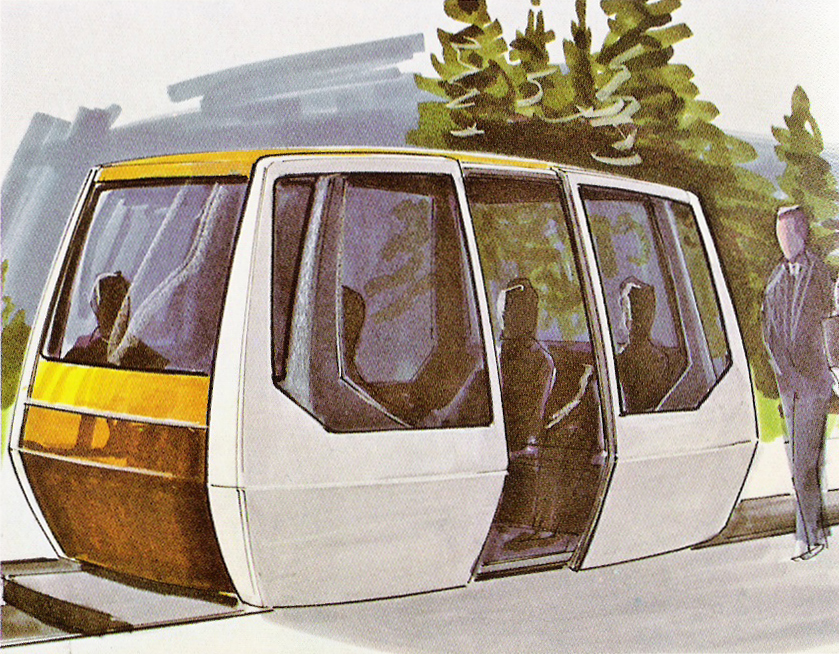 Wouldn’t you rather take the WEDway?
Let me make up a scenario off the top of my head. Let’s say that a guest is staying at Coronado Springs, and they want to go to EPCOT in the morning, do some shopping at the Village for lunch, go back to their hotel to change and wind up at the California Grill for dinner. First, they take a bus to EPCOT – that’s easy, unless there’s a long wait or the bus is crammed in with strollers and ECVs. EPCOT to the Village is a difficult one, since Disney doesn’t run buses from the parks to the Village to stick it to those tiny fraction of guests who would park at the Village to avoid parking fees. So instead guests are either forced to walk through EPCOT to the International Gateway, to take a Downtown Disney bus from Boardwalk or the Yacht Club, or to take a monorail to the TTC and catch a bus there. This trip, being wildly optimistic, would take at least an hour. Downtown Disney to Coronado Springs requires a single bus trip, although you might have to stop at Marketplace, Pleasure Island and Typhoon Lagoon along the way. That eats up quite a bit of your time as well. To get to the California Grill from your hotel, you’d either have to catch a bus to the Magic Kingdom and walk to the Contemporary, or take a bus to the Village and then take another bus to the Contemporary. This route would include all of the internal stops in Coronado Springs, and the Contemporary bus may stop at the TTC or other resorts – I’m not sure on that one. Heaven help you if you want to do something afterwards; a minigolf whim would require a trip from the Contemporary to a theme park or the Village, then a bus to the Swan hotel, then a walk to Fantasia Gardens. When all is said and done, you have to hope that transportation is still operating to get you back to a theme park or the Village to take you to the connecting bus back to Coronado Springs. Don’ t you wish you had your car?
Basically, unless you’re just going from your hotel to a theme park and back, internal transportation is a headache. Fixing the system would require a massive investment, tackling many separate goals simultaneously. It would require an entirely different plan for the resort’s infrastructure, and it’s needed immediately. They won’t do it, but they should.

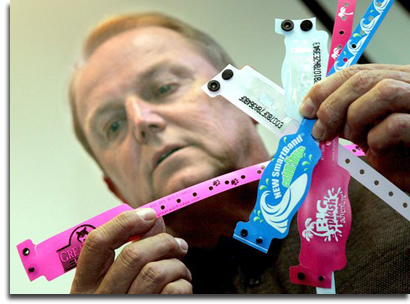 Robin Barber, Vice President of RFID wristband manufacturer Precision Dynamics, displays wristbands that the company has produced for various theme parks (Los Angeles Times)
 STOP THE MADNESS!!





Recent Comments