Contribute to Our Research |
By Michael - June 8th, 2014 As we prepare for tonight’s finale of Cosmos (sadness!), what better way to prepare than with another look back at the cutting edge of science education… thirty years ago.
Close-Up On The Planets was a 1982 release by the Walt Disney Educational Media Co., directed by Charles Finance. It was produced during a very exciting era for space-related science; the Space Shuttle was making its first flights, and the two Voyager probes were returning a constant stream of new revelations from the outer solar system. Incidentally, it was also the same year that Epcot Center opened here on Earth, so you might say it was a perfect nexus of time, space, and events to forge a generation of geeks like myself.
What’s interesting about this film is what has changed in the years since and what hasn’t. Much of what is stated about Venus and Mars reflects current knowledge, as well as mysteries that still linger. In the 32 years since this film we’ve only sent two probes to Venus, neither of them landers, and much remains unknown about the planet. On the other hand, we’ve sent an armada of craft to Mars in the last decade, both orbiters and rovers, but answers about whether there was ever life on the red planet remain elusive.
We’ve learned the most, however, about the outer planets. In the years after this film was made, Voyager 2 made flybys of Uranus and Neptune, creating vivid portraits of those systems that went far beyond the tiny, featureless blobs shown here. Jupiter and Saturn have both been intensely studied by their own dedicated orbiters, and even distant Pluto will receive its first ambassador from Earth next year when New Horizons sails past on its way out of the solar system.
What we’ve learned in later years makes the information presented in the film seem charmingly quaint in retrospect. Instead of 15 moons, 67 have since been discovered orbiting Jupiter. Saturn has 62 confirmed satellites – 53 of them named – instead of 23. And Uranus and Neptune, as predicted in this film, were discovered to have large satellite systems of their own, with 27 and 14 known moons respectively. Neptune also harbors faint rings, a fact unconfirmed before Voyager 2’s 1989 visit. Jupiter’s moon Io is no longer the only world aside from Earth known to be geologically active; such activity has since been confirmed on Venus and with the ice volcanoes of Saturn’s moon Enceladus and Neptune’s moon Triton.
Incidentally, Eugene Shoemaker, featured in the film, became a bit of a celebrity in the 1990s for his co-discovery of Comet Shoemaker-Levy 9, which collided with Jupiter in 1994. Richard Terrile, the Voyager imaging scientist, continues his work at the Jet Propulsion Laboratory today. And special acknowledgement must go to the computing equipment used by Harold Masursky, who had a sweet videodisc player hooked up to his Apple II. I would have been insanely jealous of that back in the day; it’s like having your own personal WorldKey for the solar system! Although I’m not sure why they showed him playing a video of him narrating a video, instead of just him narrating the video, but oh well – if you’ve got the videodisc player, you use the videodisc player!
And speaking of technology, how about those killer 1982-era animations of the planets? Those JPL computer-generated flybys were a constant presence when I was a kid, and if you recall they were shown during the descent portions of the original Spaceship Earth. I tell you, it all tied together…
So now sit back and prepare yourselves… for a CLOSE-UP ON THE PLANETS.
Related Posts...
By Michael - June 6th, 2014 Like every other website, I am now required to meet a daily quota of posts about Star Wars.
Back in 1987, vacationers looking for a bit of “intergalactic pleasure travel” were able to embark for the first time on Star Tours at Disneyland. But while the attraction’s grand opening was held on January 9th, the evening before the park opened for a special preview event from 7 P.M. until midnight.
The “Interplanetary Launch Premiere Party” was a hard-ticketed event for Disney fans to get an early peek at the new E-ticket attraction. And, of course, it kicked off with a bit of pageantry.
There’s Jack Wagner doing his weird Obi-Wanish Serious Star Wars Voice™! There’s Jack Wagner as Disneyland space traffic control! There’s the exciting sounds of someone’s Casio! There’s banter! There’s… “beaming”?
Related Posts...
By Michael - June 5th, 2014 Heard any Star Wars news lately? Nah, me either.
Considering the recent explosion of all things Star Wars since Disney’s purchase of Lucasfilm, it’s interesting to look back at the beginnings of the company’s involvement with the Lucas empire. Overtures between the two parties went back as far as the Ron Miller era, when Imagineer Tony Baxter and others began to conceive ideas based on the Lucas films, but things finally came to a boil after Michael Eisner arrived in Burbank.
Star Tours was one of the very first attractions, alongside Splash Mountain, to be selected for construction by Eisner (or rather, his son) on his early visits to Imagineering. Having no previous theme park experience, Eisner was shocked to discover that it would take a few years to actually complete the attraction after his greenlight; the impulse to get something Lucas-related in the park as soon as possible led to the creation of Captain EO.
On January 9, 1987, Star Tours had its ribbon-cutting ceremony in Disneyland’s Tomorrowland. There was action. There was adventure. There was interpretive dance. Yes, just in case you forget it was the 1980s, the opening ceremony features a somewhat unexpected Star Wars ballet. Then Eisner and Lucas come out to do the ribbon cutting itself, featuring perhaps the world’s only cord-powered lightsaber in existence. I guess this was when they didn’t have cordless lightsabers, or car phones.
There are dignitaries in the audience, too, and they’re a cut above the typical grand opening celebrity list. Mercury astronauts Gordo Cooper and Deke Slayton are in attendance, as is Betty Grissom – wife of Gus Grissom, who died in the Apollo 1 fire. Cooper, Slayton, and Mrs. Grissom had all been in attendance nearly a decade earlier for the Disneyland debut of Space Mountain. Cooper had also previously been on the Disney payroll, as a vice president of research during the early days of planning Epcot Center’s Future World.
Also present were aviators Dick Rutan and Jeana Yeager, as well as aircraft designer Burt Rutan. The trio were then in the public eye for their achievements with Voyager, the first aircraft to circumnavigate the globe without refueling (Burt Rutan continues to make news today, as the designer of SpaceShipOne and its successors).
Incidentally, you’ll note Eisner looking down as he introduces the guests. That’s because he has a cheat sheet painted onto the stage at his feet. You can read more about that, with pictures, here.
So forget about J.J.’s antics out in the desert, slip on those ballet shoes, and let’s go back to 1987 for some Star Tours pomp and circumstance. Be sure to stick around to the end to catch Jack Wagner’s kinda-sorta impersonation of Alec Guinness.
Related Posts...
By Michael - June 4th, 2014 Here’s something I’ve wanted to share for quite some time now – it’s a video that made the rounds on the Disney fan circuit years ago, and is still some of the best documentation out there of Tokyo DisneySea. This spectacular park – Tokyo Disney Resort’s “second gate” – opened in 2001, and is world-renowned as perhaps the most detailed and elaborate theme park ever made. In this video, you’ll get a sense as to why theme park fans revere its name.
The park overall has a nautical theme, with areas evoking ports of call from around the world as well as from the pages of fiction and fantasy. You can visit Renaissance-era Italy, or Captain Nemo’s mysterious volcanic hideaway. There’s turn-of-the-century New York City, the lost ruins of South America, and the exotic bazaars of Arabia. There’s even an undersea playground for aspiring mermaids. At the park’s entrance is the Hotel Miracosta, Disney’s most ornate and luxurious hotel.
One look at the video and you’ll understand why stateside fans clamor for a trip to Tokyo. It’s a shame so little documentation of the park is available here in America – the park’s many DVD and CD releases are only available for exorbitant prices on the secondary market, and there are no books or magazines available in English. An “art of” book for the park would surely do well sales-wise among fans worldwide.
This video was made in the park’s early years, so later additions like the park’s magnificent version of the Tower of Terror are missing. Of note is ride Sindbad’s Seven Voyages, which would go on to be completely reimagined in 2007 as Sindbad’s Storybook Voyage. The attraction’s overhaul saw it transformed into a more whimsical musical adventure, made much more “cute” to appeal to local sensibilities.
Hopefully the park will see some equally impressive expansions in the future, but for now sit back and enjoy the unparalleled beauty of Tokyo DisneySea.
Related Posts...
By Michael - April 22nd, 2014 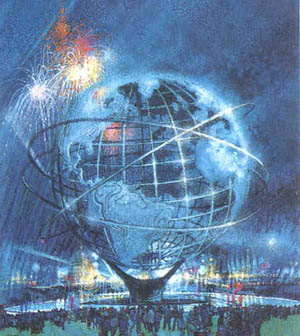
Fifty years ago, in Flushing Meadows, Queens, the 1964/65 New York World’s Fair opened its doors. This grand exposition featured exhibits from around the world in massive mid-century structures; it also included four marquee attractions developed by the Imagineers at WED Enterprises – General Electric’s Progressland, Ford’s Magic Skyway, Great Moments with Mr. Lincoln, and it’s a small world. This, perhaps, has proved to be the Fair’s greatest legacy. Five decades later – hard to believe, but true – those four attractions have paved the way for the modern Disney theme park experience. They each pioneered technologies that came to define what we think of as a “Disney” attraction; before the Fair, Disneyland was a very different park than the one it would be afterwards.
The Fair itself seems to have been the last great American expo to have a major cultural impact. There have been fairs since, true, but none have left the kind of lasting iconography of the 1964 Fair. I was born more than a decade after the Fair ended, but even in my childhood so many of the elements of the Fair – the Unisphere, the Disney shows, key elements of the architecture, and even the general attitude of bygone futurism – remained in the cultural currency. Perhaps it is the idealistic futurism that people still find appealing about the Fair; certainly, the event remains popular today with generations born long after most of the exhibits were bulldozed. The 1964 Fair occurred just as the mid-century shine started to wear off of America; while President Kennedy had already been lost, the country had yet to have its innocence ended with Vietnam, more assassinations, Nixon, the dominance of corporate greed, and everything that has followed. It was a time when even major corporations were still portrayed as innovative, benevolent forces, guaranteeing a “Great Big Beautiful Tomorrow”.
We’ll be talking about each of these four masterpieces in the days and weeks to come, but I wanted to start with a reminder of this musical treasure which is a must-buy for any fan of the Fair, the Disney attractions it inspired, or just of Walt and the Sherman Brothers. It’s been out for several years now, but I’d advise picking one up before they become difficult to find. It’s a great set of music.
I also wanted to link to this old article of mine, which is my favorite story about the Fair and a fun look at all the logistics that had to go in to operating four major shows on the other side of the continent from Disneyland.
Related Posts...
|
The Progress City Primer
 From the Progress City archives comes this collection of 33 tall tales and true from Disney history. Available in paperback, hardback, and ebook formats. |






Recent Comments