Archives

Contribute to Our Research

Your Very Own WorldKey

For many a young techie in the early 1980s, one of the many highlights of visiting EPCOT Center was getting to use the WorldKey Information System. Developed by the Bell Labs in concert with Disney, the WorldKey was an interactive guidebook to the park, which guests could access from kiosks in both Future World and World Showcase. Video content highlighting the various pavilions was streamed over fiber optic cable from centrally located videodisc players, and guests could also connect via a live closed-circuit video system to Guest Relations hosts in order to make dining reservations or ask other questions. The simple, touch-screen interface seemed sleek and futuristic, and was the first time that most EPCOT guests had probably experienced the now-commonplace technology.

Sadly, like many great EPCOT innovations the WorldKey is long-gone. Since its content was not generated dynamically, but instead had to be created by hand and recorded to videodisc, it was not easily updated or reprogrammed. It’s content grew more and more stale, with the patchy latter-day additions painfully obvious, until it was removed. Planned upgrades, like the promised inclusion of French and German language options, were never realized.

Bell Labs, which had become AT&T soon after the park’s opening, didn’t give up on the idea so easily. Witness this ad, from February of 1986, for AT&T’s Ariel system – the commercially available version of the WorldKey technology. It offered a “centralized source of information in a variety of public locations,” and promised applications as diverse as “a tenant directory in office buildings, an entertainment guide in hotels, a product and service guide at retail locations, and a point-of-information terminal in financial service institutions.”
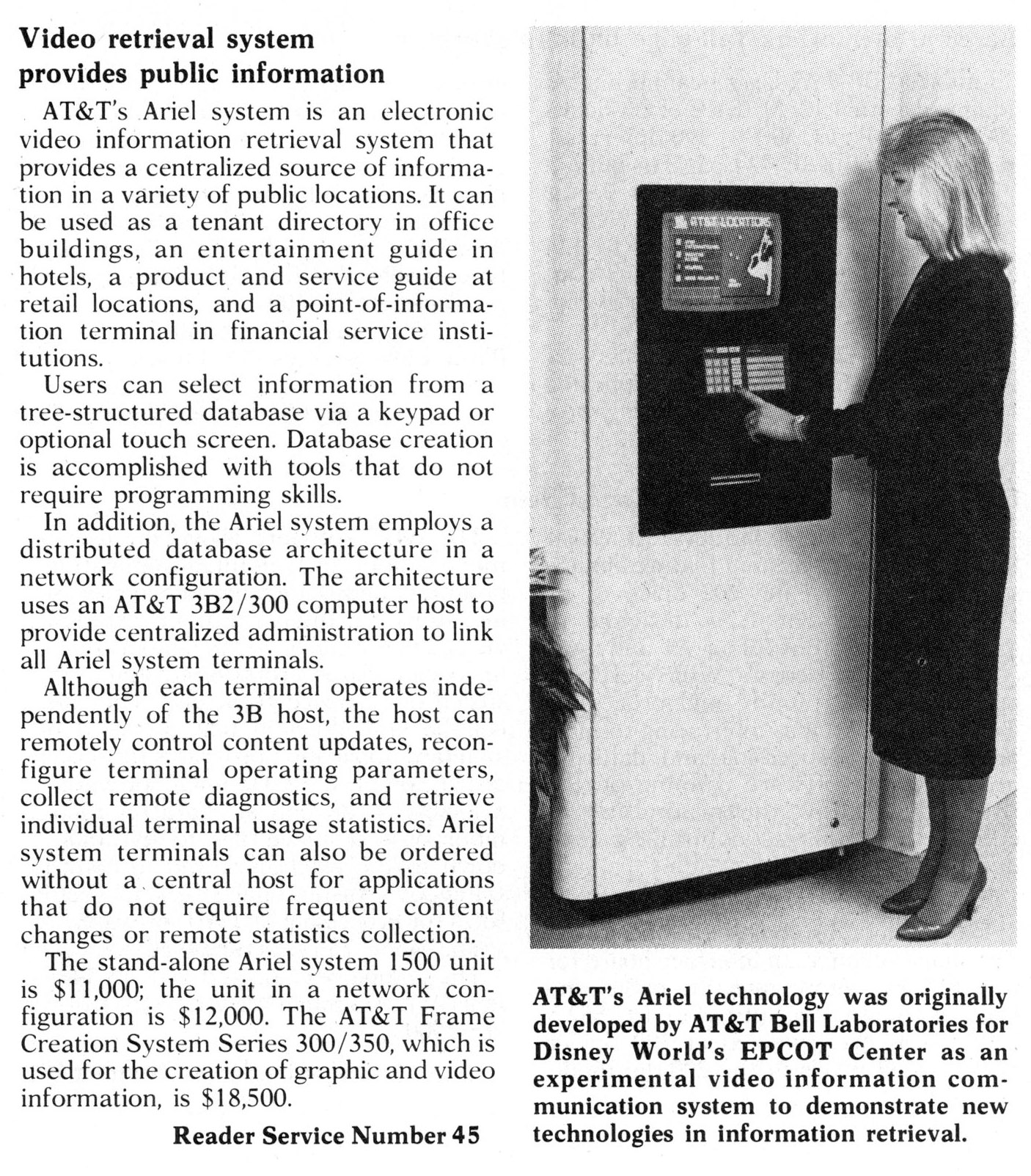
Ad for AT&T Ariel system, 1986All for the low, low price of $11,000!

What I love about this is that it truly is a rare example of executing the intended purpose of EPCOT – testing and prototyping new systems and technologies that would then be introduced to the free market. The Ariel system, released four years after WorldKey debuted, advanced the design and increased its flexibility. The 3B2/300 computer mentioned as the heart of the Ariel came onto the consumer market in 1985; it was a 32-bit UNIX-based system and was priced at around $10,000 for the model with 512K of RAM and a 10 megabyte hard drive, and $15,500 for the deluxe version with 1 megabyte of RAM and 32 megs of hard drive space. Networking hardware and software, of course, would cost a few thousand dollars extra. The 3B2 series would stay in production into the 1990s, and many remain in use today.

What’s funny, of course, is that the technology inside any given handheld device today would wipe the floor with the Ariel, and content that would have had to be painstakingly created in the old system could easily be recreated in Flash. This begs the question – where’s today’s version of the WorldKey? Why can’t any given hipster with an iPhone enter the park and, via free wi-fi, access an interactive park map with featurettes on each attraction and dynamically updated information about show times, dining reservations, attraction wait times and Fastpass windows? And Handwich stands?

It’s these elements of gee-whiz innovation that made EPCOT so exciting in 1982; technology has come so far that a high school student could probably whip up in a long weekend what most likely cost millions in 1982. Time to push the envelope again…

Related Posts...

Follow Figment to the Image Works

The great and mighty Martin Smith has struck again, this time with a new documentary about the Image Works – the creative playground of the future! This electronic wonderland occupied the upper level of Journey Into Imagination’s glass pyramids from its opening in 1982 until the notorious pavilion overhauls of 1998-99. The attraction featured a series of interactive exhibits and games that were on the cutting edge of technology at the time. Even after touch screens and digital technology became commonplace, though, it was still a colorful and exciting area.

Sadly, the upstairs area is still walled off, despite many rumors over the years that Disney intends to reopen it. There is another ImageWorks now, occupying a portion of the lower floor that was formerly used by the Imagination ride itself, and it lacks the charm and artistry that the original exhibit displayed. But don’t take my word for it – see for yourself!

Related Posts...

“We Haven’t Announced Anything For Paris”

They might not have, but they also might want to talk to the people making their park maps. The always-revealing site WDSFans has posted the official 2010 map graphics for the Disneyland Paris Resort and the Walt Disney Studios park itself. And it has a secret for you:

2010 Park Map of the Walt Disney StudiosOh poor Walt Disney Studios – no one will ask it to the prom

Do you see it? Unless the Rowlingesqe strategy Disney is trying to use to hide major construction in plain sight of millions of people has worked, you might notice the as-yet-unannounced Toy Story Playland hiding in the barren wastes of the Walt Disney Studios park:

Walt Disney Studios map with Toy Story Playland John Hench is sooooo mad at you right now

I continue to find this hilarious. First Bay Lake Tower, now this. At least that made sense – Disney was trying to unload all its unsold DVC stock before they announced a new resort. But why the secrecy here? To hoodwink the Hong Kong government into thinking their Toy Story Land is an original idea? Or to keep French farmers from burning tractors at the park’s gates when they find out that the park’s next much-needed attraction comes in the form of a trio of carny rides?

This isn’t the Da Vinci code, guys. We can see it on the map!

UPDATE: More information, pictures, and some amusing fan reactions can be found at Disney and More.

Related Posts...

Just Because.

Related Posts...

Searching For Your Emails

Hello folks – Beacon Joe here – sitting idly by for a year on the Rivers of America for over a year without a blog post.  But good news on our horizon here at Progress City!  Within the next few weeks we’ll be introducing our very first podcast – the Progress City Radio Hour!  I’m diligently filing in tuba and banjo players all tuned up and pretty, and Michael is diligently combing the Progress City Public Library for information and musings to share with you.

The one piece that’s missing is you!  We’ll be reading emails on each podcast, usually with a prompt of some sort.  For our inaugural podcast, however, I thought it would be nice to open the floor to you all for any subject whatsoever – whether it be questions of our opinions on certain news, history, strategy for tackling WDW, anything you can think of.  Send us an email at podcast@progresscityusa.com with the subject line “Radio Hour” and ask us, and be sure to include your name or a clever handle.

You’ll be hearing from me again soon, until then – enjoy it!

Related Posts...