The “Stuff From the Parks” blog has posted this fascinating diagram from 1954 of a proposed layout for Main Street at Disneyland. Notable are the early ideas for shop themes, the Nautilus set walk-through in the Opera House and accompanying animation studio demonstration, and most interestingly the International Street concept that would never be built but resurfaced nearly thirty years later as World Showcase at EPCOT Center.
One of the stories that kind of slipped under the radar recently was that Scott Trowbridge, vice president of Universal Creative Studios, was hired away by Walt Disney Imagineering and is now the new vice president of creative research and development. This is big, big news as Trowbridge was senior show producer on The Amazing Adventures of Spider-Man, a perennial contender for the title of best dark ride ever created. This is a huge coup for WDI and I can’t wait to see what it leads to.
Staying in the parks, about.com has an interesting talk with Imagineer Tony Baxter about Disneyland’s new Finding Nemo Submarine Voyage and the path that the attraction took from the original Submarine Voyage‘s senseless closure in 1998. While a great story, it underlines how my ‘home park’ in Florida has suffered from the lack of a powerful champion in WDI’s brain trust.
Disneyland in Malaysia! Disneyland in… Siberia? Malaysia and Siberia might want to call Hong Kong, who’s going to have to bail out the faltering Hong Kong Disneyland, which continues to fall below attendance expectations due to the glaring lack of any actual amusement in their amusement park.
Finally, I should mention the passing of renowned Imagineer and author Bruce Gordon who died November 6th at the far too young age of 56. Gordon was a fan favorite at various conventions, and authored or co-authored a number of authoritative books on Disney parks, animators, and imagineers. He was currently working with the Disney family on The Walt Disney Family Museum in San Francisco and had a number of books in the pipeline for publication. He will be greatly, greatly missed.
And… this. Umm…
This post brought to you by the BUY-N-LARGE company store
On this day in 1886 (!), Isaiah Edwin Leopold was born in Philadelphia, Pennsylvania. When he would later run away from home to join the vaudeville circuit, he would change his name to Ed Wynn to save his family the embarrassment of having an actor in their midst. While Disney fans will know Wynn for his later work with the studio, the actor had already lived through several careers before he came to Disney to voice the Mad Hatter for Alice in Wonderland in 1951.
Wynn rose through the ranks of vaudeville to star in the Zigfield Follies as early as 1914; he continued to write, act, and produce on Broadway for decades. He was a popular radio show host in the 1930’s and a TV host in the late 1940’s and 1950’s, winning an Emmy in 1949. As Wynn prepared to retire, his son Keenan persuaded him to try serious acting and he made his debut in Rod Serling’s Requiem for a Heavyweight on the anthology series Playhouse 90. He would continue to work in film and television until his death in 1966.
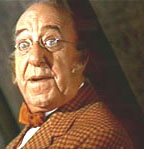
Wynn’s vaudeville fame no doubt appealed to Walt Disney, who had grown up while Wynn was a big star on Broadway. Disney was obviously a fan of the old vaudeville stage, and Wynn would appear in Disneyland’s own “Golden Horseshoe Revue” for its 10,000th performance in 1962. Wynn would make eight films for Disney, most prominently Alice in Wonderland and Mary Poppins, but also The Absent Minded Professor and Son of Flubber, Babes in Toyland, Those Calloways, That Darn Cat!, and The Gnome-Mobile.
This long list of Disney credits gets to something I often think about – the fact that for a great portion of the 1950’s and 60’s, Disney had a fairly steady stock company of actors and filmmakers creating a constant stream of live-action films for the company. While the old studio system was dying elsewhere, Walt was running a shop that centered around contract players and in-studio production talent. While such a system has its benefits and its shortcomings, at its best it can result in a consistent supply of familiar faces producing dependably entertaining films. It requires constant quality control and the occasional freshening though; Disney’s own system would return to bite the studio after Walt was gone. When his eye for quality and urge to push the envelope was lost, decay set in and what was comfortable and familiar in the 1950’s became trite and threadbare by the 1970’s.
Every film geek knows the thrill of seeing some favorite character actor show up in a bit part, and for me that experience began with watching these films as a kid. A lot of actors from this period in Disney history tend to pop up as character actors in other major studios’ films in this and previous eras. Similarly, as a budding film geek it was fun to spot familiar composers, writers, directors, and even set designers and effects technicians from film to film.
While I would never suggest that Disney eschew the urge to continually explore new material and bring in new talent, I’ve always rather hoped that they’d make a return to these early roots and establish a small internal production group that could foster new talent and produce a series of films with a similar continuity. Even an anthology television program, produced for ABC or the Disney Channel and centering on the fictional town of Medfield could provide a reliable source of entertainment and a touchstone with Disney’s past. Keep it interesting, avoid cliche and general cheeseballery, and hire talented people with good ideas – actually think about what you’re making and you can avoid the stream of tapioca that most people think of when they think of Disney post-Walt. How else are kids of the future going to know about 121-year-old vaudevillians?
As stated by Tangaroa so eloquently in his previous blog, Disney has gone overboard in promoting their parks as one identity, and we could really give two cents. In fact, it strikes me as uncreative and cheap (although I like the pictures). When Walt Disney World opened, Disney realized that a bulk of their guests were first-timers, and marketed to them. Disneyland was always much more the regional park of the two, with tons of locals coming in over and over again.
Strategies for promoting these parks became quite different even before WDW became the younger sister to its Aneheim predecessor. Imagineers wanted to make the parks different – vast spaces and soaring spires in the Magic Kingdom versus intimate detail at Disneyland, but also entire new attractions and lands. Fantasyland dark rides based on Peter Pan, Snow White, and The Wind in the Willows (Mr. Toad) were to be replaced by Mary Poppins, Sleeping Beauty, and Sleepy Hollow (Ichabod Crane), respectively. That plan was cut early by Roy O. Disney due to budget concerns. Gone was New Orleans Square, as New Orleans itself was clearly too close to Florida to be seen as exotic, as was its defining attraction, Pirates of the Carribean. In its place went Liberty Square, another detailed land with its own Haunted Mansion and a completly different feel.
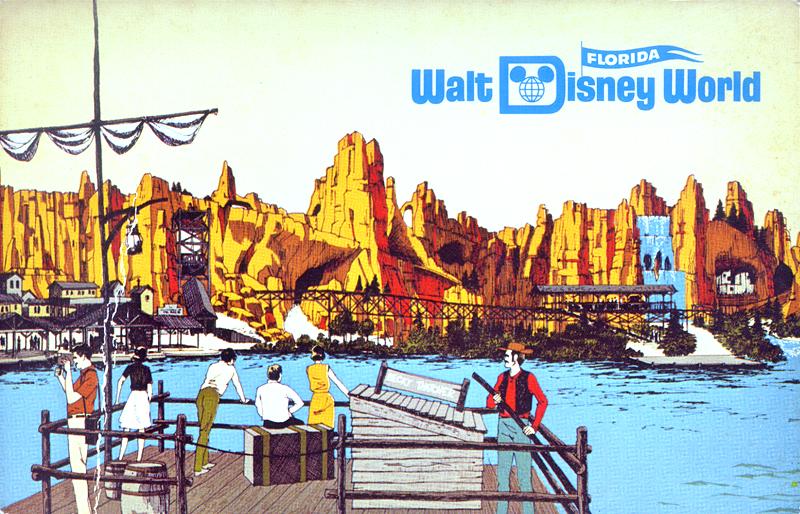
The Pirates equivalent of course was supposed to be the Western River Expedition, a part of the giant Thunder Mesa complex that made it onto park maps at one time, but never off the drawing board. Brian Martsolf has an interesting site dedicated to Walt Disney World in postcards, and pre-opening the marketers at Disney decided to bet on difference from Disneyland to push their product. There are postcards of watercraft on giant bodies of water (in relation to any at Disneyland), resort hotels, and recreation.
Looks fun. As for the theme park equivalent of Disneyland, there were only three postcards for the Magic Kingdom. Of course there had to be one with the castle, but this painting by Herb Ryman emphasises the scale difference of this castle to Sleeping Beauty’s. Note the procession in front of the castle, and the distance used as per the standard view of Disneyland’s castle. Disneyland guests are always shocked at the scale of not only the castle itself, but the breadth of the hub in general, and this picture clearly captures it.
As for the other two postcards, there’s one with the new land Liberty Square (not exactly a blockbuster attraction pictured here).
The other? A view from a Tom Sawyer raft of Thunder Mesa, which made it onto park maps and postcards but never off the drawing board. The folks at Disney must have been pretty sure that this was going to make it, and if you’re interested about why it didn’t, you should read this Jim Hill article about the long process of this attraction’s death.
Regardless, the folks at Disney were not that eager to rely on touchstones for their marketing for WDW. In fact, it appears quite the contrary – that they looked for a different product to promote and new challenges to tackle.
Unfortunately, in the post-Walt era, this thinking vanished for the most part. Tokyo Disneyland was in large part a copy of the Magic Kingdom in Orlando, and though the dream of Disney lived long enough to make EPCOT anew as a respectable theme park, and Eisner built Euro Disney with an eye for quality, this form of thinking does not seem to have much legs at Disney anymore.
Eisner wanted every property to be a “resort” like WDW, including hotels and second gates. The Disney Studios and California Adventure show the budget cut agenda, cutting corners on quality while taking wholesale attractions from other parks, namely the Disney MGM Studios. Recent popular attractions, such as the Tower of Terror, Buzz Lightyear, Pooh, even the mountains Splash, Space, and Big Thunder have been sent around the world in near identical versions.
Now, with the Disney Parks ad campaign, it is clear that the folks at Disney marketing want to consolidate even further, refusing to admit the difference in the Resorts’ drawing power and demographic, and the differences and advantages of each particular resort. Obviously they are trying to establish more “brand essence,” Disneyspeak for a corporate image. But perhaps for once, they should develop more individual resort identities.
The other day I wrote a blog about Showbiz Pizza Place , a lighthearted tribute to a well enjoyed somewhat frightening institution of the ’80s. Before I drop the subject completely, I would like to point you to a certain video clip that is on the particular Showbiz tribute site I mentioned.
Anyway, Disney’s really on fire for this idea, and I suppose judging by the crowds in the Muppet Labs clip, expect more of this in the future. It’s interesting to see this again frightening Showbiz Pizza alternative from 1984. Also, there’s an interesting Wikipedia article about digital puppetry that’s worth a read, that deals with historical development of the technology that’s popping up around Disney parks worldwide.
From the Progress City archives comes this collection of 33 tall tales and true from Disney history. Available in paperback, hardback, and ebook formats.
 Staying in the parks, about.com has an interesting talk with Imagineer Tony Baxter about Disneyland’s new Finding Nemo Submarine Voyage and the path that the attraction took from the original Submarine Voyage‘s senseless closure in 1998. While a great story, it underlines how my ‘home park’ in Florida has suffered from the lack of a powerful champion in WDI’s brain trust.
 John Lasseter talks about animated shorts, WALL-E, and Pixar’s future slate and animation’s chances at the Oscars. WALL-E has started having sneak previews, and Leslie Iwerks’ documentary The Pixar Story has started a round of public screenings.
 Finally, I should mention the passing of renowned Imagineer and author Bruce Gordon who died November 6th at the far too young age of 56. Gordon was a fan favorite at various conventions, and authored or co-authored a number of authoritative books on Disney parks, animators, and imagineers. He was currently working with the Disney family on The Walt Disney Family Museum in San Francisco and had a number of books in the pipeline for publication. He will be greatly, greatly missed.
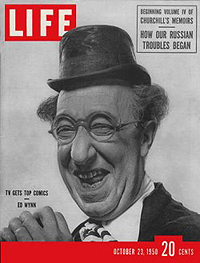 On this day in 1886 (!), Isaiah Edwin Leopold was born in Philadelphia, Pennsylvania. When he would later run away from home to join the vaudeville circuit, he would change his name to
  Wynn’s vaudeville fame no doubt appealed to Walt Disney, who had grown up while Wynn was a big star on Broadway. Disney was obviously a fan of the old vaudeville stage, and Wynn would appear in Disneyland’s own “Golden Horseshoe Revue” for its 10,000th performance in 1962. Wynn would make eight films for Disney, most prominently Alice in Wonderland and Mary Poppins, but also The Absent Minded Professor and Son of Flubber, Babes in Toyland, Those Calloways, That Darn Cat!, and The Gnome-Mobile.
 Every film geek knows the thrill of seeing some favorite character actor show up in a bit part, and for me that experience began with watching these films as a kid. A lot of actors from this period in Disney history tend to pop up as character actors in other major studios’ films in this and previous eras. Similarly, as a budding film geek it was fun to spot familiar composers, writers, directors, and even set designers and effects technicians from film to film.
 As stated by Tangaroa so eloquently in his

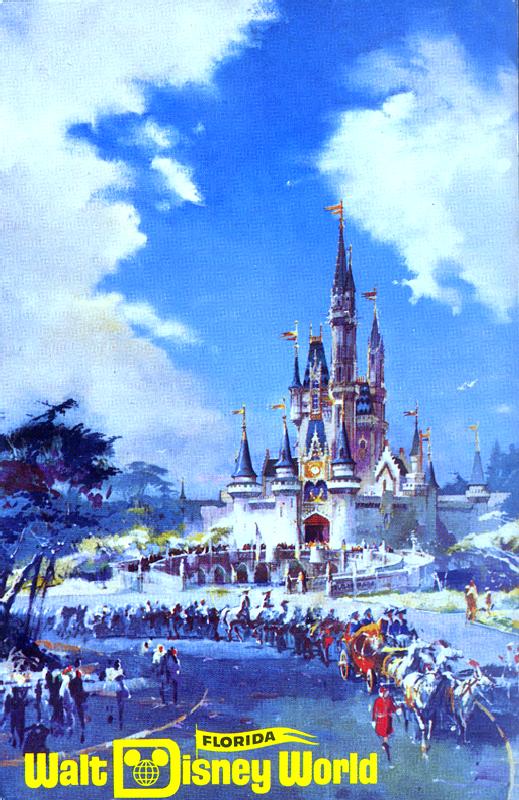 Looks fun. As for the theme park equivalent of Disneyland, there were only three postcards for the Magic Kingdom. Of course there had to be one with the castle, but this painting by Herb Ryman emphasises the scale difference of this castle to Sleeping Beauty’s. Note the procession in front of the castle, and the distance used as per the standard view of Disneyland’s castle. Disneyland guests are always shocked at the scale of not only the castle itself, but the breadth of the hub in general, and this picture clearly captures it.
 The other day I wrote a






Recent Comments