Contribute to Our Research |
By BeaconJoe - November 15th, 2007 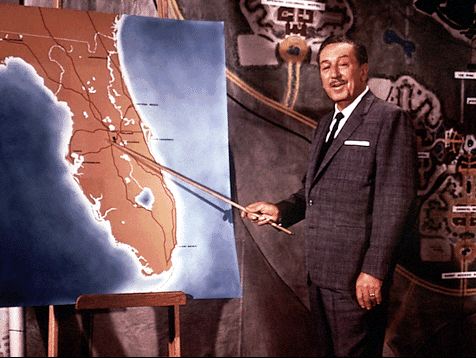 “Here in Florida, we have something special that we never enjoyed at Disneyland . . . the blessing of size. There’s enough land here to hold all the ideas and plans we can possibly imagine.” – Walt Disney “Here in Florida, we have something special that we never enjoyed at Disneyland . . . the blessing of size. There’s enough land here to hold all the ideas and plans we can possibly imagine.” – Walt Disney
Walt Disney used these words when he presented his Disney World concept to a thrilled public close to his death in 1966. Indeed, at that time, the land that Disney had purchased under several dummy corporations seemed limitless. Still today, there is a scale and largesse in Florida that is seen nowhere in other Disney parks. Yet, through the 36 year history of the property, particularly starting during the Eisner era, there was significant property abuse: poor planning and a cavalier attitude about building have eaten up acres of Florida swamp. This column will be a regular one here at Progress City looking at the Blessing and Curse of Size at WDW, how Disney has used this space effectively and abused it conversely.
But let’s look on the bright side first – the area of the property that uses space most to its advantage – the Phase I Magic Kingdom resort area.
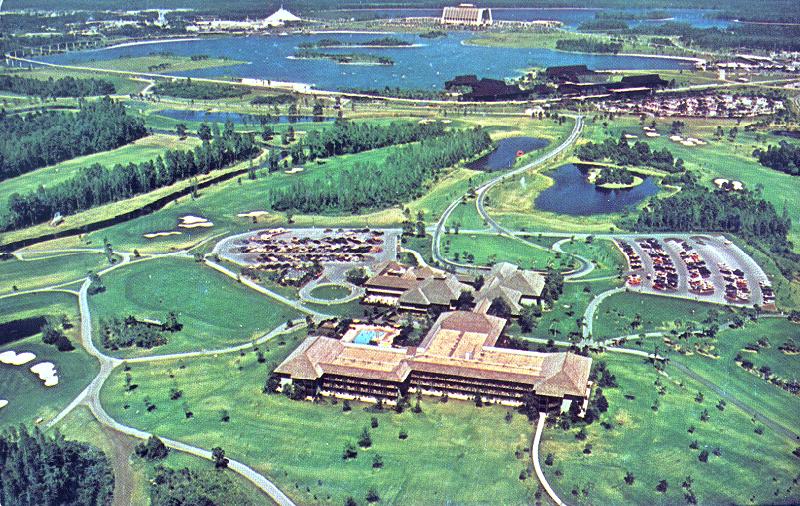
This space is all very reactionary to the clausterphobia of Anaheim, and is the work of an Imagineering department at the top of their game, with Walt tossing around his last ideas prior to his death. In some ways, I believe this area to be the best thing WDI ever did. They use space so much to their advantage for dramatic effect.
First, there are the obvious points: the castle is huge compared to Disneyland, it was designed to be seen from the toll plaza and start anticipation and excitement. There’s a lake in front of the theme park instead of a parking lot! In addition to being aesthetically pleasing, this allows for people to be seperated from their everyday lives. Before the MK resort busses, the only way you could get to the Magic Kingdom was by monorail or ferry. You were already being transported into fantasy before you entered through the park gates. This was a big concept floating around WDI at the time not only with this plan, but with EPCOT (the city) and the failed Mineral King Resort Project in California, where guests would have parked in a subterranian parking deck and been transported up the mountain.
 In addition to the modes of transportation, you are being surrounded by fantasy with the hotels, an extension themselves of the Magic Kingdom. Unlike the later-built Yacht and Beach Club (much discussion to come) that had no relevance to the park it was butting up against, every hotel constructed or even planned represented a land in the Magic Kingdom – The Contemporary for Tomorrowland, The Polynesian, The Asian, and The Persian hotels for Adventureland, Fort Wilderness and the Wilderness Lodge for Frontierland, and the Grand Floridian for Main Street. I don’t exactly know where the never-built Venetian hotel was supposed to fit into this, but I digress. In addition to the modes of transportation, you are being surrounded by fantasy with the hotels, an extension themselves of the Magic Kingdom. Unlike the later-built Yacht and Beach Club (much discussion to come) that had no relevance to the park it was butting up against, every hotel constructed or even planned represented a land in the Magic Kingdom – The Contemporary for Tomorrowland, The Polynesian, The Asian, and The Persian hotels for Adventureland, Fort Wilderness and the Wilderness Lodge for Frontierland, and the Grand Floridian for Main Street. I don’t exactly know where the never-built Venetian hotel was supposed to fit into this, but I digress.
All of it has purpose, all of it fits together seamlessly. There are no scale issues either. Keep in mind that the Contemporary and Cinderella’s Castle are only 200 feet tall, and the Seven Seas Lagoon is not that large of a lake. Forced perspective of the islands that Disney built along with the lagoon, the scale consistency and lack of any reference point otherwise, makes these icons, or Walt’s term “weenie,” seem larger than life.
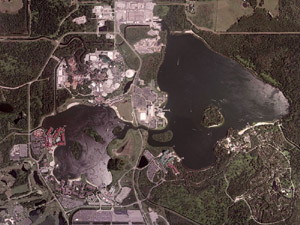
In addition, the infrastructure is superb. As you can see from the map, the roadways are not in the way, they’re spare – and when the park opened, there were no traffic lights. The goal was to have none on the property, obviously this changed over time. The Central Shops, power plant, water treatment plant, monorail and train roundhouses, and so on are tucked far beyond the berm and kept from the eye. The monorail was constructed with long straightaways – one for the Asian, the plot that ended up being the Grand Floridian, and one for the Venetian (note the long straightaway from the Contemporary to the TTC).
This is Disney planning and spatial usage at its height. In the future I’ll go into more detail about all I’ve mentioned, and move on to other parts of the properties, and see where things started to go South. Until then, this is Beacon Joe signing off.
Related Posts...
By BeaconJoe - November 14th, 2007 
Rest in peace Brian Keith, born this day in 1921 in Bayonne, New Jersey. Keith is perhaps best known as “Uncle Bill” in The Family Affair, but to us Disney geeks he provided the father figure for two Hayley Millses in The Parent Trap. Other Disney credits include Moon Pilot, A Tiger Walks, and Those Calloways.
I enjoyed Keith as a drunken angry sheriff in The Russians Are Coming, The Russians Are Coming, and his gruff adventurous ways as Hardcastle in the 80’s TV show Hardcastle and McCormack. But most, I enjoyed his sense of style – a cosmopolitan John Wayne of sorts with a take no prisoner attitude, and a Diner’s Club finesse.
You are definitely missed, Mr. Keith.
Related Posts...
By BeaconJoe - November 13th, 2007 
First and foremost, I’m happy to know that Lost will not initially be affected by the writer’s strike. There are several articles all around the net from different perspectives, and all point to the fact that the first 8 episodes will air as scheduled, in opposition to the plans of 24 to hold off on airing episodes. Hopefully, this will be a nonissue if there’s a swift resolution to the writer’s strike, but good to know.
Should the writer’s strike go on through the new year, there should be little competition for Lost and ABC should reap the benefits. TheSpoof has another article from the writer’s perspective, trying to work as hard as they can to tie up loose ends in a complicated show pre-strike.
2719 Hyperion has a thorough article up about one of my favorite shorts, Donald and the Wheel. It includes Buddy Baker’s “That’s the Principle of the Thing.” Baker, for those of you who do not know, is one of the prolific Disney theme park songwriters. Anyway, the article is here.
Finally, there is a great article that was posted on Halloween on Passport2Dreams that I missed. In celebrating the Haunted Mansion, Foxxfur discusses “The Myth of Story,” further discussed in an article on re-imagineering. Both these are worth a read and sober thought and judgement.
Good day.
Related Posts...
By BeaconJoe - November 12th, 2007 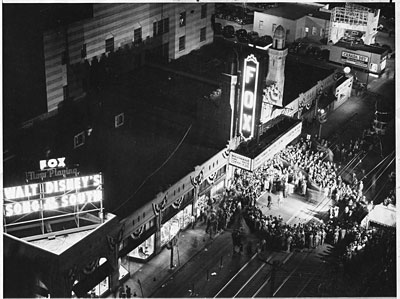
Happy 61st birthday to Song Of The South, the Disney/RKO motion picture that debuted on this day at the Fox Theatre in Atlanta, Georgia. This movie was obviously based on the Uncle Remus stories from Joel Chandler Harris (who in turn wrote them from previously told folk tales), but nonetheless gave us three frequently used characters in Disney parks: Brer Fox, Brer Bear, and my favorite Brer Rabbit.
 Obviously, we can ride Splash Mountain to celebrate, or we could sit and sulk about how Song of the South is not yet released in home video format. Eisner and Co. thought it too racially sensitive to release, and I can see why. I do believe that this movie has much more charm than the racial issue though. Obviously, we can ride Splash Mountain to celebrate, or we could sit and sulk about how Song of the South is not yet released in home video format. Eisner and Co. thought it too racially sensitive to release, and I can see why. I do believe that this movie has much more charm than the racial issue though.
There’s been a buzz recently that Iger and Co. are looking to rerelease Song Of the South, and Iger’s even admitted pondering this himself. Let’s hope that soon we will be able to get this movie as next in a long line of the Walt Disney Treasures series.
Related Posts...
By Michael - November 11th, 2007 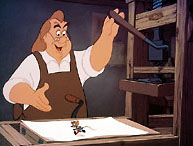 On this day in 1953, Walt Disney Productions released a pair of animated shorts that remain well-known to this day. Ben and Me told the odd story of a mouse who lived with and inspired Ben Franklin. Based on a book by Robert Lawson and adapted for the screen by the great story artist Bill Peet, the two-reeler was eventually nominated for an Academy Award. On his blog, Michael Sporn has posted a series of storyboards that Peet created for the film. On this day in 1953, Walt Disney Productions released a pair of animated shorts that remain well-known to this day. Ben and Me told the odd story of a mouse who lived with and inspired Ben Franklin. Based on a book by Robert Lawson and adapted for the screen by the great story artist Bill Peet, the two-reeler was eventually nominated for an Academy Award. On his blog, Michael Sporn has posted a series of storyboards that Peet created for the film.
 Also released today was the famous Donald Duck short Working for Peanuts. Directed by Jack Hannah, and featuring perennial Duck antagonists Chip and Dale, the short was Disney’s first to be released in 3-D. While it would later be seen on television in 2-D, it would be revived for 3-D presentation in Walt Disney World’s Magic Kingdom as a preshow for Magic Journeys from 1987-1993 and again theatrically in front of 3-D presentations of Meet the Robinsons in 2007. The Animation Backgrounds blog has posted a series of stills from the short showing the stylized, non-traditional backgrounds created by Disney artist Eyvind Earle. Earle, who most notably worked extensively on Sleeping Beauty, employed a very modern and impressionistic style that marked a break from the past in Disney animation of the 1950’s. Also released today was the famous Donald Duck short Working for Peanuts. Directed by Jack Hannah, and featuring perennial Duck antagonists Chip and Dale, the short was Disney’s first to be released in 3-D. While it would later be seen on television in 2-D, it would be revived for 3-D presentation in Walt Disney World’s Magic Kingdom as a preshow for Magic Journeys from 1987-1993 and again theatrically in front of 3-D presentations of Meet the Robinsons in 2007. The Animation Backgrounds blog has posted a series of stills from the short showing the stylized, non-traditional backgrounds created by Disney artist Eyvind Earle. Earle, who most notably worked extensively on Sleeping Beauty, employed a very modern and impressionistic style that marked a break from the past in Disney animation of the 1950’s.
Related Posts...
|
The Progress City Primer
 From the Progress City archives comes this collection of 33 tall tales and true from Disney history. Available in paperback, hardback, and ebook formats. |






Recent Comments