And so we continue…
#5 – Rethink Tomorrowland

Welcome to…
THE FUTURE!!!I realize that most of my discussions so far have involved the Walt Disney World resort, as that is my main area of concern. This item, however, applies equally to all the Magic Kingdom parks worldwide and is an issue that should be addressed and coordinated at the top levels of Imagineering to ensure the best possible consistency of vision across all the parks. There’s trouble in Tomorrowland – all Tomorrowlands, actually – and something needs to be done to rectify the situation.
It seems to be some strange quirk of history that Tomorrowland is the area of each new park to receive short shrift. With both Disneyland and Walt Disney World, Tomorrowland was barely functional on opening day. In both cases, Tomorrowland was the last area of the park to be built and seemed to suffer from the rush to opening day and the scarcity of funds due to cost overruns elsewhere. Walt Disney World fans might be shocked to see pictures of Tomorrowland from 1971 – not only was there no Space Mountain or Carousel of Progress, but no Astro Jets tower or WEDway station either. The land essentially ended right past where Stitch’s Great Escape is today. Disneyland’s situation was equally dire – with the madcap rush to have things functional for opening day, Imagineers hustled to cram in sponsored exhibits and “attractions” such as the “Clock of the World” and the “Bathroom of the Future” just so guests would have something at which to look.
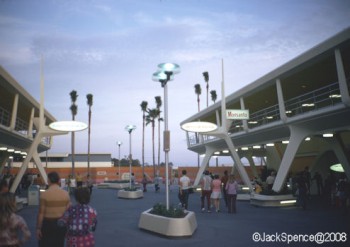
Some of our theme park is missing: The Magic Kingdom’s Tomorrowland in 1972 (Photo from
AllEars.Net)
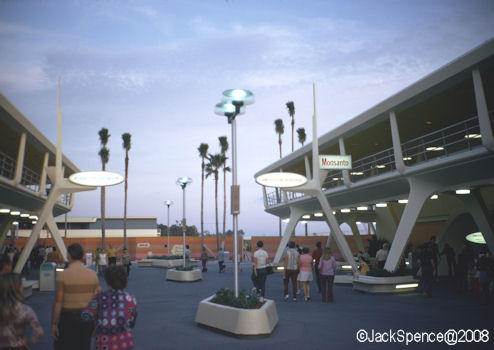
So unsatisfactory was Disneyland’s Tomorrowland to Walt’s exacting standards, it received a massive expansion in 1959 and a complete overhaul in 1967. Sadly, as I mentioned recently, this 1967 “New” Tomorrowland remains the greatest realization of the concept to date. Walt Disney World’s Tomorrowland, while larger, was missing certain attractions and was never as thematically consistent (as wonderful as it was, If You Had Wings was no Adventures Thru Inner Space, thematically speaking). Tokyo Disneyland received a stripped-down clone of Walt Disney World’s Tomorrowland, missing the critical element of motion created by the PeopleMover track.
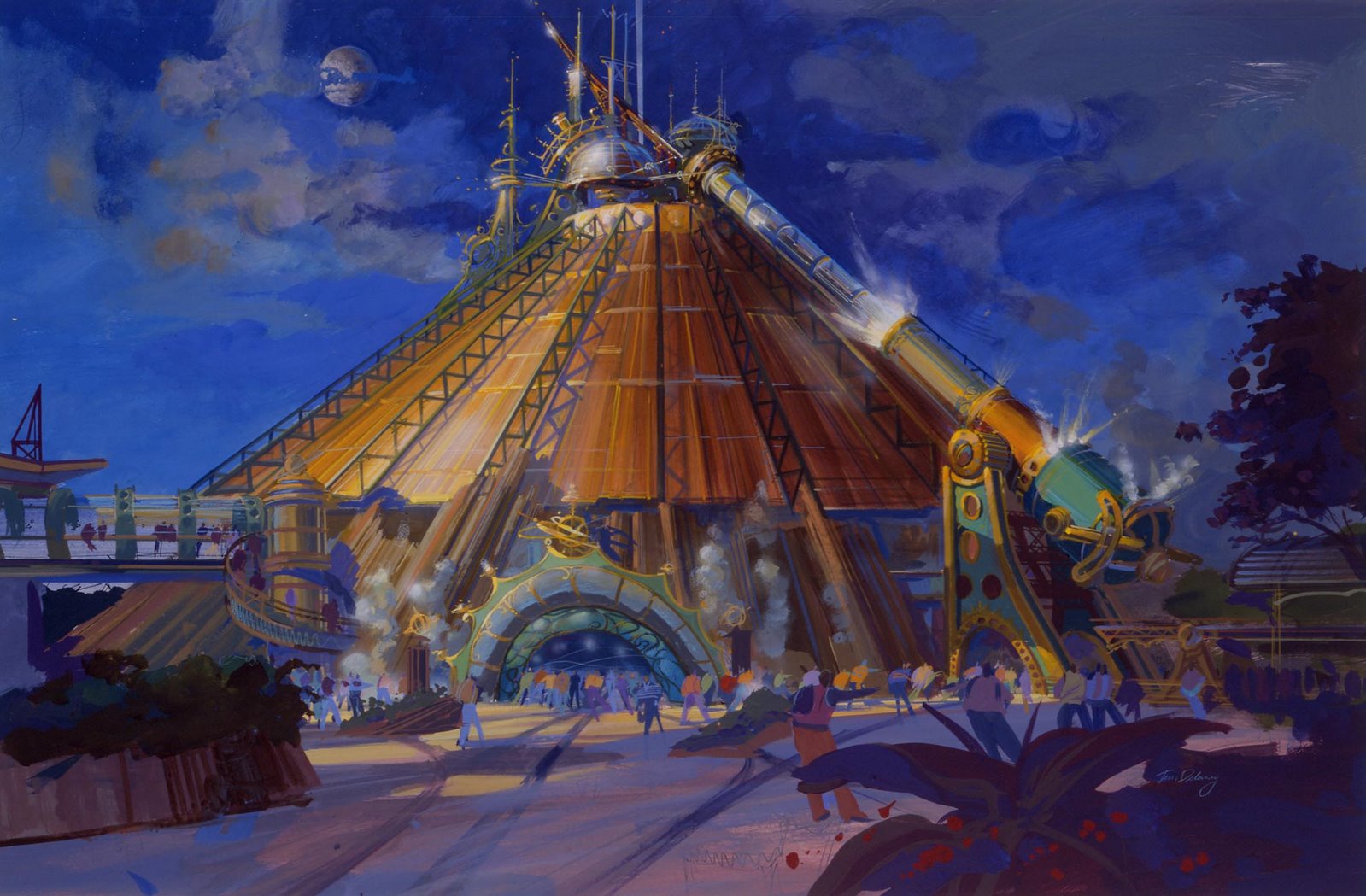
When Imagineers created Disneyland Paris, they attempted to avoid the pitfalls of having to update the area for the sake of modernity by re-thinking the land from the viewpoint of Victorian and Edwardian futurists such as Jules Verne and H.G. Wells. The result, dubbed “Discoveryland” and owing a great deal to Disneyland’s abandoned Discovery Bay concept, was well-realized but suffered from a lack of later expansion and, again, missed that “second level” effect provided by a PeopleMover track, monorail or skyway. Hong Kong Disneyland took a fantastical approach to Tomorrowland as well, with a neon-heavy retro-cartoony feel akin to Walt Disney World’s 1994 Tomorrowland remodel which transformed that land into a Buck Rogers-inspired, neon future-deco “future that never was”.
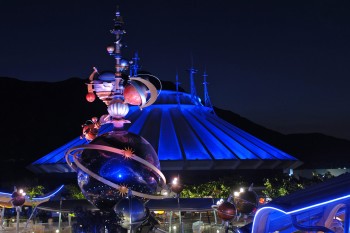
The glowy science-fantasy future of Hong Kong Disneyland
Tomorrowland’s drift from science-fact to science-fantasy, and from attempting to provide a window into humanity’s future to relying on character-heavy franchise tie-ins, shows that no one can really get a handle on what this land should be. The fact that the concept of Tomorrowland has become increasingly jumbled since 1967 shows how much the company depended on Walt to drive innovation and push for consistent upgrades. Walt Disney died before 1967’s Tomorrowland officially opened, and without his unifying vision and willpower the same lack of purpose that led to the eventual abandonment of the EPCOT city project in Florida also led to the abandonment of Tomorrowland as a constantly-changing vision of the future. This is easily illustrated by the quantum leaps in design, technology and scope that occurred in the twelve-year span between Disneyland’s opening in 1955 and the New Tomorrowland of 1967. That decade saw numerous changes in Tomorrowland, and ended in a complete rebuilding of the area. Compare that to the current day, when it’s been a full fifteen years since the opening of Walt Disney World’s Tomorrowland of 1994; many of the original plans for that renovation were never even realized, and the only changes since have come in the form of new, low-budget cartoon-based attractions.

The High Water Mark: Disneyland’s New Tomorrowland, 1967
These new attractions, built to capitalize on popular characters from Disney (and especially Pixar) films, have often been criticized for turning Tomorrowland into “Fantasyland East”. Bringing characters from Toy Story, Lilo and Stitch, and – most egregiously – Monsters Inc. into Tomorrowland destroys all pretense of attempting to create a coherent theme of futurism. Moreover, these attractions tend to be franchised and retro-fitted into other parks, leading to thematic non-sequiturs such as Buzz Lightyear inhabiting the Vernian steampunk future of the Parisian Tomorrowland.
Then there’s the original Tomorrowland – that wonderful Californian vision of the future from 1967. It was, in great part, destroyed a decade ago to make way for the now-infamous Tomorrowland ’98. Culled from a variety of stylistic sources, including the Parisian futurism of Jules Verne, the golden age sci-fi stylings of Florida’s park, Eisner’s obsession with “Montana future”, and precious little from the original Imagineering plan for re-design called “Tomorrowland 2055”, the Tomorrowland of 1998 was a disaster upon opening and remains widely loathed today. Several attractions closed to make way for the remodeling, and were replaced mostly with shops and restaurants. The centerpiece of the new land, the Rocket Rods, took the place of the PeopleMover but was soon forced to close because a lack of funding led to shortcuts in its construction which rendered it prone to breakdowns and eventually inoperable. Thus Disneyland’s once-vibrant Tomorrowland sits desolate, with an empty PeopleMover track and a net loss of attractions.
This is the situation we find ourselves in, and no matter how it happened it needs to be turned around. Disney needs to devote the effort and, most importantly, the funding to take care of this situation not only in one specific park but in all five of its resorts. There needs to be coordination at the highest levels to determine a specific theme and purpose for each individual Tomorrowland, and a concerted program to fully fund and construct each individual concept as quickly as possible. Tomorrowland is a mess, and Disney has pussy-footed around the issue for years. It’s time to fix it. My suggestions:
Disneyland
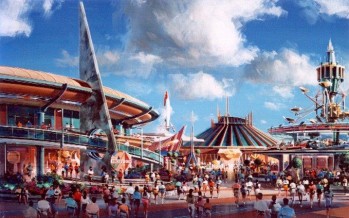
The rusty, rocky future of 1998
The first and once-greatest Tomorrowland is, strangely, the most in need of immediate attention. Some elements of Tomorrowland ’98 have been removed or painted over, but many unpleasant vestiges remain. The 1998 remodeling was a half-hearted effort that attempted to cheaply put a Discoveryland veneer over the original 1967-era Populuxe infrastructure, and the result was a chimerical disaster.
The greatest amount of damage that was done to Tomorrowland’s infrastructure resulted from the Astro Jets being removed from their location atop the WEDway station and being relocated as a new spinner ride amongst Eisner’s “Montana future” rockwork at the land’s entrance. Not only did this ruin the thrill of the Astro Jets and remove the land’s traditional “weenie”, but it also provided a massive hindrance to traffic flow between Tomorrowland and the Hub. Job one for any Tomorrowland refurbishment should be returning the Astro Jets to their proper place atop the WEDway station and doing any necessary refurbishment work required to get both the Jets and the WEDway operating again.
The dominant rumor at the moment is that as soon as the economic crisis eases up and the corporate offices release the purse-strings, Tomorrowland will be the first area of Disneyland to receive attention. The Imagineers are well aware of the land’s current unfulfilled promise and now that John Lasseter has influence at the highest levels, the creative neglect of the Eisner years should come to an end. Imagineer Tony Baxter, it is said, has a plan. How soon that plan is revealed is anyone’s guess.
My opinion is that they should return Disneyland’s Tomorrowland to its roots – a real-life exploration of science and technology with an eye towards humanity’s future. While I’ll admit that a return to its kitschy Populuxe roots would be highly enjoyable – Saturn V and all – I think the concept of 1967’s Tomorrowland could easily be updated for the modern age. Space travel is no more of an everyday event for the average person than it was then; NASA’s planned Ares-series rockets – intended to return us to the moon and later take us to Mars – provide a nice analogue to the Apollo age of the 1960s. Issues with transportation are just as relevant as they were then, and science has learned a lot about what fills that “inner space” that we once were able to explore at Disneyland.
Disneyland’s Tomorrowland should be sleek, modern, and relevant. It should look forward, not backward or sideways. There’s room for the whimsical and fantastical – we know of many fantastic abandoned concepts from the past and who knows what WDI can come up with to revisit futuristic themes with modern technology.
Walt Disney World
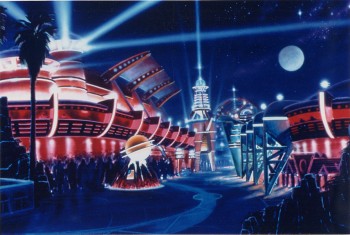
While I’m usually of the opinion that Tomorrowland should reflect and expand on its original intent, I’m willing to cut some slack in Florida. The Orlando resort is blessed by EPCOT Center, which gives Disney the opportunity to explore the ideas that Tomorrowland was created to espouse, but in a much larger scope. EPCOT has (or, rather, should have) the actual future covered, so that gives Tomorrowland a little room for zaniness.
That doesn’t mean it should be a free-for-all. Monsters, Inc. has got to go. Thankfully, its simple construction should mean that it’d be easily to pluck it out of Tomorrowland and remove it to Hollywood Studios’ Pixar Place, where it’s somewhat thematically relevant and hurts no one. Stitch’s Great Escape has to go – mostly because it’s awful – and as we already have one Toy Story-themed shooter at the Studios I think that gives us free reign to re-think Buzz Lightyear.
So, where to start? First, pick a theme. I really don’t mind the whole Buck Rogers 1930s future angle, but it needs to continue all the way through the land. Compare the area leading from the Tea Cups down past the Speedway to Rockettower Plaza – you can almost see the seam where the money ran out and they just gave up. It’s possible to be fantastical and classy at the same time – witness Metropolis – without being overtly cartoony.
Then they need to pick a roster of attractions that fits whatever theme they select. This fits my personal agenda of moving the Carousel of Progress to EPCOT. I love the Carousel, although it needs updating, but it doesn’t fit the rest of Tomorrowland anymore. It would make a lot more sense at EPCOT, perhaps at the end of Innoventions East where it could serve as a grand finale of sorts for the “Road to Tomorrow”. In its place in the fantastical Tomorrowland could be an animatronic spectacle akin to the once-proposed Plectu’s Intergalactic Revue.
Something needs to be done with the abandoned Skyway station, the expansion pad beside it, and the demolished Galaxy Theater. The Speedway needs to be completely re-imagined, with at the very least a conversion to electric cars. As I’ve mentioned before, I’d like to see its footprint reduced by having a multi-story ride building with indoor and outdoor segments, which could feature black-light vistas of the “City of Tomorrow” akin to the former finale of the World of Motion.
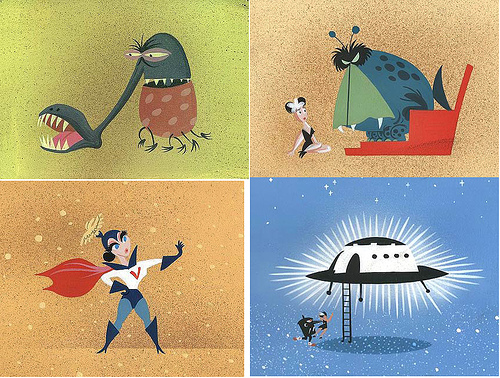
Imagineering could then come up with new concepts to replace Stitch, Buzz, and the Monsters. The Monsters theater could always be reverted to CircleVision – I enjoyed the concept of Timekeeper, although its execution was a bit over-the-top. Or, perhaps, a re-voiced Timekeeper and Nine-Eye could take over a redesigned Monsters theater for a new show. One final option would be to incorporate the Monsters show space with the adjoining Buzz ride, creating enough room for a truly special dark ride of some sort. The entrance and queue could be on the Monsters side facing the hub, making the land more open and inviting from the entrance. If they really wanted to go far out, why not a ride based on those insane Ward Kimball cartoons for the Tomorrowland-themed Wonderful World of Color shows in the 1950s?
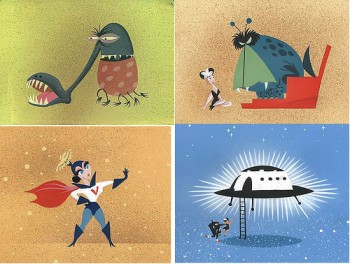
Admit it – this would make a killer ride
Perhaps a Kimball-themed dark ride about zany alien invasion could be paired with Plectu’s Revue and a flying saucers attraction in the former Galaxy Theater location to create a sort of Tomorrowland Roswell – Area 71? I think anything’s game for Tomorrowland as long as we have the luxury of EPCOT to represent the “real” future.
Tokyo Disneyland

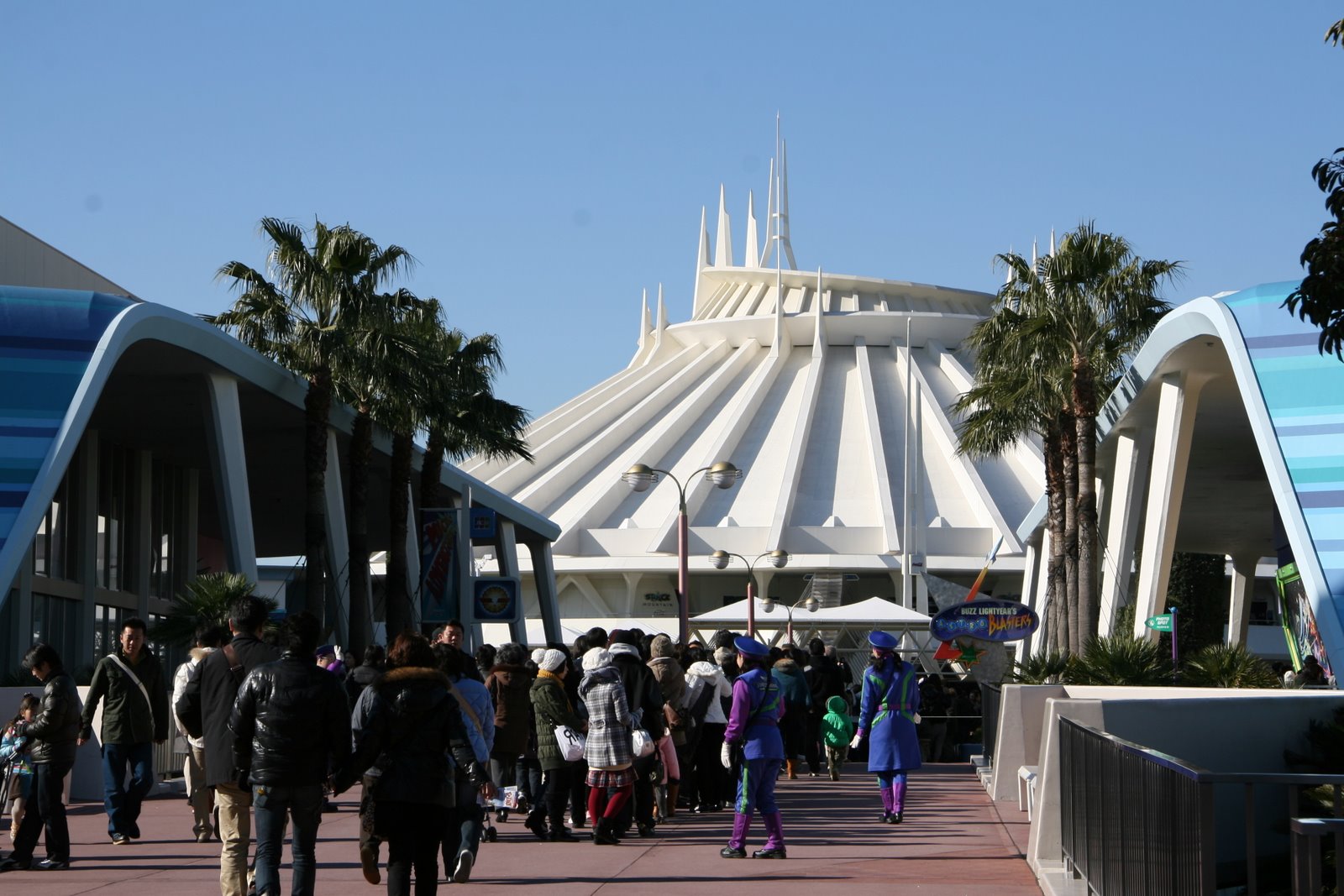
It looks awfully familiar, but doesn’t it seem like something’s missing? (Photo from
Disney and More)
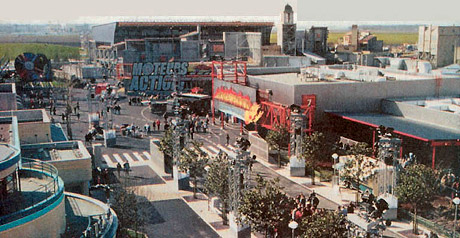
Tokyo has farther to go, as their Tomorrowland is sort of a stripped-down version of Walt Disney World’s original 1970s version. Here’s where things get dicey, as they’re just preparing to debut an incredibly expensive, E-ticket dark ride… themed to Monsters, Inc. I don’t know what to do with that. My feeble lizard brain cannot reconcile the issue.
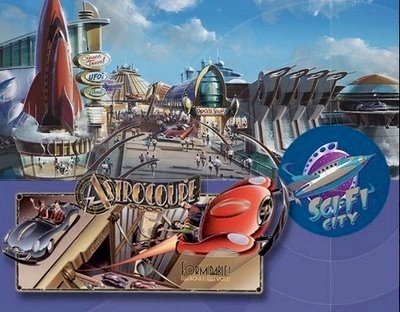
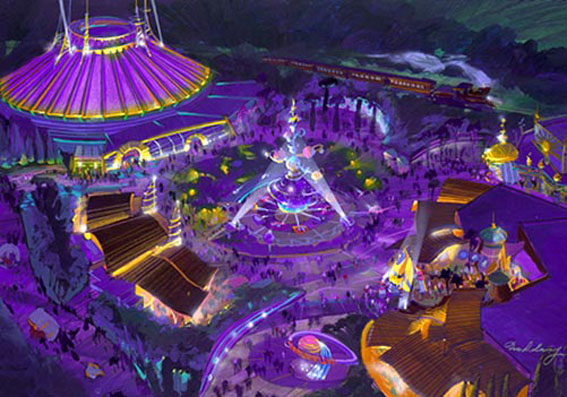
Much like at Disneyland, there was a plan for a complete makeover of this Tomorrowland in the 1990s. Known as “Sci-Fi City”, the concept was a combination of Florida’s neon-retro Buck Rogers “future that never was” with the lived-in, rough-around-the-edges future of Blade Runner. Sci-Fi City would be a total conversion of the land, with several new attractions unique to the Tokyo park. Eventually, though, the land’s multi-billion dollar price tag led to its postponement when that money was instead routed to the construction of the DisneySea park. To date, the only concept from the plan that has seen the light of day was the planned retheming of Tokyo’s Star Jets; the flying saucer-shaped designs seem to have been used as the basis for Hong Kong Disneyland’s Orbitron.

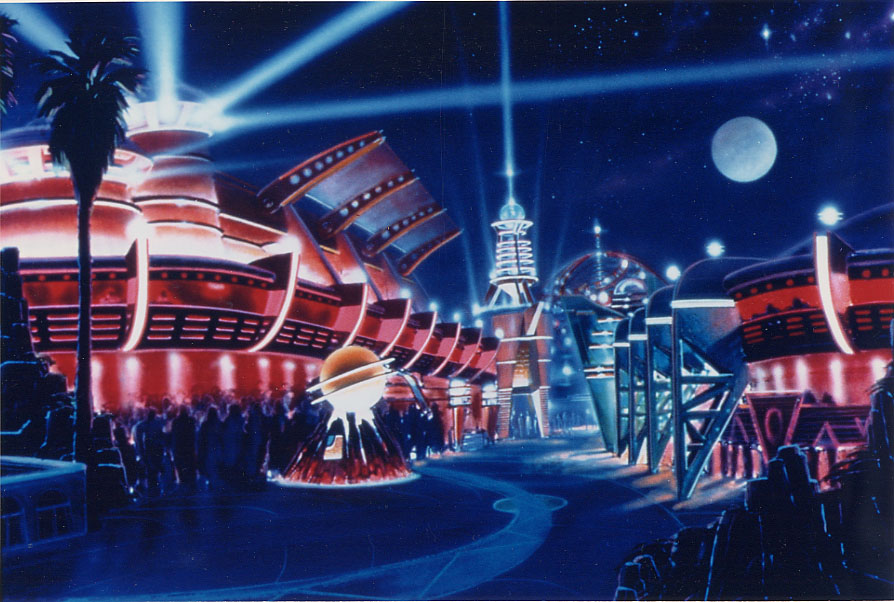
I ain’t gonna play Sci-Fi City
No doubt, the plans for Sci-Fi City were impressive. The combination of unique attractions, kinetic atmosphere and visuals, and the addition of the necessary “second story” to Tomorrowland with a Rocket Rod-spinoff ride served to create a unified and immersive themed area that did not skimp on detail. While the plan was not as based in hard science as the original Tomorrowland, it wasn’t an overtly cartoon-driven vision and many elements – such as the area themed as an asteroid mining colony – gave a real otherworldly feel missing the from other parks.
So what should Tokyo’s Tomorrowland be? Should it merely elaborate on more traditional themes, or should they go whole-hog and do something totally new like Sci-Fi City? I’d like to see a new, unique Tomorrowland with the full backing of the Oriental Land Company, but there’s still the unfortunate fact of their own recent Buzz Lightyear attraction and the brand-new Monsters, Inc. E-ticket. And, sadly, despite Michael Eisner’s attempt to the contrary, the Tokyo resort doesn’t have a Disney-MGM derived park in which to dump this sort of attraction. Maybe Tokyo’s Toontown needs a Pixar-centric cul-de-sac?
Disneyland Paris

Discoveryland is a fantastic concept that has never been fully exploited. Euro Disney’s financial woes precluded a great deal of park expansion after its opening, although the 1995 addition of Space Mountain is often cited as a key element in rehabilitating the park’s image and financial stability. Discoveryland was, for years, left in neglect and never really expanded on; many rides originally conceived for the park have never been built. In recent years, the park-exclusive Le Visionarium was replaced by another Buzz Lightyear clone.
Still, the fact that not much expansion has taken place in the area means that little has been done to destroy the overarching theme of the area. The foundation is still there to create a fantastic Verne-derived land, and Imagineering’s archives are full of unrealized concepts that could be easily adapted to the theme. The Toon Studio at the neighboring Walt Disney Studios park would be an excellent place to relocate Buzz Lightyear, as that park has not yet been saddled with Toy Story Midway Mania and there would thus be no duplication of theme. Then all WDI would have to do is add those critical elements of motion that make Tomorrowland “a world on the move” (steam-powered WEDway?) and bingo – a unique Tomorrowland with a cohesive and interesting theme.
Hong Kong Disneyland
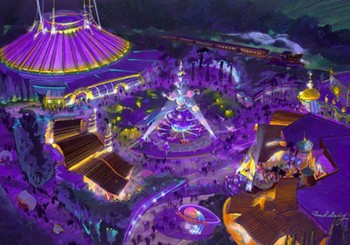
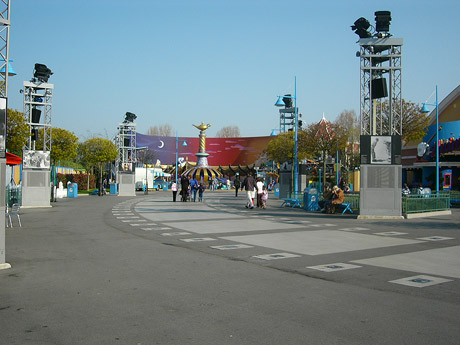
Hong Kong Disneyland’s Tomorrowland – like Kristen Chenowith, quite pretty but very small
As mentioned earlier, Imagineering went with a neon-retro design for Hong Kong; in effect it’s most similar to Walt Disney World’s 1994 redesign and the chrome-and-primary-color exterior of Florida’s Mission: Space. But there’s not a lot there; the area has four ride attractions, none of them unique to the park. Hong Kong’s Autopia does have one nice feature, though – its cars run off of electricity.
Hong Kong’s Tomorrowland is essentially a blank slate – some nice atmosphere but it could go in many directions. Yet Hong Kong Disneyland’s need for expansion is so desperate that it might be a while before Tomorrowland receives attention – current rumors point to Adventureland as the site for the next expansion, if it indeed comes, and after that it’s expected that the park will add a Frontierland or Toontown.
In summary…

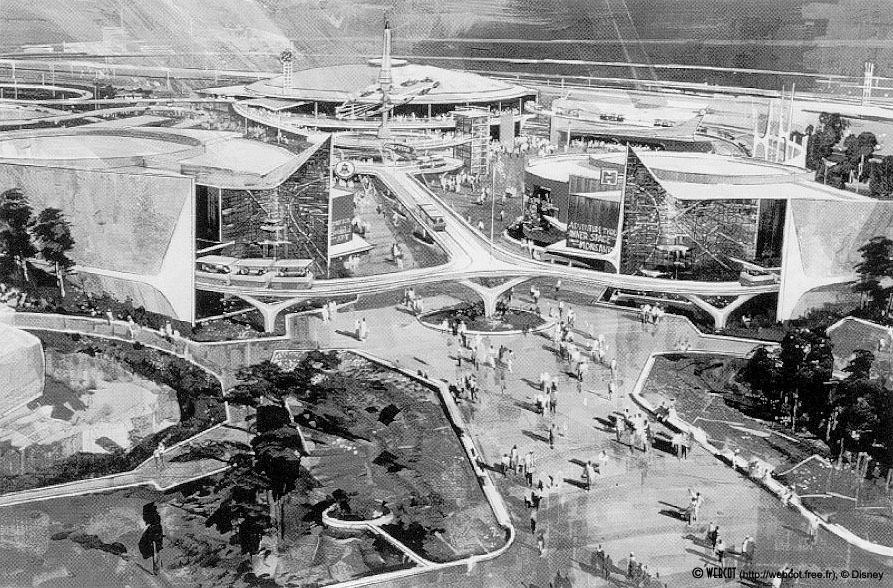
There’s A Great Big Beautiful Tomorrow: Disneyland, 1955
It’s possible for each of the five Tomorrowlands to have a unique and special identity that doesn’t betray Walt Disney’s original intent for Disneyland’s “world of tomorrow.” I think that they should run the gamut from science-fact to science-fiction, but even when they delve into the realm of science-fantasy the focus should remain on humanity’s promise for the future – not on toys, monsters, superheros, or any other franchised product.
Related Posts...
 Flying Saucer… Truck Tires? Coming soon to California Adventure














Recent Comments