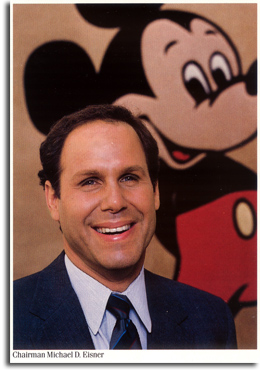
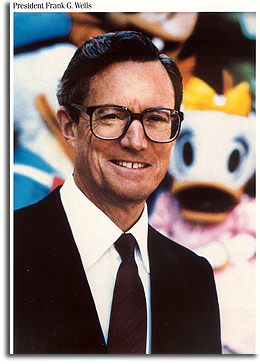
 Previously, on as the Eisner turns, we’d seen our doughty new CEO wrap up his first complete year at the helm of Disney alongside his stalwart counterpart Frank Wells. Profits were on the rise, due in no small part to Eisner’s affinity for raising prices at the popular Disney resorts while cutting costs. There had also been a great expansion in film and television production, as Eisner focused less on new investments in the theme parks and more on expanding the studio’s release slate. Projects initiated under previous management, like the Disney Channel, Touchstone Pictures and a European Disneyland, continued to develop. Work also began on plans for the Disney-MGM Studios park in Florida, as well as a studio-themed attraction to be built on property adjoining Disney’s actual studio lot in Burbank.
More important for us, though, is that 1986 marks the first time that Eisner signs the annual letter to stockholders by himself, claiming that Frank Wells decided that Eisner should go it alone with his inimitable folksy style. This means less formal recitation of statistics than in Eisner’s first two years, and the advent of the pseudo self-deprecating homespun references that would turn the shareholder reports into annual letters from wacky Uncle Mike. We get our first solid mentions of the Eisner kids – those lovable scamps! – and even some in-laws to boot. From now on, the letters would become triptychs through the Disney world – a year in the life of Uncle Mike. So allons-y!
To Our Owners and Fellow Disney Employees,
This annual report marks the third since Frank Wells and I have come into the company, and I thought (or rather Frank thought) that I should write our report in the same somewhat informal style that I frequently use during the year to fill in your Board of Directors.
Last year we began this annual letter with an exclamation: “what a year it’s been!” Some of us felt that bold statement could be bad luck, that it might never happen again, and that we were being too confident. (Of course during my eight years at Paramount, in moments of uncertainty, I felt every successful movie or television series we had was the last hit we would ever have – maybe the last good idea or good movie any living person would ever see – but luckily it was not.) We let the “great year” statement stand.
 I begin the 1986 report by saying, “What a Year It’s Been! II, The Sequel!” But 1986 was not merely a sequel to 1985. It topped it, and revenues and earnings (naturally gratifying because that is how we are judged); surging attendance at our parks; an impressive number of live-action hit movies (defying my usual fears); a widening presence in network television and syndication; continued vigorous growth of The Disney Channel; the development of new markets and business relationships in mainland China and Europe.
Revenues climbed to nearly $2.5 billion during fiscal 1986 from some $2 billion the previous year, an increase of 23 percent, and this increase occurred during a time of relatively low inflation. Net income rose 43 percent to more than $247 million, or $1.82 per share, up from $173.5 million or $1.29 per share in fiscal 1985.
For the second straight year, those results set company records. Equally important, earnings per share more than doubled 1984 levels and return on equity continued its improvement to 19 percent. (Three or four years ago, as a relief from reading mediocre scripts and treatments, I read books and articles on how to manage during times of rapid inflation; I cannot really say it was a waste of time, for I can now recognize how truly significant our progress has been given the current period of modest inflation.)
Our fiscal 1986 financial results are given the full attention they merit in other sections of this report, and I am sure they will be studied and restudied by business experts in the months ahead. For me they constitute no more, no less than a numerical representation of the countless exceptional accomplishments of Disney employees during the period.
Of course I love the figures, but what these numbers cannot convey is the long-range significance of those accomplishments and their portent for the years ahead. We are convinced that many of these achievements are merely an early indication of an enormous reawakening at Disney, a renaissance sure to occur when talented new people blend their fresh ideas with our company’s traditional values.
Considering that heritage and the specific achievements of 1986 – covered in detail in the pages that follow – our company expects to be increasingly successful into the 1990’s.
In addition to being the industry leader in theme parks and resorts, the strongest reason for a lot of our optimism is the remarkable progress that continues in our motion picture operations. Almost overnight Disney became number one in average box office gross for all titles released in 1986 and among industry leaders in overall box office results – by far the most successful live-action film year in the company’s history.
We turned out quality films… on schedule… under tight budgets, and we began to prove that we can produce them in the quantity expected of a major studio. We have a team of executives, led by Jeffery Katzenberg, Rich Frank and Roy Disney, who work exceptionally well together. We have a good time and share the pain of the creative process, which is always a difficult one. To succeed, the cross-utilization of resources and ideas is critical. When I come to the studio with what I think are the most original thoughts (mostly arrived at by stealing an episode involving my children, their friends, their mother, their doctors, dentists, coaches or our 16-year-old’s girlfriend) only to hear how we already have that idea in development, I return to my office knowing not only do others have good ideas but comedic home lives as well. We have fun collaborating, and more than occasionally move forward on a movie or television idea that sounds original.
Just as we have expanded our moviemaking capacity, we have taken steps to assure that our films will be properly financed. As you can tell so far in this letter, as confident as we are, we are also extremely cautious. So, to help us sleep through the whole night, it’s gratifying to know that Silver Screen Partners II and III, both limited partnerships, have raised almost half a billion dollars, demonstrating the financial community’s continued confidence in the Walt Disney Studio team.
Another significant achievement continues in network television. Last year “Golden Girls” received 15 Emmy Award nominations and won for best comedy series. It remains among the top ten rated programs this season.
Equally important, “The Disney Sunday Movie,” which returned last February, has built additional momentum. These weekly movies not only keep the Disney name in the public consciousness today, thus promoting our parks and consumer products, but promise to be extremely valuable in syndication here and abroad. Its success is particularly pleasing to all of us because it takes so much work.
By doing the host spots, I have confirmed that I still stoop and I still speak too quickly, but I am happy to report my son’s threat that he would never again go to school if I hosted “The Disney Sunday Movie” did not become a reality.
In a little more than a year, syndication has emerged as a major new revenue stream for the company. Again a great group of executives have forged a company that deserves much more space in this letter than the printers will allow.
Two other areas providing growing revenue streams are The Disney Channel and Home Video. The channel boosted subscribership 25 percent in 1986, while the Video Division led the industry in almost every category. My dilemma is how do I adequately show you how wonderful these executives are and how well they are running their areas? Trust me!
Okay – now to the gold!
Under Dick Nunis, things are happening at the parks that should attract visitors far into the future. The Disney-MGM Studio Tour, about 18 months from completion, will represent a third gated attraction in Florida and give Walt Disney World a whole new dimension. The studio itself will provide facilities we increasingly need as we reach full stride in movie production.
If Walt Disney World, Disneyland and Tokyo Disneyland are any indication, we’re got a lot to look forward to near Paris. Euro Disneyland will open there sometime around 1991 in a suburb 20 miles east of the city. Finally, and to my parents’ great satisfaction, my high school French will pay off, of course with some additional tutoring.
By now “Captain Eo” (our 3-D Michael Jackson event film) is hardly a secret. It opened at Walt Disney World and Disneyland in September to an astonishing response. And yesterday I rode our finished George Lucas “Star Tours” ride which is beyond “Supercalifragilisticexpialidocious.”
We brought “Circus Fantasy” to Disneyland last spring. It was such a hit that a similar show will return this March. In the fall, a traditional state fair sure to attract large audiences will be staged in the park, and earlier this month, I saw our plans for a Halloween themed “kind-of-scary” weekend at Disneyland that also proves we do not always need new steel and concrete attractions (capital investment) to attract guests.
Meanwhile, we’ve turned our attention to satisfying a real need at Walt Disney World – more hotel rooms on the property. Our first step was to complete a major expansion of existing Disney facilities.
Next, we broke ground for The Grand Floridian Beach Resort, due to open in 1988 with 900 new rooms. We also plan extensive, moderate-priced lodgings, again filling a demonstrated need.
For those of us who enjoy the development of movies and television, hotel development is our new and exciting challenge at Disney. I know that while budgets, strategy meetings, overhead expense discussions and other management responsibilities are crucial and necessary for proper returns on your investment, creative development, as my 13-year-old says, is “rad.”
Worldwide, enthusiasm for Disney consumer produces continues to grow, with items from high-quality apparel and watches to books and toys being licensed on six continents. (My in-laws loved the Mickey Mouse outdoor thermometer we gave them for Christmas.) By the way, this year, for the first time, Disney publications will be sold in Hungary and Yugoslavia.
Florida-based Arvida Disney Corporation continues to pursue a wide range of enterprises. At scores of Sun Belt sites in the Southeast and California, Arvida is planning and building homes, shopping centers, hotels and leisure-living facilities.
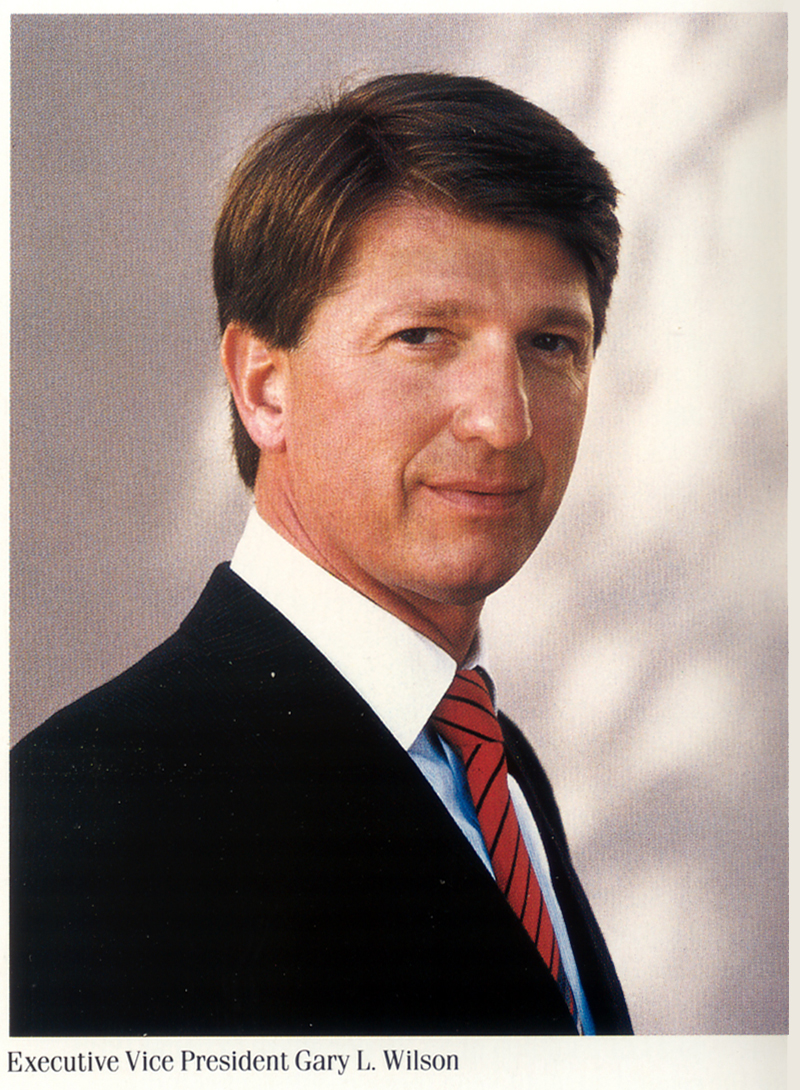
 While The Walt Disney Company continues to be driven from a creative point of view, we now have the financial sophistication and vigor to complement our entertainment strengths. Under the direction of Gary Wilson, our executive vice president and chief financial officer, we have assembled a strong and experienced financial management team and have put into place the discipline and controls necessary to achieve our continued growth.
I have always believed that the creative process must be contained in what we call the “financial box,” financial parameters that creative people can “work” in – but the “box” is tight, controlled and responsible. Gary Wilson has the key to the “box.”
Our primary goal is to maximize shareholder wealth by maintaining earnings growth with high capital productivity. Gary has established a strategic planning group to guide us toward achieving this goal.
We see vast potential in Europe and Asia. That thought was on our minds in October when we went to mainland China to announce an agreement to air our weekly half-hour animated cartoon series, “Mickey and Donald,” on the China Central Television Network.
The trip was one of the most interesting five days I have had at Disney. Maybe it was interesting to me because we are “in” early and can see the great potential there; maybe because we targeted a goal toward a China policy and, under Frank’s guidance, we realized that goal; maybe because the unknown and mysterious to me has now become clear and touchable; or maybe because I was simply happy to get back to the office. Or maybe it was all of the above, plus sharing the trip with my 8-year-old, who now knows his father better and had real knowledge and “I know more than you” on a subject like China that he can use against his older brothers.
Our prospects look uncommonly bright, now and for the future.
The fundamentals are in place. The name “Disney” retains its old magic. The strength of the company as a whole stands behind each of our individual enterprises. The opportunities remain boundless.
Most of all today’s Team Disney – 32,000 employees whose common ground is loyalty and energy and imagination – stands ready to carry our successful company forward into the 90’s.
I guess in a way we must deal with this success the way we deal with our children. We know our children are the best, the brightest, the most attractive, but we should be restrained in our enthusiasm. However, it’s hard to show humility when I am likely to start 1987’s letter with yet another parody – maybe even “The Son of What A Year It’s Been!”
Frank Wells and I send warm regards.
December 15, 1986
Michael D. Eisner
Chairman and Chief Executive Officer
So, that’s another year down.
Note that Eisner leads with news from the studio; indeed it had been the most moribund segment of Disney’s business before Eisner arrived and expanded the production slate. Low budget live-action comedies Down and Out in Beverly Hills and Ruthless People brought in the highest grosses, alongside the Scorcese-directed drama The Color of Money.
For all the talk of “fresh blood,” though, big profits were taken from re-releases; over the course of the year the studio reissued 101 Dalmatians, Sleeping Beauty, Lady and the Tramp, and – yes – Song of the South (which I saw in the Flick theater in Shelby, N.C.).
Speaking of movies, note Eisner’s odd lack of confidence in his own products. I find it an odd admission that he’s always surprised that their releases don’t flop. Also note the sinister talk about Gary Wilson holding the key to the “financial box” in which the “creative” people must work. Then there’s a throwaway line about Wilson creating the strategic planning group. To Disney fans, that’s like finding a one-paragraph mention of Darth Vader’s birth announcement in an old newspaper. It seems innocuous at the time, but in a few years planets would start blowing up and millions would die.
Of course, we get a good mention for each of the three kids, in-laws, wife, and his son has a 16-year-old girlfriend too! And don’t 13-year-old kids talk so funny with the slang and such?
What else… a few months after this letter was written, Disney would sign the final agreement for Euro Disney, and later that year would sell off the Arvida division of which they seemed to think so highly. But that’s all a spoiler alert. Then there’s all the talk of China, which would lead to years and years of negotiations that have yet to reach their full bloom.
Lastly, there’s the first mention of a country fair. Namely, Eisner’s attempt to bring a country fair to Disneyland. Now, I don’t know what happened to our dear CEO as a child that made him pine for ferris wheels and taffy pulls, but his tenure at Disney can in many ways be seen as a lengthy and stealthy campaign to make us go to the fair. Why? The world may never know.
Related Posts...
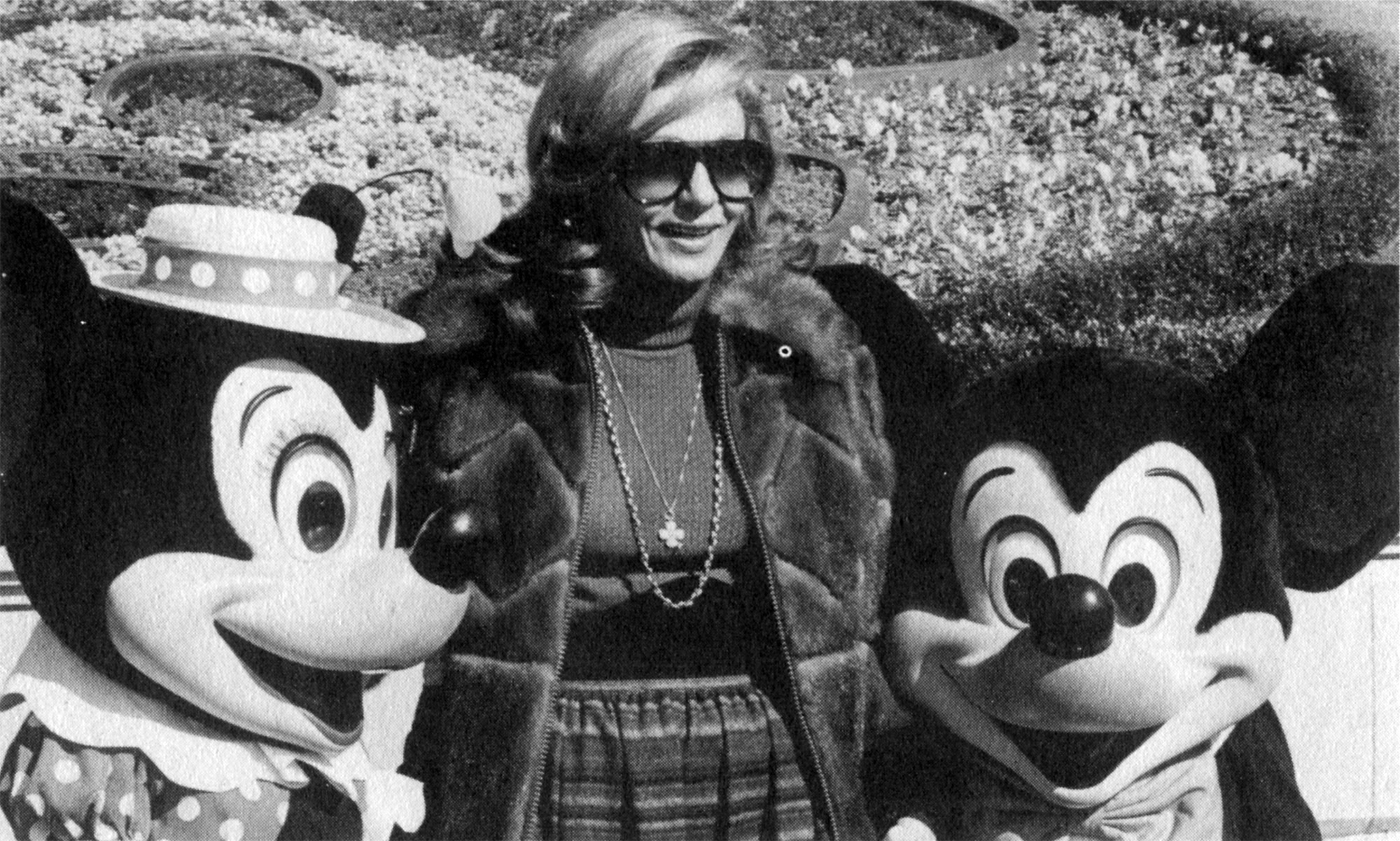 Last weekend, Bob Allen and Carl Bongirno hosted Her Imperial Majesty Shahbanou Farah Pahlavi and her official party for a briefing and update on World Showcase. The Empress of Iran and her party visited the Magic Kingdom early Saturday evening before departing for a formal dinner on the Empress Lilly where she was joined by Governor and Mrs. Askew. (Disney)








Recent Comments