Archives

Contribute to Our Research

An Enchanted Opportunity?

If you mess with Polynesia…

The collected interwebs lit up yesterday afternoon with the breaking news that the Magic Kingdom’s “The Enchanted Tiki Room – Under New Management” attraction had closed due to a small fire. Twitter immediately commenced with a torrent of snark poking fun at the unpopular attraction, and to all the scolds out there I’ll point out two things:

  1. No one was actively, actually, rooting for things to catch fire.
  2. I’m sure that no one would have been so jovial had the early reports not included the fact that the event had been a small blaze which had been extinguished quickly.

It’s even possible that some folks use extreme hyperbole for comedic effect, and don’t mean for every statement to be taken absolutely literally, but that’s beside the point.

In the end, the cascade of jokes about the incident (Did Jose do it? Was it the Orange Bird returning to kick a little tail? Could the elusive Rosita have been responsible?) revealed one thing – people dislike the Under New Management show just as surely as they love the original Tropical Serenade. This isn’t just a fanboy-exclusive gripe, either – the general public stays away in droves, leaving the attraction almost always abandoned. Amidst the puns, jokes, and barely-constrained glee in some quarters was a question: Could this somehow lead to the return of the original show?

I was skeptical. Fans can be a little over-optimistic, sometimes keen to dismiss potential roadblocks to a project, and this sounded like a fairly small-scale incident. Surely it would be up and operating within a few days, and there seemed to be nothing in the story that could reasonably lead to management randomly deciding to throw the fans a bone and go to the trouble of restoring this classic attraction.

Then the news emerged today from a trusted source that, in a twist that might lend credence to the “Tiki god vengeance” theory, the fire most severely damaged the Iago 1 animatronic. This is the Iago figure that hosts the majority of the show, not, ironically, the charred version of the character that appears for the finale. Damage was also done to the Zazu animatronic as well as the large, rotating “birdmobile” that descends during the show; again ironic is the fact that a lot of this collateral damage was done by the fire suppression system instead of the fire itself (although, of course, without the fire suppression system things would have been much worse). This damage, though, was apparently minor compared to Iago’s injuries.

In fact, a word that has popped up repeatedly from people that have seen the animatronic is “unsalvageable,” and the general gist is that our feathered host looks like he’s had a bad run-in with Sarah Connor. This sheds new light on the situation entirely – if there is now need to contract an outside company to manufacture a new Iago animatronic, is it suddenly now cost-effective to return the attraction to its original show? After all, this fire seemed to be an almost tactical strike against only the unpopular elements of the show. Could we actually get the Tiki Room back?

It depends. I have no insider information on this, but we can guess at what a retrofit of the attraction would entail. To restore the attraction to its original state, Imagineers would have to remove the Iago, Zazu, and “Uh-Oa” animatronics and the “magic fountain” would then need to be restored to the central planter. I assume that they would want to remove the fancy movable lighting rigs added for the more raucous Under New Management numbers, and it’s possible that they’d take the opportunity to upgrade the necessary lighting and audio systems. One other question mark would be the ride control system – I have no idea how current the original show’s control equipment was when it closed in 1997, or how easy it would be to port the original show’s commands over to current equipment.

That’s one option. If the show were to stay “as-is”, and the damage is as bad as we’ve heard, Disney will first have to purchase a new Iago animatronic as well as affecting repairs to Zazu. Repairs will have to be made to other damaged elements, including anything damaged by water from the sprinkler system. Add to the the fact that the show was already in very rough shape physically, and desperately in need of a complete refurbishment regardless of its content, and this suddenly becomes a lot of cash to throw into a show that you know no one is going to come to see.

So that’s the choice. I’m not even going to consider option #3, which is leaving the pavilion sitting closed for years at a time. That’s unacceptable. There’s always the outside shot that we’ll get an entirely new show, as was rumored years ago before the economic woes hit, but that would take some time to design and install. Of course, if they wanted to go crazy they could turn it into an elaborate supper club dining facility and show, but I’m trying to manage expectations here.

Wouldn’t it be better, my dear friends at Disney, to rush into production on a restoration of the Tiki Room to celebrate the resort’s 40th anniversary this October? To bring back a true Walt-inspired vintage Disney classic for the park’s birthday celebration? To do something that would not only make fans ecstatic, but would please “civilian” guests as well?

You’re going to have to do something, after all, so wouldn’t it be wonderful if this were both cost-effective and crowd pleasing? And all so cosmically perfect considering the 40th anniversary? Look at all that Tiki-inspired Kevin Kidney & Jody Daily and Shag art they sell at Disneyland! Don’t you want a little bit of that action? Wouldn’t you rather we drop our Tiki coin in your coffers instead of Anaheim’s?

This might just be your chance to do something awesome, oh Disney friends.

One thing is important, though. If you do restore the attraction you must move its entrance from its current concealed location to somewhere more visible – the promenade leading to Pirates of the Caribbean would be an obvious choice. A barker bird wouldn’t hurt, either. Just saying.

Do it for Jose, Fritz, Michael, Pierre, Rosita and the Orange Bird. Do it for the sake of doing incredibly awesome things just because you can. Do it because you can take the unfortunate circumstances of this fire and transmogrify it into something super-fantastico and crowd pleasing.

A give us a Tiki Garden, too? Pretty please?

Think how happy the Tiki gods would be…
Related Posts...

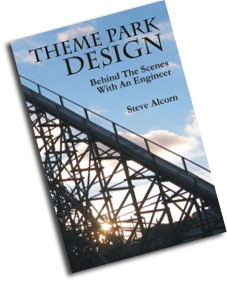
Progress City Library – Theme Park Design: Behind The Scenes With An Engineer

For my entire living memory I’ve been obsessed with Imagineering. A childhood was spent poring over my hoarded issues of Disney News and the few park-related books that existed, and was aided and abetted by daily viewings of Walt Disney Presents and the fact that the Disney Channel actually showed park-related content. Yet despite the near-constant presence of WDI in my life, I’ve come to discover in recent years that I actually know very little about the Imagineering process.

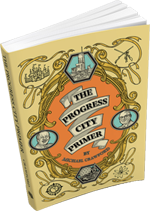
It’s easy to conjure images of talented artists cranking out conceptual renderings, or of wacky engineers tinkering with animatronic chickens and pirates. Imagineering doesn’t end after that, though, and something happens after those inspiring renderings are handed off that’s more complicated than just “guys show up and build a building and the ride opens.” Imagineering is often defined as the combination of the skill of the artist and the talent of the engineer and that’s where this book comes in. Theme Park Design, by Steve Alcorn, provides a look at the Imagineering process that goes beyond the Blue Sky phase into actual ride and show design, engineering and installation.

Alcorn is no stranger to the industry; after becoming an Imagineer to work on EPCOT Center, he founded Alcorn McBride Inc. in 1986 and subsequently became one of the best-known providers of show control equipment. This lends an air of experience to his writing; while this book is by no means is a narrative of his time at Disney, he does incorporate several anecdotes throughout to illustrate certain points. More amusingly, he conveys the viewpoints of different groups from the creative and technical disciplines, and the internecine rivalries that result. Even among the various engineering disciplines are key differences in perspective and – naturally – in the trenches, everyone thinks that they have it right. Alcorn conveys these differences and the “gallows humor” that comes from looming project deadlines with his trademark good humor and light tone.

One of the confusing features of Imagineering is that is uses terms that might be familiar from the film industry, but in different ways. Hence my frequent confusion over terms like “art director” or “show producer” when they’re used in discussing attractions. Alcorn explains these roles, as well as the differences among the many types of engineers, and explains the difference between show control systems and ride control systems. These might seem like elementary concepts to those who create attractions, but to laypersons like myself the differences are easily lost.

Also described are a number of design and operational considerations that we might not think of when we’re “backseat Imagineering” our own attractions; it all goes to show how complicated even the simplest attraction is to design, and why exactly it takes so long for these things to come together. Things have changed since Disneyland was built in a single year.

The book almost takes the form of a primer; it doesn’t dwell too long on any one topic, choosing instead to serve as an introduction to the industry by touching briefly on a number of subjects. It’s not overtly technical, and discusses complicated systems in a fairly simple way. There are a few extremely minor nitpicks for the park history obsessive – Walter Cronkite was not the first narrator for Spaceship Earth, and Mr. Toad’s Wild Ride closed at Walt Disney World instead of Disneyland – but as you can see these are indeed minor semantic issues in a book that is not a historical work. On the topic of engineering ride and show system, few are more qualified to speak than Alcorn.

It’s possible that I’m biased, as I agree with many of the statements that Alcorn makes about the philosophy of themed design. At first I winced when the supremacy of “story” was brought up, as the term “story” has been flogged to death in recent years to excuse a number of sins. The lines between “story,” “plot,” “narrative” and “theme” all seem to have dissolved, and I was afraid that Alcorn was going to push in that direction. Thankfully, that turned out not to be the case.

At the end of the book, Alcorn gives a wish list of trends he’d like to see emerge in the industry. I agree with all his points, but most especially his third. I’ll excerpt briefly:

I long for themed experiences that really immerse me in history, or technology, or whatever their specialty may be.

There are so many wonderful discoveries being made about space and molecules, our bodies and our environment. Captivate me with such knowledge. I’m certain that with the right story it can be done.

We aren’t ignorant fools. It’s time theme parks stopped treating us as if we were.

Amen.

Whether this book is for you depends on a number of factors. As I said it’s not a historical work nor is it an autobiography. There are a few examples taken from Alcorn’s work throughout the years, both on EPCOT and on attractions like Universal’s superb The Amazing Adventures of Spider-Man, but this is neither a book specifically about Walt Disney Imagineering nor a behind the scenes tell-all. But for those of us who really do want to understand the processes underlying the themed attraction industry, and want to discover what happens in that mysterious “black box” between Blue Sky and opening day, this is a great place to start.

Theme Park Design: Behind The Scenes With An Engineer – 224 pages, softcover. Published by Theme Perks Press. $19.99. Available in print and for Kindle.

Related Posts...

Elseworlds – A Different Look At The Polynesian

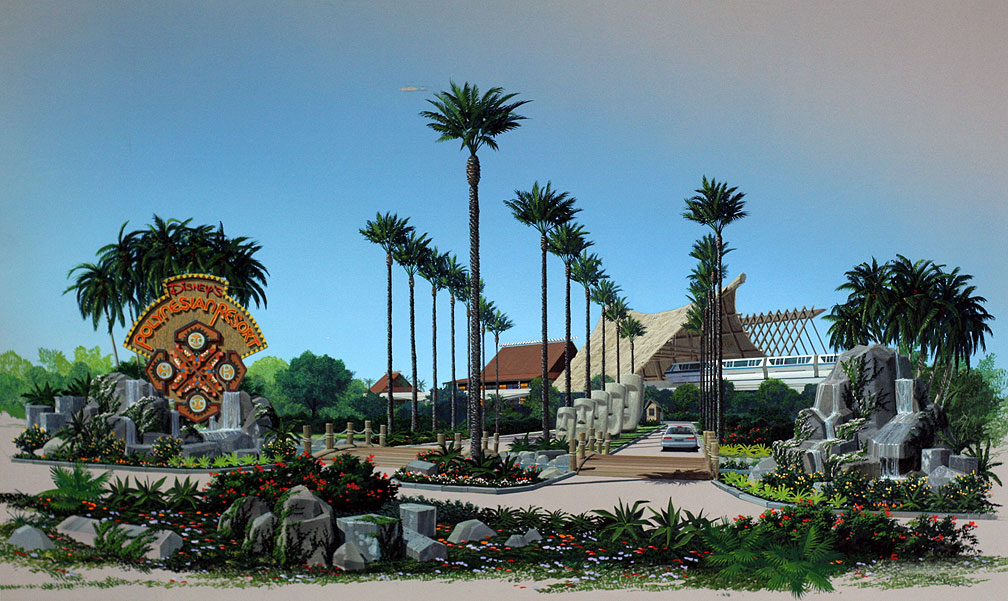
Tiki Talk has posted this intriguing artwork, which was found, of all places, at a flea market. Apparently the artist made a living in the 1980s doing renderings for architectural firms; he produced this work for a Houston company that was bidding on the contract for a mid-’80s refurb of the Polynesian Resort at Walt Disney World. Obviously, the firm’s proposal was not selected.

I kind of dig this design. I would make some changes – substituting tikis in for the Moai for one – but overall I find the effect far more pleasing than the resort’s current entrance. I like the wide-open layout and the use of greenery, rockwork and moving water. It’s a far more impressive approach than the current design, which routes cars through an inauspicious entrance into a rather unappealing parking lot. It’s not really an atmospheric way to arrive at a “deluxe” resort, especially one whose theming in general is quite appealing and immersive. The design in this artwork is far more welcoming and grand.

And I really dig that sign treatment, too.

Related Posts...

Hmm…

Related Posts...

Diggin’ In Hong Kong Disneyland

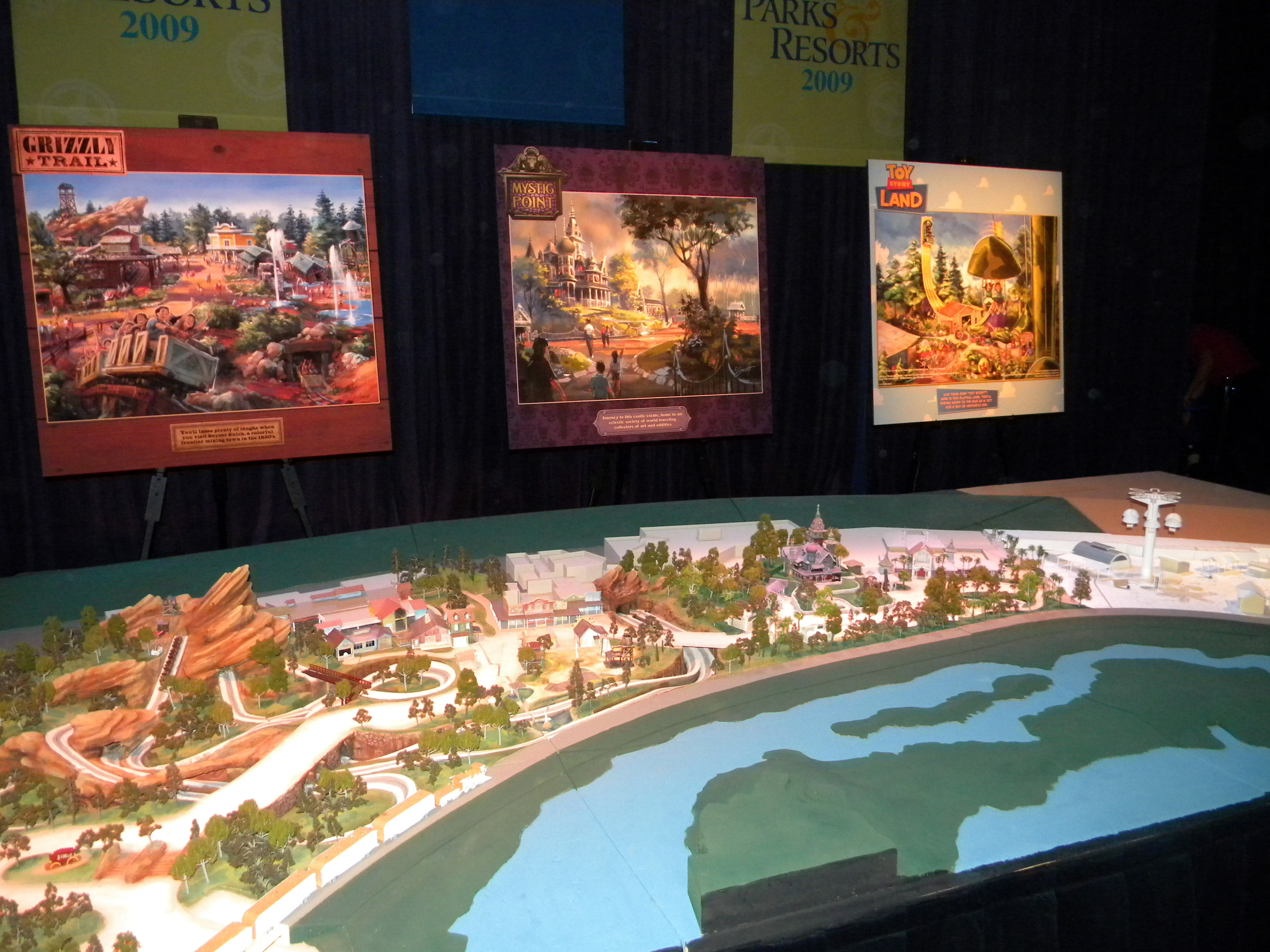
A model of the three Hong Kong Disneyland mini-land expansions from the 2009 D23 Expo

Before the holidays, Hong Kong Disneyland posted a rather triumphant video showing the construction that is currently underway in that park. The massive expansion site sits outside the park’s berm, and will contain three mini-lands: Grizzly Trail, Mystic Point and Toy Story Playland (ugh). It’s always exciting to see earth being moved in a Disney park, even if I don’t speak a word of Chinese. At least everyone seems really excited!

You’ll find the video below. After that, I’ve included some pictures from 2009 of models and artwork for the Big Grizzly Mountain Coaster. It looks like it should be a fairly entertaining ride, as wacky animatronic bear gags are always welcome. We’ve shown artwork for Mystic Manor in a previous post; for Toy Story Playland you’re on your own. You can see the model in the video, though, which just goes to show how badly it will screw up the park’s sightlines. Those parachute towers will look great from the Jungle Cruise! The other new areas look pretty nifty, though, so check it out:

Continue reading Diggin’ In Hong Kong Disneyland

Related Posts...