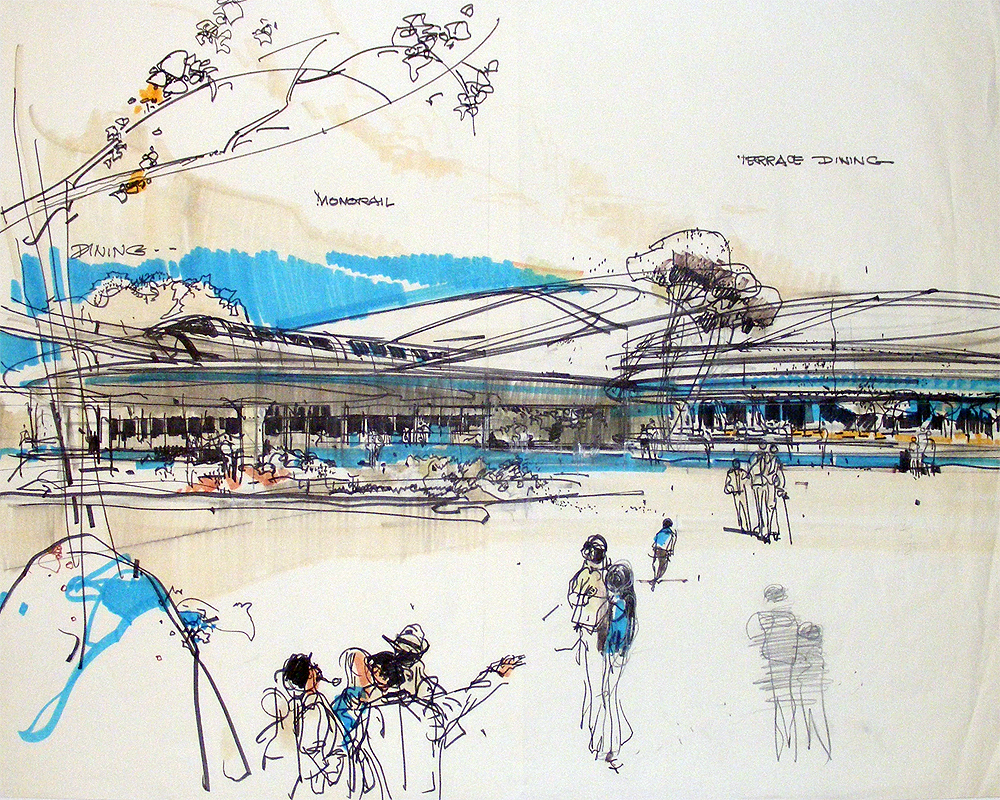
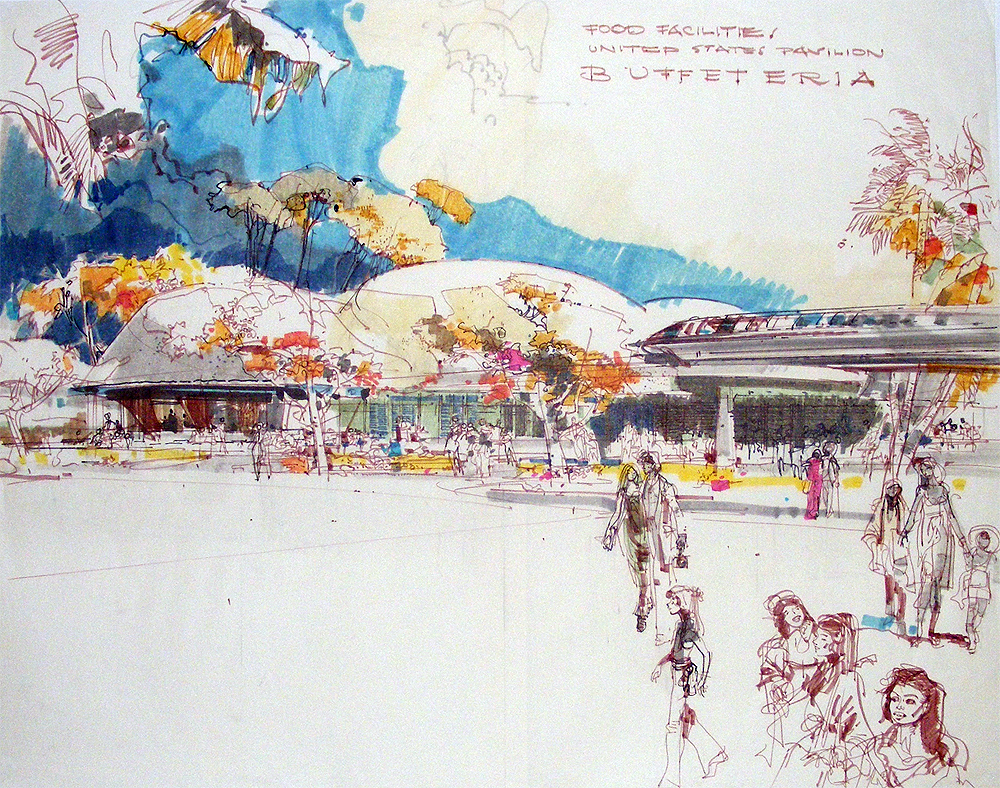
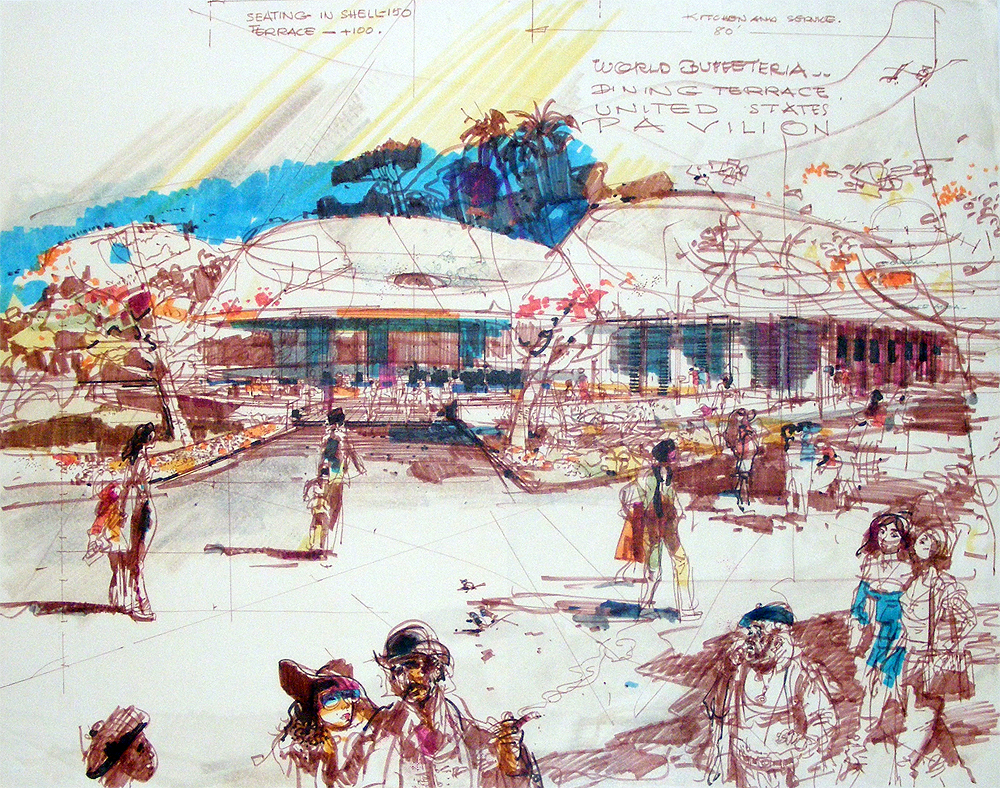
Here’s a little look at the development of an idea that never appeared in the parks; these sketches by Imagineer Herb Ryman show the evolution of a concept for a “buffeteria” dining area in EPCOT. The sketches are undated, but we can divine that they are from fairly early in the park’s development – most likely somewhere between 1976 and 1978. First, they’re labeled as “United States Pavilion” instead of American Adventure, and we also see the monorail in two of the sketches which indicates that this was indeed the earlier version of the pavilion that was to be built between Future World and World Showcase.
Notes on the sketches indicate that the facility would seat 150 inside the “shell” and 100 on an outside terrace. The restaurant is labeled as “World Buffeteria” – perhaps that indicates that it was to feature a variety of cuisines? Buffeteria, of course, is one of those great old coined words that Disney used to create for their parks; this invented vernacular helped create a sense that you were truly in a unique place set apart from the regular world. Other buffeterias included the original incarnation of EPCOT’s Le Cellier as well as the beloved Trail’s End Buffeteria at Fort Wilderness.
Take a look at this progression of sketches:
While few will argue that this was Ryman’s most compelling assignment, and, in fact, details of the building itself are frustratingly vague, there’s one thing that’s really entertaining about these sketches – the people! Ryman’s art was famous for the cast of characters that circulated in the foreground, and it looks like Herb might have been more interested in the people in these sketches than in the buffeteria. I especially love the Edwardian gent in the bowler hat with his stogie, with what appears to be Carmen Sandiego on his arm. In that last sketch it even looks like Mr. Smee is in attendance, and, in a strangely prescient touch, Princess Jasmine. Some of these characters are so detailed, I wonder if they were based on real people.
Maybe the World Buffeteria won’t wind up being as lamented a lost attraction as Equatorial Africa, but the cast of characters there would have been really interesting!
Special thanks to John Donaldson for sharing these images
Disney’s roll-out of classic titles on Blu-ray continues with the recent release of 1951’s Alice in Wonderland in a Blu-ray/DVD combo pack. While the high-definition release adds little new bonus content, the slate of extras ported over from previous DVD releases means that Alice still features far more to see than most new Disney home video releases.
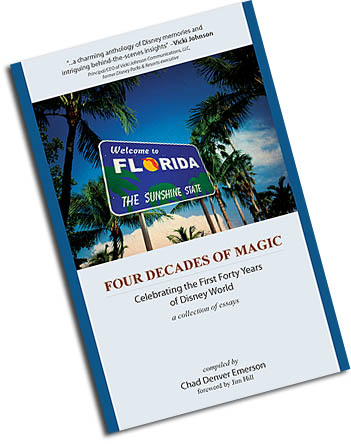
One more notice for those of you who – like me – insist on having physical representations of media instead of digital: Four Decades of Magicis now available in actual, made-of-paper form from Amazon. It is, of course, also available for Kindle.
For more details on its contents, and on my contributions, check out our previous article or Ayefour’s website.
Tomorrow marks the end of an era, when Mickey’s Toontown Fair closes in Orlando. Twenty-two years after its opening as a “temporary” area, Mickey’s Birthdayland, the cobbled-together land will face the bulldozer in preparation for the Fantasyland expansion.
Mickey’s Birthdayland debuted to celebrate the Mouse’s 60th birthday in 1988. Pieced together on a shoestring budget in only a few months, the area included a live show, a Mickey meet-and-greet, a petting zoo, and a small playground. The rather low-rent aspect of the land was kind of shocking back in 1988.
The show in one of the circus tents was replaced a few times over the years; when the area was renamed Mickey’s Starland in 1990 the show changed to focus on the the-popular “Disney Afternoon” cartoon lineup. In 1996 the area was closed and upgraded, and re-opened as Mickey’s Toontown Fair. The buildings were made more permanent, the rotting temporary tents were replaced, and more landscaping was added. Disney also added the Barnstormer kiddie coaster, and houses for Minnie Mouse and Donald Duck.
For a trip back to when the land was new, let’s look at this clip from the 1988 Walt Disney World 4th of July Spectacular. It gives a pretty thorough look at the land at the time, and shows actual scenes from the Minnie’s Surprise Party show. There’s actually quite a bit packed into this clip, so watch closely:
So, let’s break down some of the small details. You might have noticed that Mickey’s Birthdayland wasn’t even Toontown – it was Duckburg! Considering that the TV show Ducktales was popular at the time, and that Duckburg was the only prominent fictional urban area in the Disney canon at the time, it made sense. I still pine for Duckburg to be done right in a Disney park. The area was filled with lots of trappings alluding to the fictional culture of Duckburg.
Did you see the kids eating the old – and much more awesome – Mickey Mouse ice cream bars? How about the old-school blue strollers? Did you see Roy Disney looking spookily like Walt? How about young Michael Eisner? The tiny boat, which was supposed to be Donald’s house, which was actually in Mickey’s backyard? How about Roger Rabbit, making his way into the picture? Grandma Duck’s Barn, and Maid Marian? The Mouse-ka-maze? And someone with a side ponytail!
How about the street names? Walt Street, Hyperion Blvd., Tailfeather Trail and Cornhusker Lane.
You can also see that there were several small-scale fake storefronts around the outside of the circus tent. There was Daisy’s Cafe and the Duckburg News, as well as Goofy’s Clip Joint Barber Shop – a name I’ve always found surprising!
One question – why do Mickey’s home movie titles make it look like he’s 4 years old?
Anyway, after two decades of mockery by theme park snobs like me, Toontown Fair is gone for good come the morrow. Mickey and Minnie will take up residence temporarily in Tomorrowland, until their new digs in the Main Street Exhibition Hall are completed. So sayonara, Toontown Fair – may your basic concept be revisited in the future with better results.
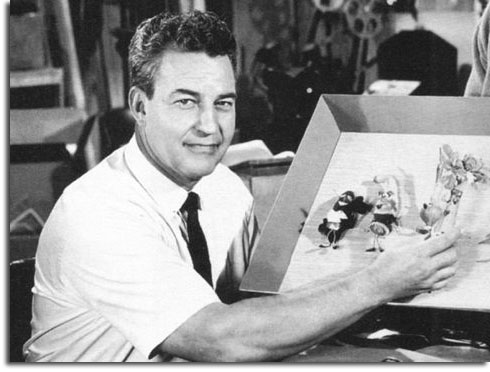
Bill Justice in his animation years (Photo via Cartoon Brew)
The sad news arrived today that Disney animator, artist and Imagineer Bill Justice passed away this morning only a day after his 97th birthday. During a remarkable 47-year career at the company, Justice contributed to the animated features of Disney’s golden era as well as the later theme park triumphs of WED Enterprises.
Born February 9th, 1914, in Dayton, Ohio, Justice grew up in Indiana and studied art there before moving west in 1935 and signing on as an animator at Disney in 1937. He worked on a number of the classic animated features (contributing the character of Thumper to Bambi) as well as famously creating Donald’s arch-nemeses, the mischievous chipmunks Chip and Dale. Later, with fellow artists X. Atencio and T. Hee, Justice began to experiment with stop-motion animation using both cut paper and found objects; this technique was used in a number of shorts such as Noah’s Ark (1959) and A Symposium on Popular Song (1962) as well as in many well-loved feature film title sequences of the period. Here’s one from 1961’s The Parent Trap:
And here’s one of his animated segments from A Symposium on Popular Song:
Justice even appeared as himself in a 1961 episode of the Disneyland television show entitled The Title Makers, which showed how he, T. Hee, and Atencio created these sequences.
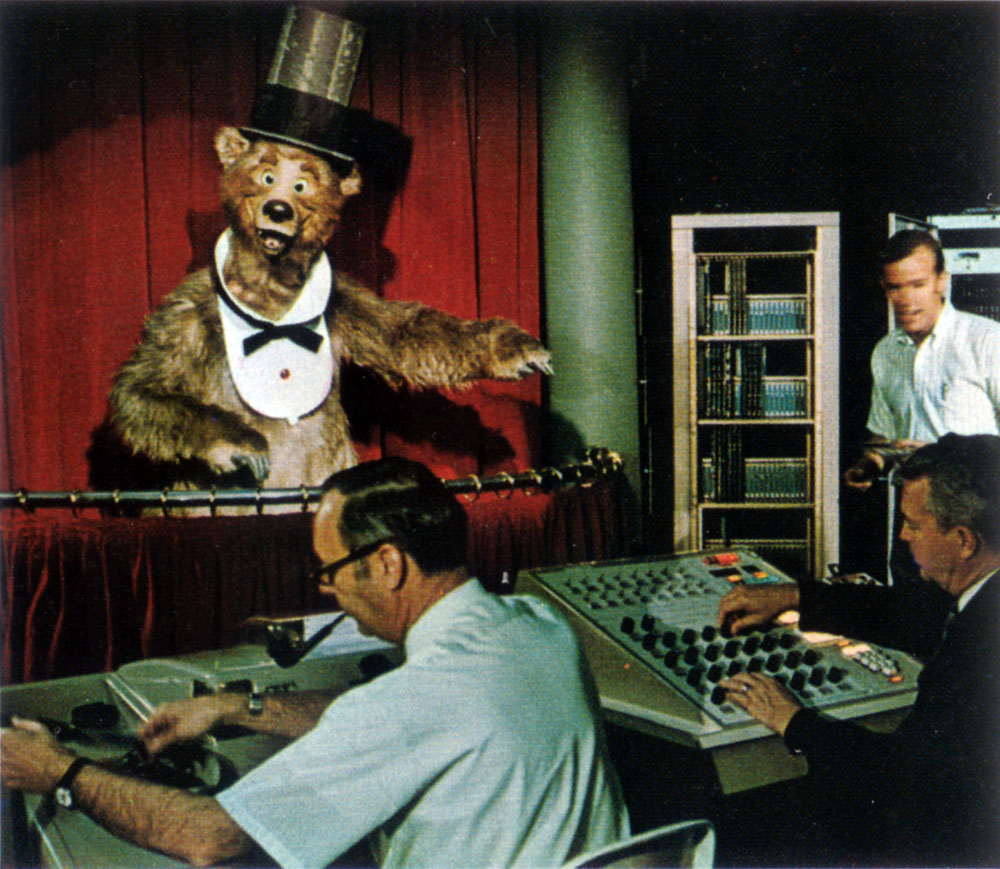
Like many of his peers at Disney during this era, Justice was a renaissance man who wound up working in many different media. In 1965, Walt moved Justice to WED Enterprises and made him an Imagineer, where his skills as an animator served him well as a programmer of Audio-Animatronic figures. Justice programmed figures for the big-name attractions of the time, including Pirates of the Caribbean and the Haunted Mansion. For Walt Disney World he would program the vast robotic casts of The Hall of Presidents and The Mickey Mouse Revue.
Wathel Rogers and Bill Justice programming the Country Bear Jamboree, 1969
Justice also designed this logo for Disney's ACES motion-control camera system
But like any good renaissance man, Justice was always busy working on a number of small projects that used his talents to plus every corner of the Disney empire. Perhaps best-known to Walt Disney World history buffs is his character mural that decorated the pre-show area for 1973’s The Walt Disney Story in the Magic Kingdom. Containing more than 170 characters from all of the Disney features and many of the most popular shorts, the mural took four months to complete.
The tradition, for several years, was for new characters to be added to the mural after each new Disney animated feature was released, but this practice was discontinued some time in the mid-1980s. Sadly, the mural has been little-seen since the Walt Disney Story closed in 1992 and the preshow area became increasingly disused, with only a brief revival as exhibit space for Walt Disney World’s 25th anniversary in 1996. When the attached building became the Main Street Exposition Hall a few years later, Justice’s character mural was placed off limits and concealed behind a curtain. The area is currently being extensively remodeled to accommodate a Mickey and Minnie meet-and-greet, and many fans worry that the mural will not survive the changes.
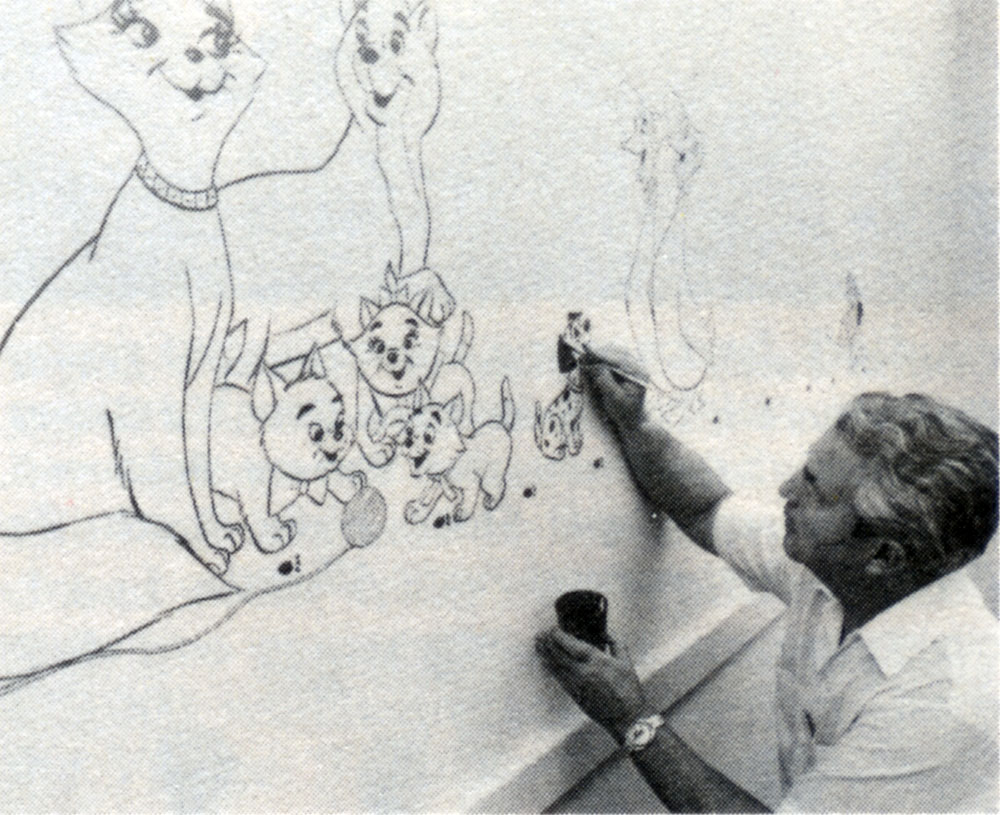
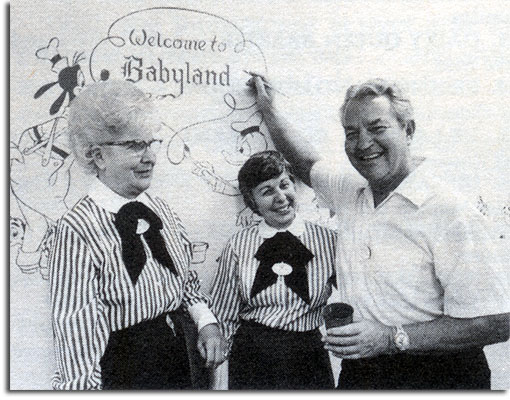
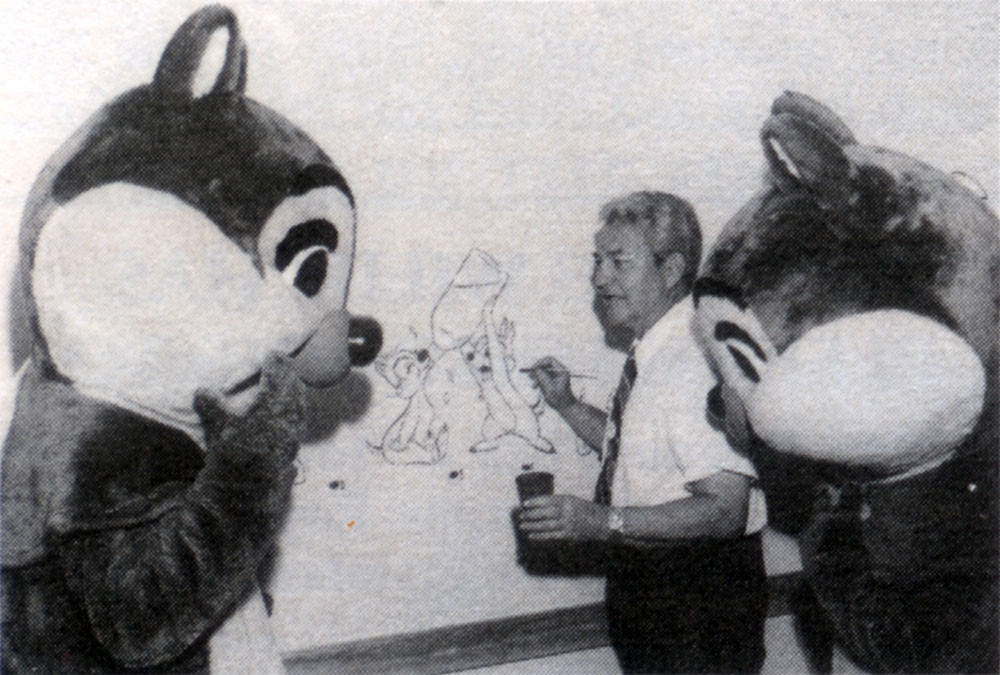
But Justice’s contributions extended down to even the most small-scale project. Take, for instance, the Magic Kingdom’s Baby Station, for which Justice painted a mural after the facility’s refurbishment in 1976.
Justice paints Dalmatians for the Baby Station in 1976
The Baby Station had opened from an extensive rehab in January of 1976, and Justice visited from California that March to paint a decorative mural for the area. Said Eyes & Ears, reporting on Justice’s visit:
Bill started off by painting Goofy and Donald ‘painting’ a sign at the entrance to the station, saying ‘Welcome to Babyland’, with some Dalmatian puppies playfully looking on. And of course, several of the puppies stumble into the buckets of paint and off they go romping around the Station walls, leaving hundreds of small footprints and meeting many of their favorite Disney characters.
A count of the mural components shows there are 74 Dalmatians with 1,268 spots on their backs leaving 186 footprints and meeting 34 other Disney characters. That’s quite a mural!
The Ladies Man? Justice with Babyland hostesses Helen Schley and Jean Cullity.
Eyes & Ears spent some time asking Justice about his life and career, and we’ll post this as a tribute.
Justice, who hails from Indiana, answered a Disney ad for animators back in 1937, and began his long career with our company. But he was not new to the field of art, his schooling included art lessons four hours a day for four years through high school, then on to a professional art school.
When Bill joined Walt Disney Productions, he was put to work on our company’s first full-length animated feature film, “Snow White.” He moved up to become one of our key animators and worked on such Disney classics and “Fantasia,” “Alice in Wonderland,” “Bambi,” “Peter Pan,” “Babes in Toyland,” and “Mary Poppins.”
Bill told us one story we found interesting … of how he had created two new Disney characters some years back, Chip and Dale, and was later asked by a friend to speed up a record at a party as a joke. When he sped up the platter, the highpitched chatter that came out was just what he had been looking for to be his two new characters’ voices … so Chip and Dale became speaking characters.
Along came television and Bill moved to directing animation and cartoons for the “Mickey Mouse Club.”
Around 1968, Bill left the Studio for WED, where he became involved in a new art form … Audio-Animatronics. He put his animation talents to work on a computer programming machine, as he say behind the console and brought mechanical characters to life with natural movements. He worked on attractions including Hall of Presidents, Haunted Mansion and Peter Pan.
Today, Bill is still with WED as both an animator and designer. And if you visit his mural, you’ll see that his talent of bringing Disney characters to life is more evident than ever!
Justice paints the Baby Station mural with help from a few friends
Justice was a true Disney legend, and our thoughts go out to his family today.
From the Progress City archives comes this collection of 33 tall tales and true from Disney history. Available in paperback, hardback, and ebook formats.

 in actual, made-of-paper form from Amazon. It is, of course,





Recent Comments