Engine 275, a Baldwin 4-6-0, en route from the Yucatan to Tampa, where it was refit and restored to become the Walt Disney World Railroad’s “Roger E. Broggie”
When Walt Disney World’s Magic Kingdom was being designed, Imagineers had to seek out steam locomotives to power the park’s new Railroad. In early 1969, two of Disney’s in-house train specialists, Roger Broggie and Earl Vilmer, traveled to Mexico’s Yucatan peninsula in search of antique engines. The Ferrocarriles Unidos de Yucatán (United Railways of Yucatan) was divesting all of its old steam engines as they began to upgrade to diesel stock, and the Disney men wound up purchasing five locomotives and an array of spare parts and other cast-offs.
The well-worn engines were shipped by train – very meta – across the continent to Tampa, Florida. There, at the Tampa Ship Repair and Dry Dock Company, they were extensively restored and retrofitted to bring them up to Disney show standards.
Above and below are two rare pictures of the locomotives en route from the Yucatan to Florida. As you can see, they were hardly the showpieces they are today. Above is engine 275, a 4-6-0 model built by Pennsylvania’s Baldwin Locomotive Works in 1925. Today park guests know it as the Roger E. Broggie, named for the Imagineer who purchased it in 1969. Ironically, the Roger E. Broggie bears the serial number 58445; this shows it was built consecutively with another Disney engine, the Walter E. Disney, which is serial number 58444. Still in operation in the Magic Kingdom today, the two trains once sat on Baldwin’s production floor way back in 1925; both 4-6-0 designs, they are essentially “twins”.
The five Disney locomotives en route from the Yucatan to Tampa, 1969
Here we see all five Disney locomotives as they were arranged for transport. From the front of the train we have the Lilly Belle, a 2-6-0 Mogul built by Baldwin in 1928; the Roger E. Broggie; the Walter E. Disney (Engine 274); and the Roy O. Disney (Engine 251), a 4-4-0 American built by Baldwin in 1916. The final train, the one in the picture’s foreground, was a fifth engine that the Disney men bought for $750. It had apparently been junked, but perhaps Broggie thought it could be salvaged.
This mysterious fifth engine was a 2-6-0 Mogul, like the Lilly Belle; it had been built in 1902 by the Pittsburgh Locomotive Works. Unfortunately, the locomotive proved to be too far gone to warrant restoration, and it was later sold off to an outside party.
P.S. The other park you see is Magic Mountain in California. In the Walt Disney World footage, keep an eye out for the old Polynesian Village Resort pool.
Sometimes you can see a picture a dozen times and miss a very crucial detail. I recently watched the 1987 Disney Channel special, Backstage Disney: The American Adventure; I’ve seen this show several times since its debut oh so long ago, but somehow every time I did, I seemed to miss a very important detail.
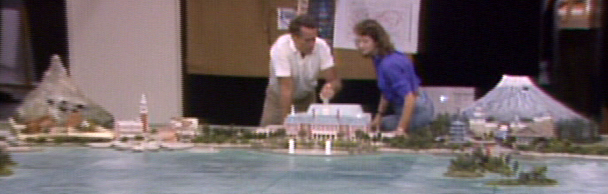
Near the start of the show, the camera lovingly takes in the large Imagineering model of Epcot Center that we’ve seen countless times in print and film. But… there are a few important details.
Do you see what I see?
Yes, that’s the Epcot Center model but there are a couple of major additions depicted that have sadly never been brought to life in the real world. Long-time fans might know that during the “Disney Decade” of the 1990s, plans were announced to build a replica of Japan’s Mount Fuji in World Showcase, as well as a new Switzerland Pavilion featuring the Matterhorn. But while some artwork was released at the time, and in subsequent years, I have never seen an image of the park model with both attractions in place. It’s a stunning thing to see with your own eyes, and really does convey just how much these attractions would have changed the park’s landscape.
Randy Bright and an unknown second Imagineer examine the American Adventure while flanked by models of the Matterhorn and Mount Fuji.
Aside from the mountains, you might also note that the model of the Italy Pavilion features some of the once-planned expansions for that area.
It’s somewhat surprising to see these mountains on the World Showcase horizon at this early date; they weren’t announced to the public until 1990. And while Switzerland had long been anticipated as a future part of Epcot Center since its 1982 opening, most early plans for expanding the Japan Pavilion centered on the Meet the World theater attraction.
One concept for an Epcot Center Switzerland Pavilion
The Japan Pavilion, with Mount Fuji towering in the background
At the very least, these mountains might have blocked out some of the visual intrusions from the Swan and Dolphin hotels.
Planned for the Matterhorn was a slightly more elaborate version of Disneyland’s original bobsled rollercoaster. Mount Fuji, too, was intended to house a thrill ride, with bullet trains instead of bobsleds as the coaster vehicles. It seems strange that Imagineers considered adding two steel coaster rides at the same time, on either side of American Adventure, and yet that is what was announced for the Disney Decade in 1990.
Obviously, the plan never went through. These attractions, as well as an announced Russia Pavilion, had not appeared by the end of the decade. Mount Fuji fell prey to a few factors; funding was one, of course, as well as the fact that Fujifilm was the prime rival of existing Epcot Center sponsor Kodak. Deals to fund Switzerland fell through, too, but the idea continued to be revisited until at least the end of the 1990s. World Showcase has not been expanded since; its most recent addition was the Norway Pavilion in 1988.
Still, it’s exciting to get a rare glimpse at what could have been. It just goes to show that you really need to pay attention when a camera pans across the room at Imagineering.
Recently, as part of their “limited time magic” promo, Walt Disney World held an event which let guests mingle with “obscure” Disney characters. In the end the characters they featured were neither obscure or even particularly rare, but the concept in general is a good one. Disney history is littered with characters who were used for special events or were tied into films, television shows, or other properties that are long gone from the spotlight; characters appeared in the park for every animated feature from the 1980s and 1990s, but when was the last time you saw llama Kuzco or the cast of The Great Mouse Detective?
While they’re no longer marquee names, many of these characters are still loved by fans and are worth trotting out on occasion. Who wouldn’t want their pictures taken with the Rocketeer, or the DuckTales crew, or any of a hundred long-abandoned walkaround characters?
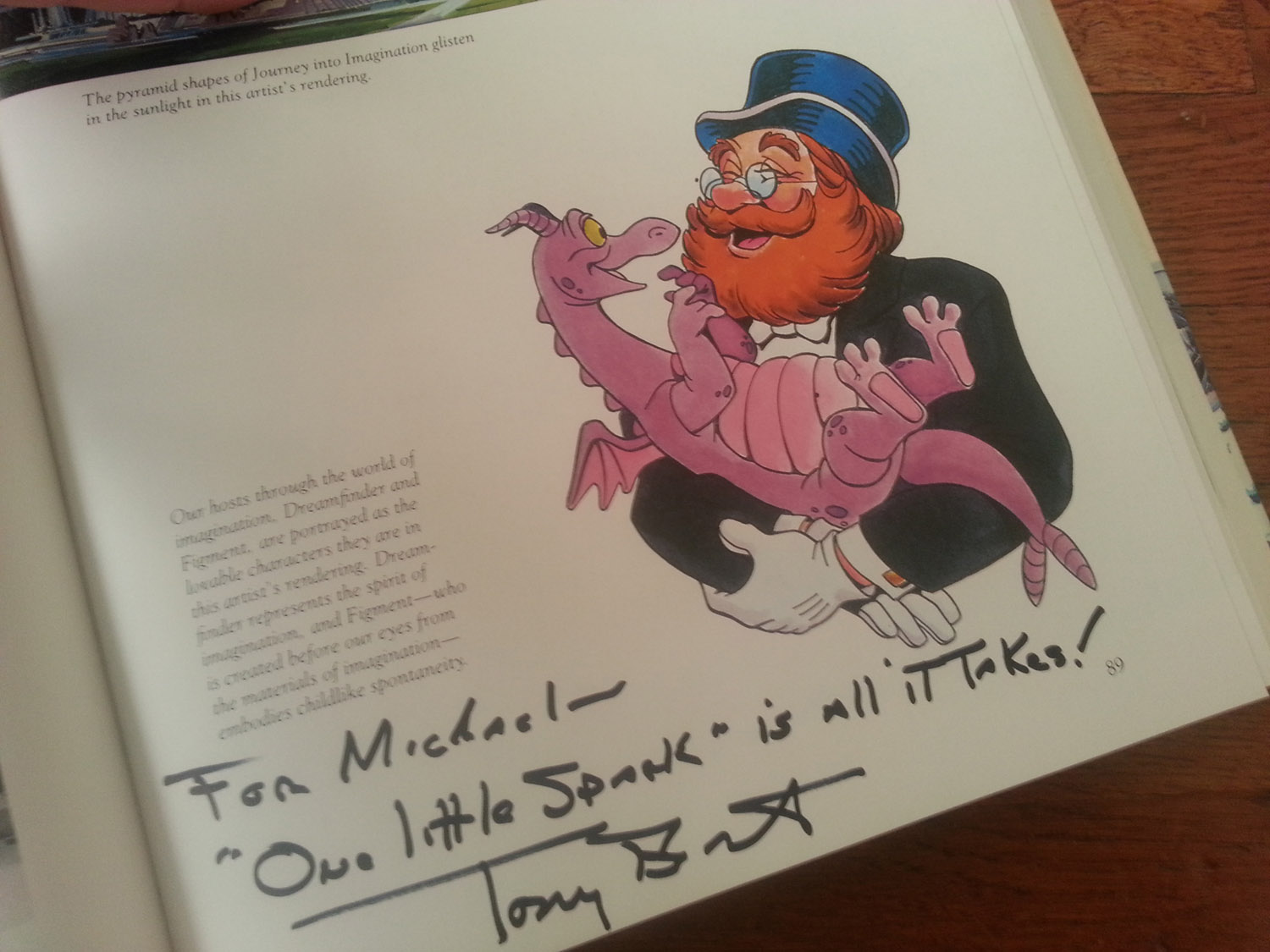
The forgotten Disney roster doesn’t end there, though. Aside from film and TV stars, Disney also has created many one-off characters for specific in-park uses or for special events or outside sponsors. Dreamfinder and Figment, as well as the recently-flourishing Orange Bird are famous examples of park-specific characters; don’t tell me there wouldn’t be a meet-n-greet queue if they were to return. Where is the line to meet the Kaiser Aluminum Pig? Outside of the parks were a slew of others, many long forgotten, including Andy Anaheim and the 1984 Summer Olympics mascot, Sam the Eagle.
Occasionally, though, no matter how much of a nerd you are for these obscurities, you find something that you’ve never heard of. Something that somehow flew under your radar. Something so bizarre and amazing that it quickly becomes one of The Best Things Ever.
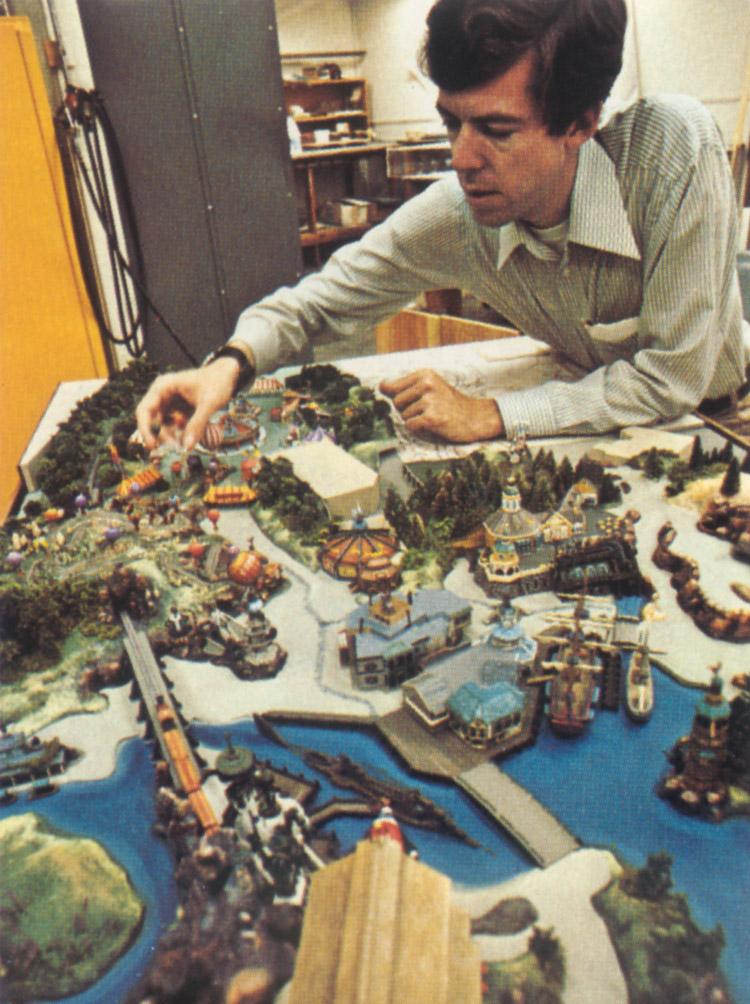
Tony Baxter with models of Discovery Bay and Dumbo’s Circus, 1976
As you’re no doubt aware by now, veteran Imagineer Tony Baxter resigned from Walt Disney Imagineering last Friday, his birthday, after a remarkable 47 years with the company. Tony will be staying on as a consultant to the company, providing his insight to those who are wise enough to seek him out.
But despite the fact that Tony will no doubt continue to do great work in the years to come, the fact that he has been a very public face of Imagineering for decades make this a deep loss for fans. Tony was not only the creative lead of a number of extremely significant attractions over the years, but he was also a very tangible link to the Golden Age of Imagineering; directly mentored by the great Claude Coats, Tony worked alongside a pantheon of creative legends in his early years. He is also one of the very few active Cast Members who were working for the Company when Walt was still alive.
As for the slate of Tony’s accomplishments, I’m reminded of the scene in Jaws when Robert Shaw introduces himself by saying “You all know me; know how I earn a livin’.” Tony’s resume is well-known to any fan, but bears re-examination; when you think about it, you’re staggered by its magnitude. With the customary caveat that no project is the work of any one individual, it seems clear that Tony has had the single greatest influence among active Imagineers on the modern Disney parkscape – the vision of Disney theme parks that most of us grew up with.
After all, what is a modern Disney park without Big Thunder Mountain? Without Splash Mountain? It’s hard to imagine what Disneyland would look like without Tony’s influence, and his breathtaking 1983 overhaul of that park’s Fantasyland completely re-invented how we envision that “cardinal realm” of Disney parks. It’s proved the template for similar lands ever since.
The list goes on: Star Tours, Indiana Jones Adventure, and the not-so-insignificant contribution of that jewel of a park, Disneyland Paris. He’s made critical contributions to everything from The Living Seas to Soarin’. And, for much of the last decade, he’s devoted himself to the restoration of his beloved Disneyland; his steady hand has guided the return of Great Moments with Mr. Lincoln, the Sleeping Beauty Castle tour, and the long-dormant submarines of Tomorrowland. Some might scoff at these smaller-scale projects, but I envy Tony for being able to tackle these deeply significant attractions that are fundamental to Disneyland’s unique texture. Disney parks are not beloved because someone plopped a bunch of “big box” e-tickets in a parking lot; it’s the unique blend of A-E ticket shows that makes Disney special, and featuring a variety of experiences allows everyone to enjoy the parks. Great Moments with Mr. Lincoln is just as important to Disneyland as Space Mountain, and Tony understands that.
Equally numerous as the attractions we’ve listed are the grand visions which never came to fruition. What fan doesn’t still pine for Discovery Bay, thirty years later? Tony’s proposed-but-unrealized projects read like a checklist of park devotee fantasies; they range from endless concepts for Disneyland and Disneyland Paris to my own personal obsession, WESTCOT. They also include a warehouse full of ideas that remain yet unknown to the general public, but will astound and amaze when they one day come to light. If you pine for “what could have been,” you ain’t seen nothin’ yet.
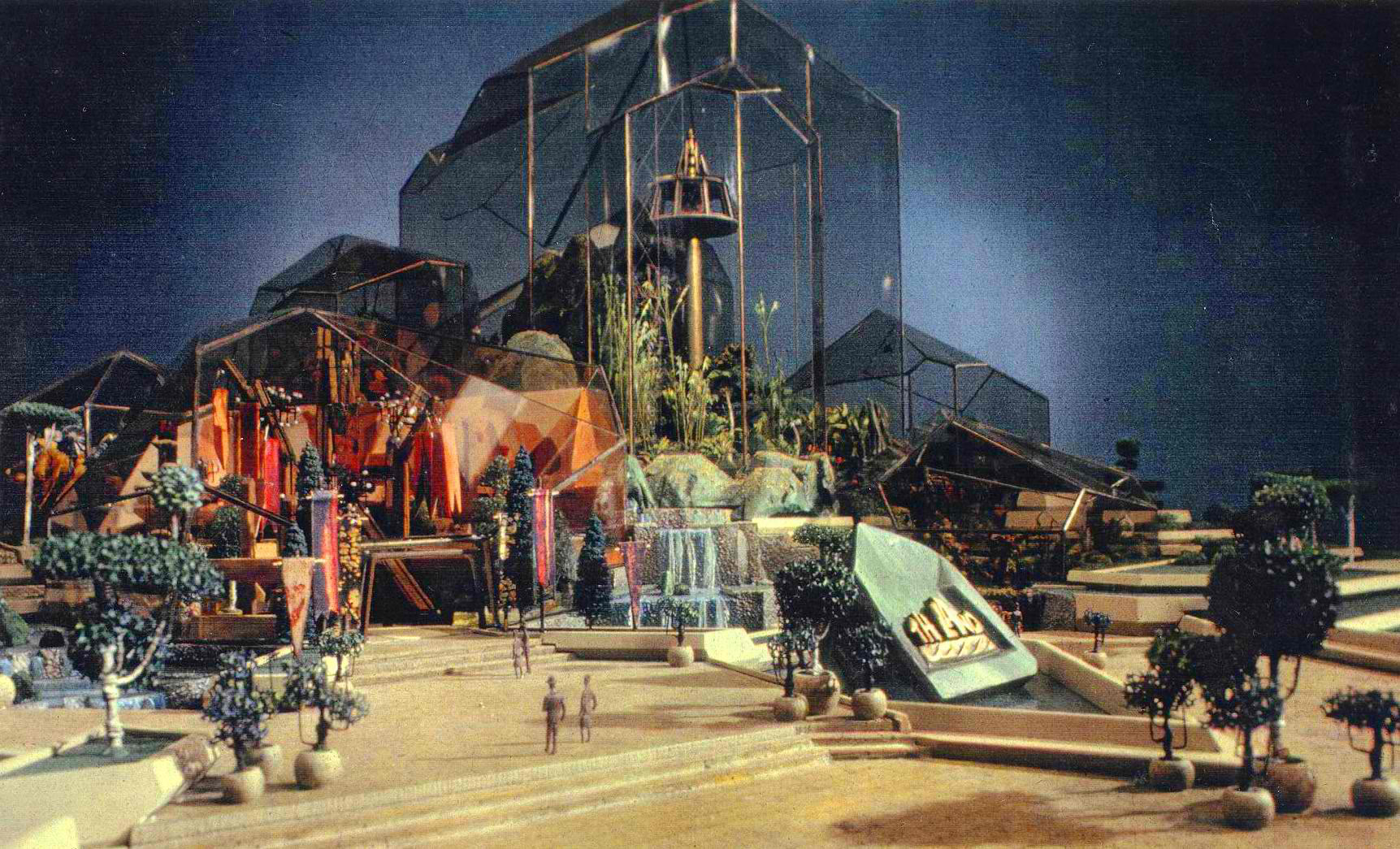
Tony’s striking original concept for Epcot Center’s “The Land.” A master modelmaker, Tony has often developed new projects through striking mockups such as this.
Special mention must be made here for my own personal favorite of Tony’s attractions, Epcot Center’s beloved Journey into Imagination. Alongside a team of talented artists and co-creators, Tony crafted an iconic and memorable experience that the public still pines for more than a decade after its closure. The pavilion gave Epcot Center what it sorely needed – it’s own trademark characters, Dreamfinder and Figment. It also combined technology and artistry to present a “creative playground of the future” that has never been bested since, despite today’s fancier technology, “interactive” flat-screen displays, and RFID. It was the one Epcot Center attraction that could have been as evergreen as the Magic Kingdom classics Haunted Mansion and Pirates of the Caribbean; it was a show that demanded no updates to keep up with “the future”, and a show with timeless, universal themes.
I won’t feed you a line about how Imagination “made the magic of imagination come alive” or anything like that; what made it special for me was that it created a completely immersive experience that played to each of the senses in indelible ways. From the smell of atomized rose fragrance which I can vividly recall still today, to the beauty of white “paper” animals dancing in multi-hued lights, to the prickly tingle of the Imageworks’ “pin screens,” the Imagination pavilion presented an array of experiences that were completely and amazingly unique at the time.
And oh, that ride. Piling into the six-seater purple vehicles before those doors slowly slid shut, before your car accelerated into the first starlit show scene; it was as if you had passed the proscenium into another world, a multimedia fantasia that combined the best of Disney illusioneering with a barrage of visual and auditory puns and gags. That incredible turntable with the massive dirigible; Dreamfinder painting the world’s largest polarized light mural with a fiber-optic paintbrush; the volcanic organ spitting out words which became the ride’s reality. And some scenes which truly terrified young me, giving the ride a menacing edge lacking from today’s offerings. I could rattle on and on about the striking images and environments featured in that ride, but in the end it would wind up listing pretty much every scene of the show. One impression after another, vividly impressed into my subconscious for all time.
When Tony announced his departure from Imagineering, he sent out a letter to his collaborators. I encourage you to read it here. It’s heartbreaking, breathtakingly succinct, and profoundly and startlingly true. All my nattering on this blog over the last five years can be summarized (and stated far better than I ever could) in that one simple letter. I wish it could be carved in gilded letters five stories tall on the cliff faces over Glendale.
With the caveat that we expect many more wonderful things from him, Tony can rest assured that his legacy is secure. The list of attractions above are certainly enough to make one a lowercase-l legend, and it’s obvious that he will one day become an “official” Disney Legend; as a friend described it to me, it’s the equivalent of a pro sports star that gets inducted as an all-star on the “first ballot”. His work and his name will be remembered for all posterity, which is more than I can say for nameless managers and bureaucrats – “strategic planners” – who, at times, stymied his work. They will be forgotten, Tony will not.
There’s so much more I could say, but in the end there’s nothing I could say that we all don’t already know. I don’t know Mr. Baxter personally, so I can’t speak to his plans or intentions or feelings about all this. But what I do know is that, if he so desires, this could only be the beginning of spectacular things. Any theme park company in the world should be camped out on his doorstep Monday morning with truckloads of cash demanding that Tony create madcap, magnificent new things for them. Freed from the shackles of WDI’s demented internal politics, the sky is the limit for Tony.
We wish him well, and despite the fact that such words are inadequate, we thank him sincerely.
I would encourage all of you to leave a message in the comments below thanking Tony; I’ll try to see that they make their way to him. Tell us about your favorite Tony attraction, or any memories you might have about his work. For those of you who are creative professionals who might have worked with Tony, how about some stories about working with him? Thanks to everyone who comments.
A very young me (and family) enjoying one of Tony’s greatest creations in October 1982.
From the Progress City archives comes this collection of 33 tall tales and true from Disney history. Available in paperback, hardback, and ebook formats.











Recent Comments