If you’re reading this from the United States, get out and vote today. No excuses. If you haven’t already, hit the polls. The future that Progress City represents depends on visionary leadership, hope, and big ideas to create a greater society for us all. But none of that happens if we don’t take a part in shaping it. Get out the vote.
Ryan at the Main Street Gazette bids farewell to Pocahontas and her Forest Friends, which ended its ten-year run at Animal Kingdom last month. The show, tucked away into a small theater on the park’s periphery, was never a blockbuster attraction, but it had a decidedly low-fi charm and its personal scale allowed guests – especially kids – to get close to the action. I won’t pretend the show was ever on my must-do list, but it had a nice ecological message for young people and, as both linked articles mention, it provided a nice showcase for its single, multi-talented female lead.
Disney remains mum on future plans for the area, but some sources say that the site will be used as part of an upcoming E-ticket expansion for Animal Kingdom. All recent rumors have centered around a Jules Verne-themed attraction much like those in Tokyo’s DisneySea park, but I have yet to hear an explanation as to how this new area could possibly be reconciled with the theme of Camp Minnie-Mickey, or if that entire area would be altered. Several sources have said that dirt would begin moving on this expansion next year, although that information came before the recent economic collapse. In any case, Animal Kingdom can’t afford to lose any guest capacity, even if it is just a small show, so one would think the logical explanation for this closure is that Disney has some plans for expansion.
While you’re on Main Street, check out this neat little detail that I had never heard of from Universe of Energy.
Alain Littaye has a nice collection of photos and artwork from California Adventure’s Blue Sky Cellar, which opens to the public on Monday. Note that many of these models are from Imagineering’s original pitch for the park’s makeover, and do not necessarily represent what will finally emerge as the finished product.
To coincide with Disney’s recent re-release of Sleeping Beauty on home video, here are some excellent character development sketches from Michael Sporn’s blog. The scans include art from Tom Oreb, Bill Peet, Ward Kimball, Frank Thomas and Ollie Johnston. Some preview videos of the DVD’s extras are viewable here.
While we’re on Sleeping Beauty, the L.A. Times has an interview with Tony Baxer about the history and renovation of the soon-to-reopen Sleeping Beauty Castle Walkthrough, as well as a detailed scene-by-scene breakdown of the new show scenes.
FREAKOUT!
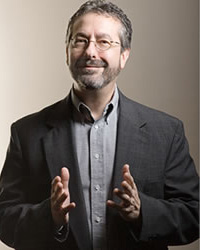
Game designer Warren Spector is working on a new videogame project in cooperation with Pixar and Walt Disney Feature Animation. Disney Interactive purchased Spector’s Junction Point Studios last year, which I somehow missed, and which is notable if also very unexpected. Spector is a legend of computer game design, developing several historically significant titles such as Ultima Underworld I & II (1992/93), System Shock (1994) and Thief: The Dark Project (1998). His Deus Ex (2000) remains one of my top-ranked games of all time. The purchase of Spector’s studio indicates that Disney is getting serious about entering the interactive market and I look forward to seeing what they come up with.
Warren Spector, designer of distinction
The Adventurer’s Club might have closed last month, but it’s still not too late to voice your displeasure to the powers that be.
More from the fancy writin’ department: Passport to Dreams Old & New brings us a comparison of Warner Brothers’ A Midsummer Night’s Dream from 1935, Fantasia, and Michael Powell’s 1949 The Tales of Hoffman. And someday I’ll write something as cool as this musical history of the Country Bear Jamboree. Meanwhile, EPCOT Central gives this excellent breakdown of the unfortunate loss of EPCOT’s unifying theme. The true shame of this is how relevant EPCOT’s original message still is to the world and how easily its many problems could be fixed if anyone in management had the courage and commitment to think it through.
Finally, a bit of late-breaking good news – on Tuesday, Disneyland Paris will announce that the resort has made a profit for the first time in five years. This is good news for European park fans, as it proves to management the rather obvious fact that adding new attractions will drive attendance. The resort had once been headed for profitability after a rocky first decade, but the opening of the shamefully executed Disney Studios Paris left it once more in the red. An emergency infusion of cash from the Walt Disney Company allowed the resort’s French parent company to add some attractions to the Studios and – surprise! – people actually started to visit the new park. Now that the resort is in the black look for more new attractions, including a Ratatouille-based trackless dark ride and a trio of Toy Story themed kiddie attractions. There might even be a new E-ticket for the long-stagnant Disneyland park itself. All in all, it’s great to see EuroDisney turn things around.
“We just try to make a good picture. And then the professors come along and tell us what we do.”
– Walt Disney
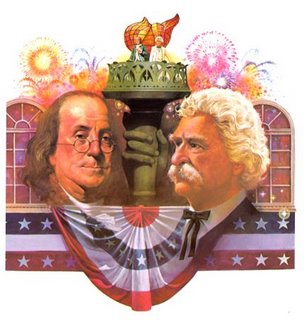
Foxx at Passport to Dreams Old & New has written an interesting series of articles entitled “For Further Study”, the latest of which surveys Frontierland’s Rivers of America for references to the works of Mark Twain. The series aims to direct readers to the vast well of history, literature and culture that informed and inspired the original Imagineers who created the Disney parks, finding surprising linkages to fairly obscure works. Such analysis is especially fruitful in the original Magic Kingdoms, as they tend to be more filled with the type of detail and references drawn from our collective past rather than the latest marketing-friendly film franchises.
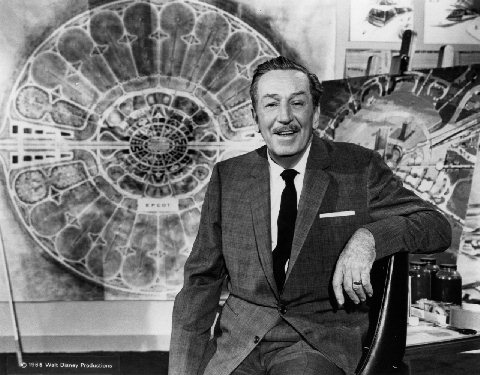
Ray Bradbury once called Imagineering a “renaissance organization”, and that’s far from hyperbole. While Disneyana has rarely been considered high culture, those who have studied the organization and its creations know the diversity of sources from which they draw. The creative team that Walt Disney assembled over the years, first in animation and later in Imagineering, were an eclectic and talented lot, with a vast range of expertise – many of them truly were renaissance men and women. Disney himself had no formal education, yet still seemed well-read in Americana and intensely curious about several fields of study. Ironically, while Disney seems to have been averse to academia and its trappings himself, his passion for finding good stories and new technology always seemed to involve him in research of some sort.
This diversity of inspiration can been seen in something as elementary as the layout of Walt’s own theme park – a conceit mirrored in the opening of the Disneyland television show:
The program, as well as the park it was designed to promote, was divided into different cardinal realms. Frontierland contained “tall tales and true from the legendary past.” Tomorrowland represented the “promise of things to come,” while Adventureland promised to whisk one away to “the wonder-world of nature’s own realm.” Note that only Fantasyland, “the happiest kingdom of them all”, represented a departure from reality – even Frontierland’s “tall tales” were based in historical truth.
Every week, the Disneyland program would feature a story from one of these lands, and when Disneyland park opened it gave guests the opportunity to experience the worlds that they had seen on television. For Walt, this represented an opportunity to share stories that, aside from being simply good yarns, he felt were important and informative of the American experience. It also allowed him to use the talents of his artists to spread ideas and information he thought important – something he had been doing since he personally financed 1943’s Victory Through Air Power in order to promote the ideas of Alexander de Seversky. The Disneyland show provided a mix of nature programming, futurism and fictionalized tales of historical heroes. Against this creative background, Disneyland and Walt Disney World were conceived.
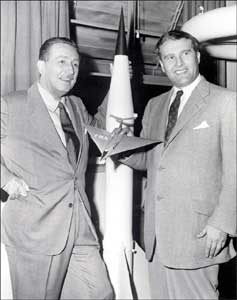
Disney and Werner von Braun, consultant on the Tomorrowland-based Disneyland episodes. It’s said that these episodes were used to help convince President Eisenhower to pursue the beginnings of the American space program.
The Magic Kingdom is peppered with these details, from the aforementioned Twain influences to name-drops of Texas John Slaughter and Johnny Tremain. The Tomorrowlands of 1955, 1959, 1967 and 1971 were designed from a real-world scientific standpoint. But while Disney often looked to mine American history and literature for inspiration, modern Disney management is far more focused on the current franchise du jour and subsequent marketing tie-ins. Without this eye towards the past, as well as the desire to incorporate ideas from diverse fields of study, I fear that the future Disney experience will inspire no further study than popping the latest animated release into the DVD player.
This might seem like an obscure and, to some, ridiculous concern, but it comes from some personal experience. I was fortunate enough to be indoctrinated to Disneyana at such an age that much of my exposure to many new ideas and concepts came through Disney. I was first exposed to everything from Dixieland jazz to linear induction motors through Disney films and parks. EPCOT Center provided an especially fruitful source of information, introducing me to solar cells, touch screens, fiber optics, Albert Robidia, DNA, and dozens of other things, including the cultures of eleven countries. Every time I see tilapia being served in a restaurant, I think of the Land.
Every time I plant rice in rocky terraces, I think of The Land
This is not to say that Disney should even remotely be considered the beginning and end of any course of study; rather, than these introductions and allusions to concepts in such an entertaining and exciting setting helped ingrain them into my young mind and thus provided an excellent jumping-off point of any number of fields. Walt had it right – leaven the entertainment with enough actual information and you can spread ideas that otherwise would be dry or unapproachable. The melange of concepts and inspiration that combined to form those original Disney parks provided the seeds for a later love of aesthetics as diverse as Victorian futurism, steampunk, Tiki culture, art deco, and populuxe, as well as fields of study from urban planning to the Old West to space exploration.
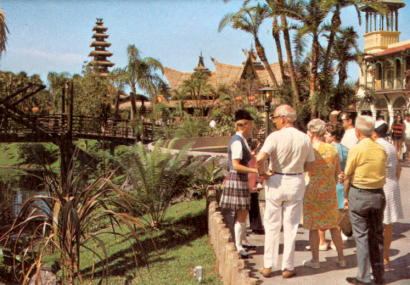
When I rail against the creep of marketing tie-ins or the “toonification” of Tomorrowland, it’s this diversity of inspiration that I fear losing. Looking at the opening day roster of attractions at Florida’s Magic Kingdom, the only attraction based on a fictional film property outside of Fantasyland was the Swiss Family Robinson treehouse. Frontierland had it’s Davy Crockett-based canoes and keel boats, but those at least had some historical basis. Everything else was based on some form of original property (Tropical Serenade, The Country Bear Jamboree), true-life adventure (the Jungle Cruise) or history itself (the Hall of Presidents). It was not until the latter day when cartoon fantasy began to make its way into Adventureland and Tomorrowland.
Adventureland, 1971. Not a toon in sight. (Photo from Widen Your World)
The slew of unsubstantiated rumors that have so far emerged for the as yet unannounced Shanghai Disneyland only point to a continuation of this trend. Every rumor brings a new twist – a Tomorrowland themed to WALL-E, a Frontierland centered on Toy Story characters, and the possible re-creation of California Adventure’s “Cars Land” have all been mentioned in various online sources. Disney fans have often lamented that the possibility of a new non-franchise based attraction like the original Pirates of the Caribbean or Haunted Mansion is extremely unlikely these days, but until I started thinking about “For Further Study” I hadn’t really considered why the idea was so disturbing.
It’s hard to conceive of the modern Walt Disney Company building something as shockingly innovative and high-concept as Spaceship Earth or Horizons anymore. The aspiration to inform and inspire seems lost, save for possibly Joe Rhode’s work at Animal Kingdom. It seems equally unlikely that anyone at WDC is interested in mining the corpus of American history and literature for inspiration, making something as simple as Frontierland’s Twain references fairly unlikely. Compare California Adventure’s Golden Dreams to the American Adventure – as whitewashed as the EPCOT attraction might be, it’s far more complex that its descendants.
As the American Adventure itself says, the golden age was never the present. It’s human nature to look fondly at the past and to be, at least slightly, suspicious of change. Many Disney traditionalists are accused of such blinded conservatism. But the thematic change in the stateside Disney parks has been noticeable even in the last decade, and the creep of franchise-driven entertainment and “toonification” of formerly “true-life” lands has eroded the interest of those of us who find our actual history and the real world we live in as fascinating as the latest tent-pole blockbuster. If we allow our interests to get so narrow – so synergistic – eventually all Disney will inspire for further study is more Disney. It would become an insular world, drawing from nothing and leading to nothing. That would be a loss for everyone.
A note to those who control the fate of the now-shuttered Pleasure Island – STOP! PATIENCE!
Now I love the nightlife. I like to boogie. In fact I was once a stalwart attendee to Pleasure Island on Cast Member Thursdays (and in 2000 Millenium Mondays), but I wish the Mouse House and WDI would take their time in getting the once popular nightclub district right.
One of the favorite Disney specials of Tangaroa and I is “Disneyland After Dark,” included in the Walt Disney Treasures collection “Disneyland, USA.” In it, Walt ushers us around his “favorite time in the park,” where we see Louis Armstrong performing on the Mark Twain, Annette in Tomorrowland at the Bandstand, dancers and firewalkers in Adventureland….. you get the point.
In the mid-70s when the “Vacation Kingdom” of Walt Disney World was in its stride, nighttime entertainment could be found at each of the major resorts on property: at Luau Cove at the Polynesian, the Top of the World dinner show at the Contemporary – and my favorite, the Hoop Dee Doo Musical Revue at Pioneer Hall in Fort Wilderness.
For those of you who know the tale of Pleasure Island, you know that Church Street Station created quite the stir in the 80s, and Eisner and Co moved swiftly to create a nightclub district to keep the night owls on property, and even take away some of the local luster that Church Street had developed.
And I think that was a great idea! I do get frustrated when looking for after dark activities on property and having everything shutter on family time. I’d like to shake a leg, have a pint, and enjoy continuing on in the Disney magic.
The problem with Pleasure Island (with noted exception of the Adventurer’s Club and Comedy Warehouse) is that even if they had a somewhat innovative concept at first, they quickly lost their luster in carrying the Disney magic to the bar. At the time of the closing of Pleasure Island, even more innovative clubs and restaurants such as XZFR Rockin’ Rollerdrome (later becoming Rock n’ Roll Beach Club – once home to a Michael Jackson skate party) and the Fireworks Factory had been toned down or changed into bland nightclubs – blandest of all being Motion, where I would often catch an ABC star who shall remain nameless molesting college kids with glow sticks in their mouths.
Everything at Downtown Disney took a crushing blow when West Side was built and the whole complex was changed in name to Downtown Disney – in another kneejerk reaction to Universal, Disney recklessly built giant architectural disasters all in a row full of third party businesses to combat the upcoming Universal Citywalk – which is equally if not more lame.
Disney’s Boardwalk (which I always thought was built in an awful spot), at first seemed to offer more themeatic promise, but quickly disappointed with more third party restaurants, and an attempt at a dueling piano bar that comes across as a warehouse version of Rum Runners (a piano bar I can go to here in North Carolina, but choose not to).
Pleasure Island was concieved with a wonderful story that Jim Hill profiles in another wonderful article here. In it was a more ambitious Adventurer’s Club, a great seaside bar called Madison’s Dive which I would have LOVED, and a seemingly more in-depth themed experience. This is all I’m asking for. The world has caught up to the Downtown Disneys of the world, I can go to a mall here and go to all the same stores – the strolling mall revolution has made West Sides all over the country with Rainforest Cafes and Virgin Megastores and the like. Whatever happened to the Disney Difference?
There’s no reason in my mind why Disney could not create a night district (complete with dancing and carousing) that could be more innovative, more themeatic, more escapist just like the rest of their resort.
So instead of building a link between two malls (Marketplace and West Side), take some time and use the space wisely! There are several ideas floating around Disney history (to be profiled in Part II) that can be used as jumping off points, plenty of synergistic possibilities as well. Again, as stressed in this earlier article – I think it’s imperative for Disney to not try and be “hip” or “cool,” but instead assert itself with confidence, not bowing to trends — or the god-awful Frankie and the West End Boys (sorry faithful fans).
Stay tuned for Part II, where I’ll float some suggestions from Disney History that may prove as stepping stones for a new Walt Disney World Nighttime District.
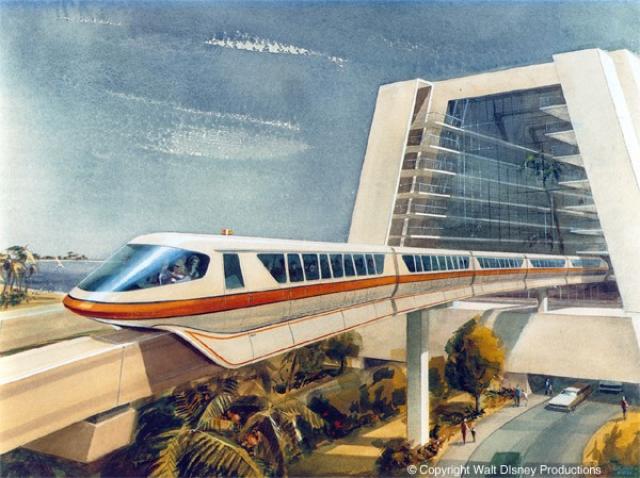
When Walt Disney was involved in planning the Florida property, transportation was one of his highest priorities. A jet airport of the future, a revolutionary city (EPCOT) that would provide public transportation to all, and a welcome center where folks could leave their cars behind and board a high speed monorail that connected the entire property.
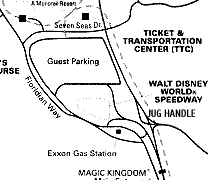
When Walt passed away and plans were scaled back bit by bit, the priority of transportation stayed. Instead of a transportation hub intersecting with Highway 192 as originally planned, Roy Disney and Co. moved it up to its current location on the shores of the Seven Seas Lagoon at the tip of the Magic Kingdom parking lot. Still, everything was connected by monorail or boat, as all early publications boasted.
Another priority for Walt (no doubt a product of the 1950s and 60s Freeway revolution) was that there were to be no traffic lights on Disney property. You can see interesting solutions to this in the roundabouts of the proposed EPCOT street layout and the “jug handle,” still in existence in the Magic Kingdom parking lot at the intersection of World Drive and Vista Blvd.
The first outlyer to this system was the construction of the Lake Buena Vista Shopping Village (now Downtown Disney) and the community of Lake Buena Vista – at the time planned as a retirement community of sorts, and a sort of testing grounds for what was to be EPCOT (city). Even then, as plans were being drawn up for what was to become World Showcase (then right by the TTC), you can see plans for a monorail running past towards the south, no doubt connecting Lake Buena Vista to the rest of the property.
Then, the proverbial mess hit the fan. As Walt Disney World was still in its infancy, projects like the Asian, Venetian, and Persian Resorts, as well as attractions such as Thunder Mesa, were shelved due to the OPEC Oil Crisis – it was assumed that so much of WDW’s guests would quit coming from states far and wide due to “pain at the pump,” in an era before the giant airline deregulation and Orlando Airport expansion of the 1980s.
Plans were scaled back – EPCOT was turned into a theme park (due to reasons more governmental than tourist related), and World Showcase was shoved into what is now known as Future World.
The dream of a transportation system were still alive – a spur of the monorail line ran into EPCOT from the TTC, and an extra pad was left at the EPCOT monorail station for a future line. Lake Buena Vista was still serviceable only by bus, but the future seemed bright.
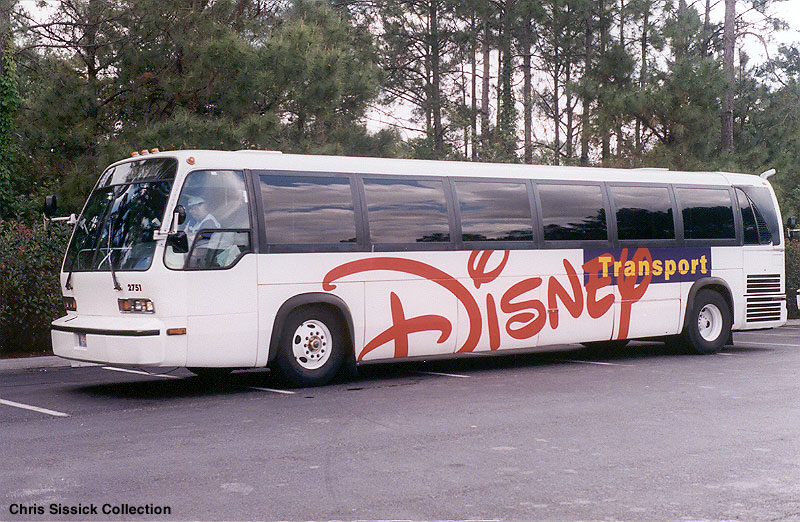
Enter Eisner and Co., and their disbelief that the property was so underdeveloped. Massive expansion efforts began, but none with the care for development and planning that Walt and his successors had. Not only were parks such as the MGM Studios built in the most unseemly of places, without any care for the flow of the theme park that the Magic Kingdom and EPCOT show, they also were built at such a pace that the increasingly expensive monorail system could not keep up with. Bus service grew to dwarf any other on property – the TTC was abandonned mostly as a bus hub for individual theme park bus stations, wait times grew, and magic was lost.
The second time I worked at Disney were the salad days of 2000 in Magic Kingdom Guest Relations. Animal Kingdom was entering its second year – attendance had been disappointing, particularly with the new threat of Islands of Adventure next door, and new theme park rumors were slowly dying. I still believe that among the whispering, the ESPN theme park next to the Wild World of Sports was perhaps most credible.
Instead, Disney execs moved their sights towards keeping WDW a “destination resort,” where folks could come and not have an excuse to leave for any reason to give money to the competition. The jet airport was considered again – I don’t know for how long or seriously, as was an airline. This I believe gave rise to what is now known as the Magical Express free bus service to the airport.
The idea and hope was that folks would not rent a car or need one while on Disney property so it would be harder to get off. Thus, the transportation service was looked at seriously. In my last day of an extensive several week long training program, we met with WDW President Al Weiss and VP Lee Cockerell, and they outlined two new initiatives for the Florida property.
The first was a hand held computer device that every resort guest could be given that would manage their stay – a palm pilot like device that could reserve Fastpasses, order photos from rides, dinner reservations, etc.
The second was a renovation of the transportation system. A study was done to see where it was needed the most – for environmental and gridlock concerns. I remember Cockerell telling that they had researchers posted at spots all across property to average out the average amount of time that a Disney bus was in view. At Downtown Disney, busses literally never left view.
In July 2000, Weiss even went so far as saying, “in two years,we are committed to drastically reducing the number of buses required tofulfill our internal transportation needs.” He put the two year date on a“transport system which will whisk guests from the airport to a new hub onproperty in five minutes.”
In most every office room in the Magic Kingdom, there is a property map – and not all are current. Most had “Future Monorail Expansion” leaving the EPCOT pad and going through the gap between Journey Into Imagination and The Land, down by the Yacht, Beach, and Dolphin, and ending at the Studios. Some had a line leaving from there to Animal Kingdom as well.
Speculation ran rampant, and Cockerell and Weiss admitted that plans were not finalized – but they were looking at several transportation systems and knew they would not use the monorail to connect everything, just perhaps the theme parks. A lead contender was a light rail line – and though there were several rumors, I believe the most credible was a spur going from the TTC down to Fort Wilderness, Dixie Landings, and Port Orleans, and another going down Buena Vista Drive basically from Downtown Disney, Typhoon Lagoon, Carribean Beach, Studios, Coronado Springs, Blizzard Beach, and perhaps the All Stars.
It was exciting to hear of these changes, and with attendance booming, why not take some time to invest in infrastructure?
Then, everything stopped. September 11 took away the record numbers flocking into the theme parks, and in a scramble to compensate for problems, the WDW execs put the band aid on quietly and bought a new fleet of more fuel efficient busses. The plans discussed in 2000 were dead.
In this time of financial crisis, I can only hope that the new regime of Disney execs, who appear very able and in touch with Disney history learn the lessons of their fathers and don’t respond with knee jerk reactions to economic turmoil. Shelve the plans for now if you must – but don’t forget them, and don’t come up with the lowest possible solution to your problems.
From the Progress City archives comes this collection of 33 tall tales and true from Disney history. Available in paperback, hardback, and ebook formats.


 on home video, here are some excellent character development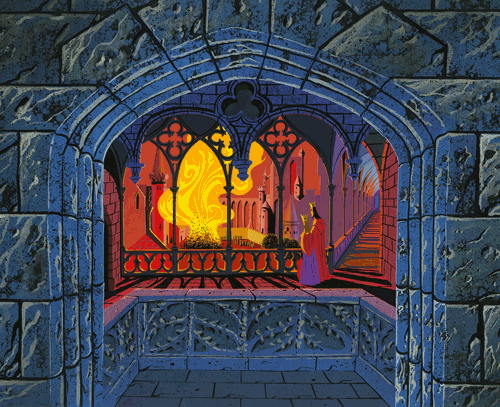
 Disney and Werner von Braun, consultant on the Tomorrowland-based Disneyland episodes. It’s said that these episodes were used to help convince President Eisenhower to pursue the beginnings of the American space program.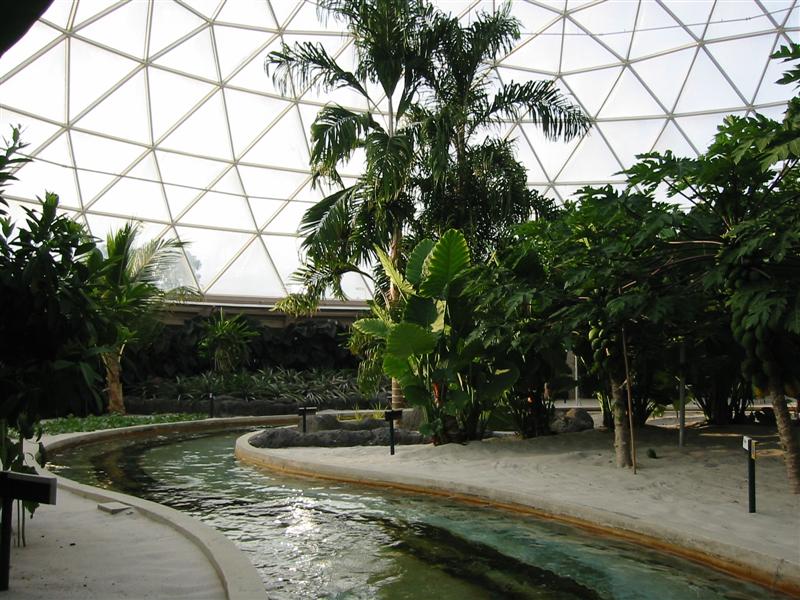










Recent Comments