Contribute to Our Research |
By Michael - November 12th, 2009 Seriously. What??
Oft-maligned (by me) Disney Parks chief Jay Rasulo becomes Disney’s Chief Financial Officer. Fair enough, he cares way more about money than theme parks anyway, and fans have wanted to see him gone for years. But current CFO Tom Staggs takes his place as chairman of Walt Disney Parks and Resorts? A switch?!
Seriously. Did anyone see this coming? Again, the year of bizarre executive shakeups continues. Jason Garcia at the Sentinel says that this might signal that Staggs is being groomed to become president of the entire Disney empire, but what in heavens name indicates that he knows anything about the parks? From his bio on Wikipedia:
Joining Disney in 1990, Staggs rose from his role as a manager of strategic planning to senior vice president of strategic planning and development in 1995. Staggs became executive vice president and chief financial officer in 1998, and was appointed his current title in January, 2000.
Staggs was born in Illinois and received a B.S. in business from the University of Minnesota and an MBA from the Stanford Graduate School of Business. He began his career as an investment banker for Morgan Stanley & Co. before joining Disney in 1990.
Seriously, that resume is like a burning hot fork in my eye. America’s already had its Death Panel, and it was called Disney “Strategic Planning” in the 1990s. Please, someone at least tell me he’s ever been to a theme park…
UPDATE: Gird your loins, it’s a press release:
THE WALT DISNEY COMPANY ANNOUNCES EXECUTIVE CHANGES
BURBANK , Calif., November 12—In line with The Walt Disney Company’s goals of advancing its global businesses and brands while providing new opportunities and challenges to executives, Disney President and Chief Executive Officer Robert A. Iger announced today that two of the company’s most senior leaders would assume new roles at the end of the year.
Thomas O. Tom Staggs, Senior Executive Vice President and Disney’s Chief Financial Officer and 20 year Disney veteran, will become Chairman, Walt Disney Parks and Resorts. In his new position, Staggs will preside over the company’s vacation businesses, which span three continents and include five-world class destinations, a top rated cruise line and the most popular resort locations in North America, Europe and Asia.
James A. Jay Rasulo, Chairman of Disney Parks and Resorts and a 23-year Disney veteran, will become Senior Executive Vice President and Disney’s Chief Financial Officer. In his new role, Rasulo will oversee the company’s worldwide finance organization, corporate strategy and development, brand management, corporate alliances, investor relations, treasury and risk management activities, controller functions, information systems, corporate responsibility, real estate and taxes.
Both will remain members of the senior management group reporting to Iger.
“Jay and Tom are both dynamic and versatile executives, who have done a great job over the last several years and have helped me to shape Disney’s strategic direction,” Iger said. “By giving them exciting new challenges that build on both their strengths at a time when each of their respective areas are on the right strategic track, the change is good for them and good for the company.”
As CFO, Staggs has helped guide Disney through one of its most important periods of expansion and financial success while steering it effectively through two sudden global economic downturns in 2001 and 2008. Throughout, he’s been praised by Wall Street for his financial and communication skills and has consistently been voted the country’s top entertainment industry CFO by analysts polled by Institutional Investor magazine.
Working closely with Iger, Staggs has played a critical role in a wide variety of Disney’s strategic and operating initiatives, including the acquisitions of Capital Cities/ABC, Pixar and the pending acquisition of Marvel Entertainment. As CFO, he spearheaded Disney’s realignment of its performance goals toward a combination of profit growth and strong long term capital returns and free cash flow. He has also led company efforts to drive greater cost and capital efficiency throughout the organization and to put in place well-received company-wide environmental and healthy food policies.
“For over a decade, I’ve had a unique opportunity to build our business by collaborating with a group of great executives running a wide range of media and travel businesses,” said Staggs. “Taking the operational reins of one of our biggest and most complex businesses during the period of rapid global expansion launched by Jay is tremendously exciting and a challenge I’m really looking forward to.”
Under Rasulo’s leadership, Parks and Resorts has built on its traditional strengths as the world’s preeminent theme park operator to create a range of businesses that have made Disney a global leader in the family vacation industry.
As part of this growth strategy, Rasulo has overseen a major expansion of Disney’s California Adventure at Disneyland Resort, which culminates with the opening of Cars Land in 2012, and of Hong Kong Disneyland, where work is underway on the creation of three original new lands. He has also led negotiations with the Chinese government to begin development of a new theme park in Shanghai.
In addition to park expansion, Rasulo has been the principal architect of the growth of the award-winning Disney Cruise Line, which is currently adding two new ships, Disney Vacation Club and Adventures by Disney. Prior to becoming head of Disney Parks and Resorts in 2002, Rasulo greatly improved the operating performance of Disneyland Paris, now the number one tourist destination in Europe.
By emphasizing innovative marketing, strategic investment and financial discipline, Rasulo has also deftly managed the Parks and Resorts businesses through difficult periods, first as the unit’s President after tourism plummeted globally in the wake of 9/11 and later as Chairman during the 2008-09 economic downturn. Throughout, he’s been an important advocate for the tourism industry, serving as Chairman of the Travel Industry Association of America in 2006 and 2007. Rasulo was inducted into the Travel Industry Hall of Leaders in 2008.
“It’s been a tremendous honor to lead the almost 100,000 Cast Members, Crew Members and Imagineers during a period of unprecedented investment at Disney Parks and Resorts ,” said Rasulo. “I look forward to building on Tom’s success as CFO by working with Bob to advance Disney’s growth strategy, while continuing to strengthen our balance sheet and create shareholder value.”
Both Rasulo and Staggs are longtime Disney executives and both serve on the board of Euro Disney S.C.A., the French parent company of Disneyland Paris.
Rasulo joined Disney in 1986 as Director, Strategic Planning and Development, advancing to more senior positions there, and later became Senior Vice President, Corporate Alliances. He then led Disney Regional Entertainment before moving to Paris as President, Euro Disney before eventually becoming its Chairman and CEO in 2000. A native New Yorker, Rasulo has a degree in economics from Columbia University and both an MA in economics and an MBA from the University of Chicago. Before joining Disney, he held positions with Chase Manhattan Bank and the Marriott Corp.
Staggs joined Disney in 1990 as Manager of Strategic Planning and soon advanced through a series of positions of increased responsibility, becoming Senior Vice President of Strategic Planning and Development in 1995 before becoming CFO and Executive Vice President in 1998. Born in Illinois, Staggs received a BS in business from University of Minnesota and an MBA from Stanford University. He worked in investment banking at Morgan Stanley & Co. before joining Disney.
Related Posts...
By Michael - November 11th, 2009 Previously, on As the Eisner Turns…
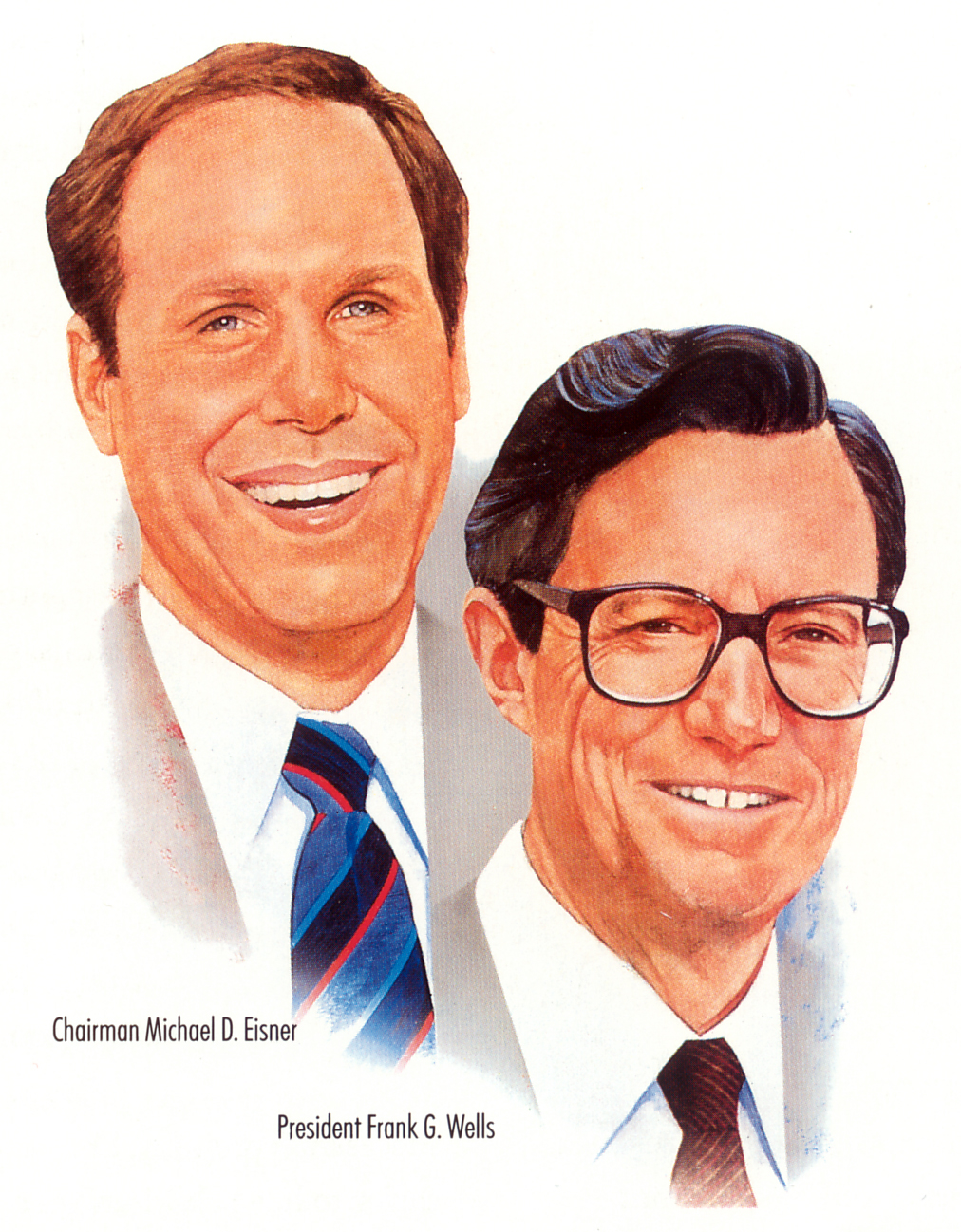
Ambitious young Michael Eisner and his boon companion Frank Wells took over control of Walt Disney Productions, which was struggling to make its way in the modern film industry. Disney began to cash in on underexploited assets, and the eyes of management shifted from theme parks to film and television production.
As Eisner ramped up production, the money started to roll in. Yet many of the company’s promising new initiatives, aside from the marked price increases that Eisner levied on the parks, stemmed from programs that had started under the previous management – Touchstone Pictures, The Disney Channel, and plans for Euro Disneyland. Still, Eisner was capitalizing on unused assets, and getting Disney back into the network and syndicated TV markets. But would it come at the expense of the theme parks?
Then, in our last episode, Eisner was fully in charge. Having seized sole authorship of the annual letter from Wells, he was free to spin us yarns of his children’s antics and oh-so-relateable escapades. Profits were taking off, and a series of low-budget adult comedies were about to get Disney back in box office clover.
I suggest that you take a moment and read the comments by our esteemed Another Voice under the previous article. They’re a very instructive encapsulation of the dynamic at Disney at the time, and one can see how the Eisner-Wells-Katzenberg trifecta held things somewhat in check. Eisner’s aspirations of moguldum were reined in by Wells’s assumption of the Roy O. Disney role, and Katzenberg assisted by producing a series of modestly-budgeted minor successes that would soon and often be referred to with baseball metaphors (better to have several solid singles and doubles rather than swing for a home run and strike out!). Eisner was kept from literally selling EPCOT Center to underwrite a series of cinematic escapades, and Disney was in turn rewarded by success and growth in the theatrical division.
Eisner’s aspirations weren’t all entirely misplaced; they allowed him to be convinced of the need to resuscitate Disney feature animation and they eventually enabled the grand plans for projects like Euro Disney. It was a dynamic that worked fairly effectively until 1993-94.
But now we’re back in 1987, so let’s see what was brewing at the House of Mouse.
TO OUR OWNERS AND FELLOW DISNEY EMPLOYEES:
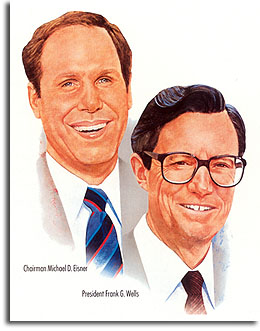 This year I am having trouble writing my letter for our annual report, and Frank Wells (our president and my partner) told me this morning if I do not complete it on my present airplane flight back to Los Angeles, our printers will be forced into overtime. One sets policy by example, so if Jeffrey Katzenberg, our chairman of The Walt Disney Studios, can This year I am having trouble writing my letter for our annual report, and Frank Wells (our president and my partner) told me this morning if I do not complete it on my present airplane flight back to Los Angeles, our printers will be forced into overtime. One sets policy by example, so if Jeffrey Katzenberg, our chairman of The Walt Disney Studios, can
be on budget and schedule with Disney and Touchstone films and television shows, I can get one letter completed on time.
I would like to say that the only reason for delay in writing this letter is my difficulty in communicating how well we have done without sounding too cocky, too confident and certainly too proud. How does one present an 80 percent increase in net income and pretend such improvement is nothing special?
But honestly, my delay has been caused by the numerous ice hockey games in which my 14-year-old son has played over the last two weeks in Southern California (four in one weekend, each 50 miles from the previous one) plus college interview time in four cities for my 17-year-old high school senior.
I now have no excuses. I am over the middle of our country looking down
upon cornfields and thinking about the idea of Dick Nunis (our president of Walt Disney Attractions) and Jack Lindquist (our executive vice president of Creative Marketing Concepts) about renting a large field and cutting the crop to create the face of Mickey so that every person who flies over will be reminded about Mickey’s 60th birthday. Have we gone too far? Jack, I don’t think so.
The next few paragraphs, which outline Disney’s accomplishments, are directed to Frank Wells’ mother, Betty, and my mother, who must have wondered in 1955 how their sons would ever earn a living. Of course, Frank was at Oxford University as a Rhodes scholar, with reasonable prospects, while I was a 13-year-old sports fanatic. The answer, of course, is to get lucky and find a team of people . . . each much better than you . . . and pray. Then you’ll earn a good living.
We really have done well this past year, with dynamic growth and progress in every area of our business: parks and resorts, film and TV, and consumer products.
Our figures are remarkable. The filmed entertainment segment achieved a 153 percent increase in operating income during the year. Consumer products had a 34 percent increase. Operating income from our theme park and resort operations at Walt Disney World and Disneyland was up 36 percent in 1987, contributing to a 34 percent compounded annual growth rate in operating income over the last five years.
We had record revenues of approximately $2.9 billion for the year, an increase over 1986 of 33 percent, and record net income of $444.7 million, an increase of some 80 percent (which I now have pointed out for the second time), all of which added up to earnings of $3.23 per share compared to $1.82 per share a year ago.
More significantly, we also showed a return on equity of 27 percent,
compared to eight percent in 1984.
While we are sure Betty Wells and my mother are proud of these numbers and the countless individual achievements they represent, I hasten to add that Frank Wells, Gary Wilson and our entire management team are aware that the task we originally set for ourselves some three years ago has only just begun.
A number of people (I was on the top of the list) troubled by the so-called stock market “meltdown” in October have asked what impact, if any, recession would have on our plans or future performance. My answer in every case is that the fundamentals of our company are stronger than they have ever been and our past experience and current surveys encourage me to be optimistic about the future.
I am supported in my confidence by the views of several prominent industry analysts (professionals whom I admire enormously when they agree with me) that Disney is “recession resistant” if not “recession proof.” One who summarized it best said, “Disney represents a haven of quality.”
We plan to continue on our charted course, which calls for the aggressive and pragmatic pursuit of growth in stockholder values. I suppose I should outline the records we broke in 1987, although the essence of our company is the feeling we get walking through Epcot Center and seeing families having the time of their lives . . . or laughing and crying during an episode of “The Golden Girls” . . . or sitting at Thanksgiving and watching 10 kids enjoying a Mickey and Donald cartoon on The Disney Channel . . . or feeling and sensing enormous pleasure and amusement with an audience at our smash hit movie “Three Men and a Baby.”
But records do say something: Our theme parks topped the 50 million mark for the first time ever; our movies were third in total box office gross, moving swiftly toward second (if “Three Men” continues to do well), all the way up from 12th among the major studios in 1984; in home video we moved to second in the industry (up from sixth in 1985); at The Disney Channel, we continued to be the fastest-growing pay-TV service.
Meanwhile, in consumer products, we extended our worldwide lead, increasing the number of licensees to more than 3,000 covering 14,000-plus products in more than 50 countries.
In addition to these broad gains, 1987 will be recorded as the year we repositioned ourselves strategically to best grasp the opportunities of tomorrow.
Our long-range strategic plan consists of two elements: continued dramatic growth and success of our existing businesses (naturally) plus selective expansion into new related business areas.
With that as a backdrop, I believe 1987 will be remembered long into the future as the year in which we:
Signed our agreement with the French government to proceed with the development of Euro Disneyland (for those of you who plan to be stockholders into the 90’s, and I assume that’s everybody, our French project is very important, and for those of you who are studying French like I am, our park will be a great place to visit);
Sold Arvida Corporation, a community development operation (a good company but a business we should leave to others); we are in the entertainment, recreation and leisure-time business;
Agreed to purchase KHJ, Los Angeles, a major independent television station, our first venture into the realm of TV broadcasting outside The Disney Channel (a business we should be in and not leave to others) and one that we hope will be approved by the FCC;
Jointly agreed (with Industrial Equities, Ltd.) to acquire the Wrather Corporation, owner of the Disneyland Hotel (buying what most people thought we already owned) and contiguous Anaheim acreage;
Signed a 10-year strategic alliance with Sears, Roebuck and Company’s Merchandise Group covering development of new Sears/Disney products, Sears promotion of Disney animated films and Sears sponsorship of major attractions at the Disney-MGM Studio Tour opening in 1989;
Developed a year-round program of tie-ins with McDonald’s, which has agreed to be our partner in jointly beneficial promotional programs involving all parts of our business;
Opened our first three Disney retail stores outside theme park environments in preparation for a nationwide rollout (to use show business terms, “a boffo opening with good legs”).
My experience in the entertainment industry is analogous to the sports world, where interest in last season is minimal. Anybody can win once, but the true champion wins over and over again. As a result, my Disney philosophy is simple:
We would rather be the Boston Celtics than the New York Giants. For the record, I was born in, lived in and worked in New York City. I was and still am a Giants fan. Since I now live in Los Angeles, I’ve become a Laker loyalist. So please, no letters!
Some of the seeds of growth sown over the past few years will come to fruition in 1988 and should help keep us a contender (to continue my sports reference) for growth. I’m thinking particularly about the opening of four major new facilities and attractions at Walt Disney World: The Grand Floridian Beach Resort (900 rooms and fantastic), the Caribbean Beach Resort (750 rooms in the first phase and our first moderate-priced facility), Pleasure Island (a most exciting nighttime Disney-style entertainment complex) and the Norway Pavilion at Epcot Center (the best and only backward-moving themed Disney ride – trust me).
All of these will add to the overall attractiveness of what is already the world’s number one destination resort and will contribute substantial new revenue.
In addition, 1988 will witness at least six new Disney retail stores and many movies and television shows. I will not talk specifically about our movies for 1988 because talking or bragging about movies brings bad luck . . . but remember the name Roger Rabbit.
And on into 1989, we will have other new wonderful Disney projects that we hope will continue to place us in the Super Bowl – the Disney-MGM Studio Tour, Typhoon Lagoon, retail stores, movies, TV and some surprises we have not thought of yet.
 Your company was the recipient of a number of honors and overly kind evaluations during the year, which I will list in case you missed the original press releases. Your company was the recipient of a number of honors and overly kind evaluations during the year, which I will list in case you missed the original press releases.
As part of a continuing survey among its readers, the marketing research department of The Wall Street Journal issued a “corporate report card” in June that ranked leisure and entertainment companies in four categories: familiarity, quality of management, reputation and investment merit. By every measure, Disney surpassed all competitors,
whose names will go unlisted because of prior, present and future friendships with our competitors.
In October, Business Week searched what it calls its top 1,000 American companies to determine which are America’s most competitive in terms of use of labor, use of capital and “the bottom line.” Disney ranked third overall in use of labor and fifth overall in the bottom line category.
No other entertainment company made the list of 42, which the magazine dubbed “America’s Leanest and Meanest.”
I consider this ranking a major tribute to all the Disney cast members, the dedicated and talented employee force that constitutes our company’s greatest strength, but I would emphasize that Disney may be “lean” . . . but never “mean.”
In December, we were named one of the five best-managed companies in the United States by Business Month magazine.
These honors are not directed at one individual. If Disney is one of the best-managed companies in America, it is because the entire management team and cast have blended their dreams, talents and dedication to the advancement of the enterprise we call Disney.
This past year has been a good one for The Walt Disney Company, and we are working to make next year even better. The foundation is set, the Disney name and consumer franchise are strong, the strategies are in place and we are ready to move forward to even better tomorrows.
But I do want to point out that managing a successful company, like managing a happy family, is difficult. It is easier to have children than to bring them up. It is easier to change diapers than to change schools.
We are, as corporations go, very young . . . in our adolescence, if you will . . . with much ahead of us.
I speak on behalf of Frank Wells, Roy Disney, Gary Wilson and all our cast members when I say I sincerely appreciate your past support.
December 8, 1987
Michael D. Eisner
Chairman and Chief Executive Officer
There you go – 1987. First of all, we need to stop and bow our heads in tribute to the very first mention of the young Eisner’s hockey games. And the other young Eisner is going to college! And Michael Eisner and Frank Wells both have mothers! Who are proud of them! Oh, I mock because I love. Seriously, though – hockey.
I was amused that they divested Arvida because they wanted to stay just in the entertainment business, but in almost the same breath he mentions the Disney Stores. Soon they’d be buying sports teams and heaven knows what else. They finally managed to get a hold of Wrather, though, after decades of trying to obtain the Disneyland Hotel.
It’s hard to argue with those profit increases, though; it’s also fascinating to watch Disney ride from the absolute Hollywood cellar to become one of the top grossing studios. I always thought that Eisner’s biggest problem was that he expected this kind of exponential growth to continue, well, exponentially. Disney went from making a few pictures each year that no one saw, to making several pictures that did pretty well – and some that did very well. Statistically, it looked like a miracle. But it was insane to expect that kind of growth to continue.
Sadly, Wall Street never met a reality it liked, so in later years those massive annual gains were still expected. At that point, the cuts began. But that’s several years off, and now we have Roger Rabbit and the Disney-MGM Studios Theme Park Tour to look forward to!
Related Posts...
By Michael - November 9th, 2009 Disneyland wasn’t always an American institution. Strange, but true. And without the Internet, and its thousands of blogs and message boards and travel planning sites, those Eisenhower-era families trekking to Anaheim in their massive cars needed to know where they could find a big juicy steak or some cocktails and tomato aspic. Thankfully, once they checked into their motor lodges they’d find a copy of Vacationland magazine.
This publication, which was published in various formats at Disneyland and Walt Disney World into the 1980s, served as a general guide to the resort area and was distributed both locally to hotels and nationwide to travel agencies.
What’s odd in the modern era of ultra-slick Disney corporate P.R. is that Vacationland seems subdued and fairly neutral by comparison. It even featured ads for attractions outside of the Disney empire! Its format was more like a magazine or newsletter than a guidebook, so there weren’t the typical listings of attractions or restaurants. Instead, and amusingly, it featured ads for Disneyland’s restaurants – in Disney’s own magazine!
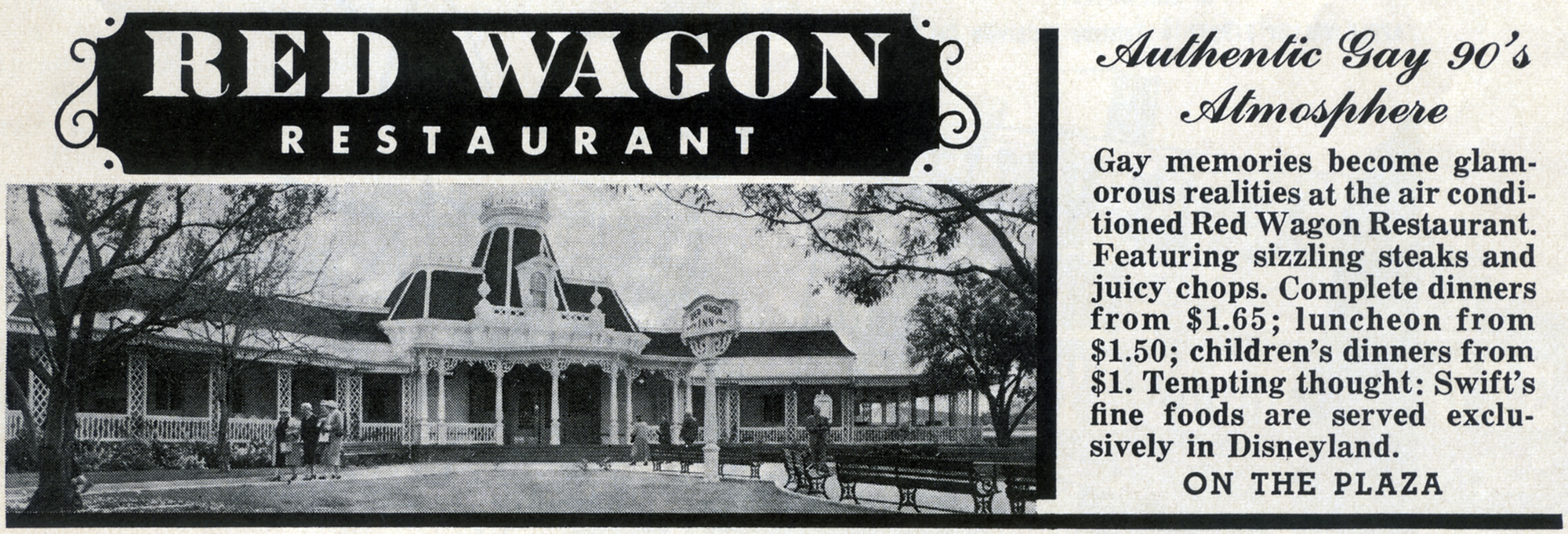
The results are fascinating. Seeing how Disney restaurants chose to present themselves in the brief space permitted by an ad seems to provide a succinct and evocative picture of the era. So, let’s see the offerings! The following ads come from a 1957 edition of Disneyland Vacationland.
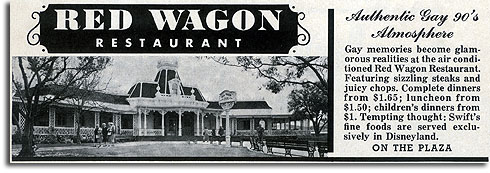 Gay memories become glamorous realities at Disneyland’s Red Wagon Inn, 1957 Let’s stop in the Plaza for some “authentic Gay 90’s atmosphere” at Swift’s Red Wagon Inn. It’s air conditioned! Sizzling steaks and juicy chops; luncheon from $1.50! Complete dinners from $1.65! For about three times that price today, you can get a Coke! Oh how I hope the kiddies can get a char-grilled hamburger sammich with french fried potato garnish!
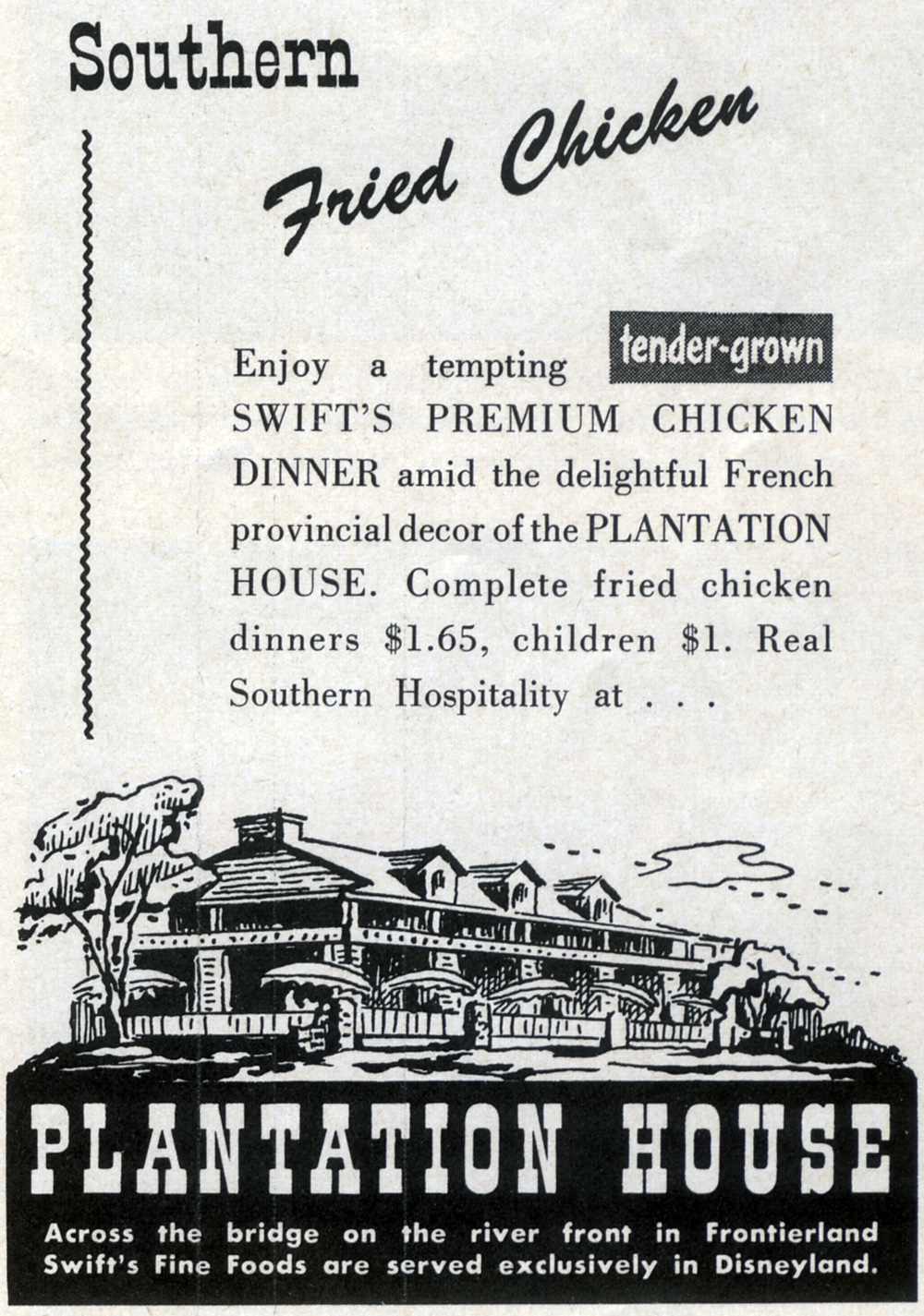
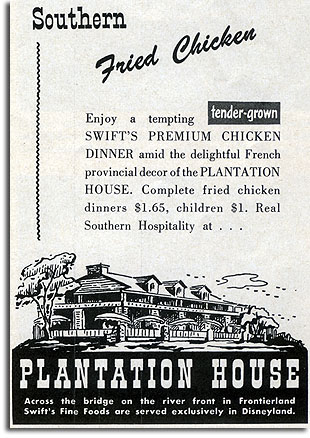 But what if you’re still a little hungry after those juicy chops? Especially after walking all the way to the end of Frontierland? Well why not stop at Swift’s Plantation House for a complete fried chicken dinner – for $1.65! And not just any fried chicken dinner – these are tempting tender-grown Swift’s premium chicken dinners! But what if you’re still a little hungry after those juicy chops? Especially after walking all the way to the end of Frontierland? Well why not stop at Swift’s Plantation House for a complete fried chicken dinner – for $1.65! And not just any fried chicken dinner – these are tempting tender-grown Swift’s premium chicken dinners!
Sadly, guests can no longer enjoy the delightful French colonial decor of the Plantation House; it was bulldozed to make way for New Orleans Square in the 1960s. Whenever you’re nibbling that Monte Cristo at the French Market, or standing along the waterfront waiting for Fantasmic, know that you’re standing on the graves of a million delicious, tender-grown chickens of days gone by.
 Ok, I’m stuffed – best to take in a few attractions. But that $1.65 fried chicken dinner cleaned me out; is there anything we can do that’s free? Surely not at Disneyland! Ok, I’m stuffed – best to take in a few attractions. But that $1.65 fried chicken dinner cleaned me out; is there anything we can do that’s free? Surely not at Disneyland!
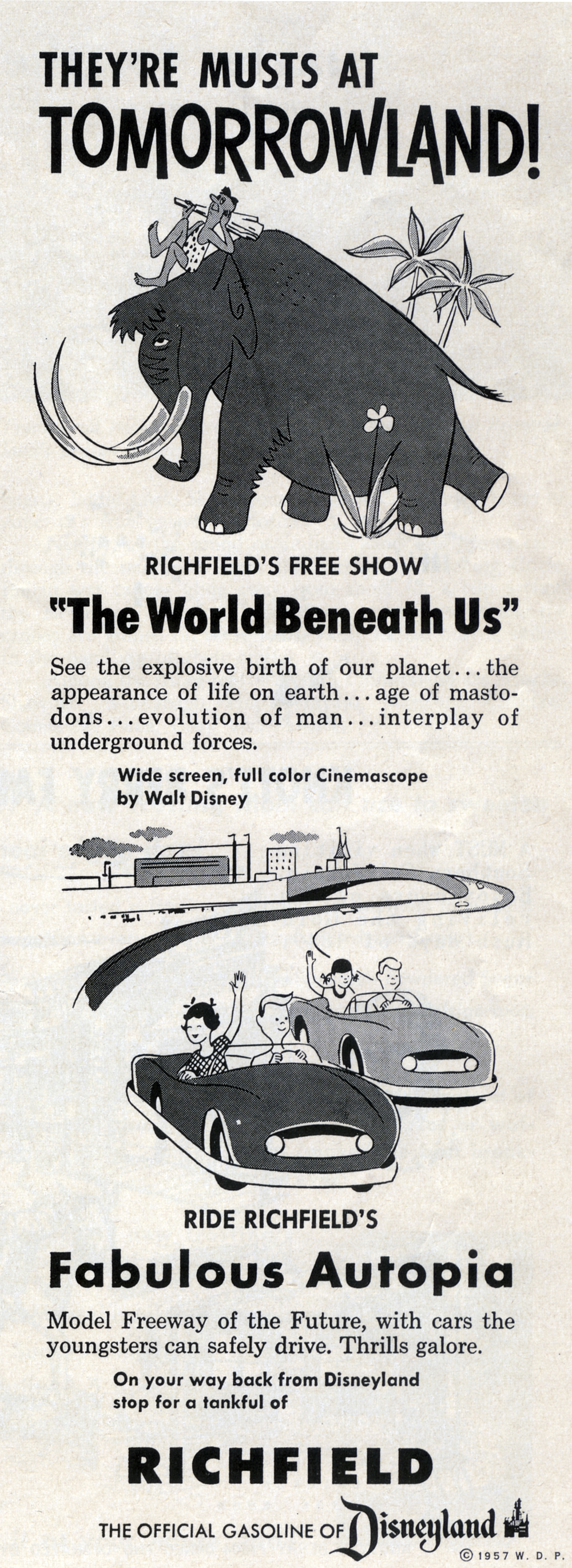
Ah, but what’s this? A free show! Richfield’s The World Beneath Us was a multimedia presentation consisting of a series of exhibits and a twelve-minute animated Cinemascope short. In something of a precursor to EPCOT’s Universe of Energy, Richfield Oil sponsored a look into the geological forces that shaped our planet. The show played in Tomorrowland from 1955-1960.
Ads for the exhibit touted the diorama of the earth’s crust, where mechanical devices helped illustrated “powerful underground forces at work”. Then, of course, there was the animation itself; designed in the modern style, it showed… the explosive birth of our planet! The appearance of life on earth! The age of mastodons! Evolution of Man! Interplay of underground forces!
My question – why isn’t this out on DVD?
But what good is all this gasoline with nothing to burn it on? Thankfully, Richfield also sponsored the Autopia where kiddies can experience “thrills galore” on the model freeway of the future. Thrills! Of course the Autopia outlasted Richfield; it putters along today under the auspices of another petroleum company. If only more people had stopped for a tank of Richfield on the way back from Disneyland…
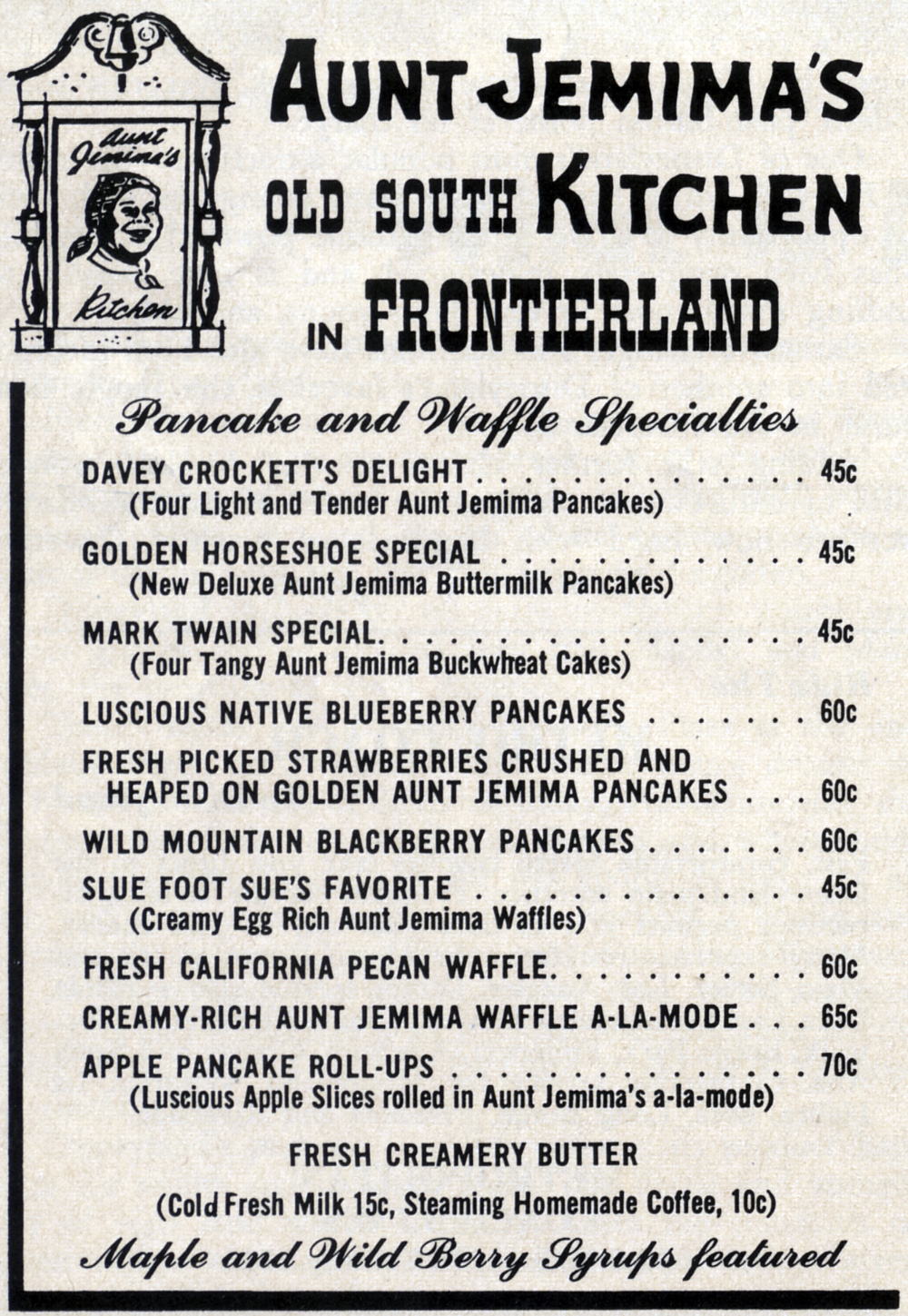
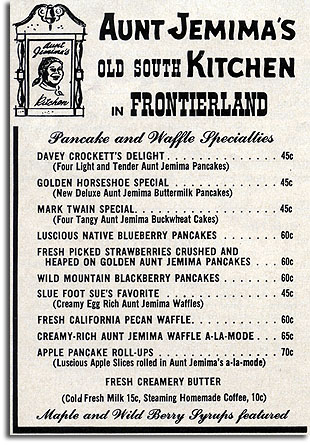 There are only two things I need out of life, and one of them is breakfast food. So what better place for breakfast for dinner than Aunt Jemima’s Kitchen in Frontierland? There are only two things I need out of life, and one of them is breakfast food. So what better place for breakfast for dinner than Aunt Jemima’s Kitchen in Frontierland?
Of course, those of us who weren’t alive in 1957 find it amazing and somehow hard to believe that there was ever an establishment called “Aunt Jemima’s Old South Kitchen” in Disneyland. Of course, looking at that menu I find it distressing that it’s not there for me to sate my breakfasty needs today. Is there anything on that menu that I don’t want right now?
There are pancakes and deluxe pancakes! But why does Davy Crockett have to make do with standard issue pancakes? I guess he’s used to roughing it. Mark Twain is apparently a fan of Aunt Jemima’s tangy buckwheat cakes, and Slue Foot Sue goes for waffles.
No wonder everyone was happy in the 1950s – if I lived in a world that I could get “luscious native blueberry pancakes” for sixty cents I’d be baby booming too. And boy I’d be ginned up to fight those Reds to defend my right to “fresh picked strawberries crushed and heaped on golden Aunt Jemima pancakes”. For sixty cents! With maple and wild berry syrups! And let’s stop and doff our hats in honor of the phrase “fresh creamery butter”. I’ve never understood nostalgia until this moment.
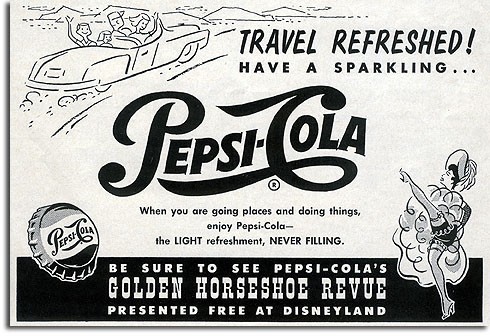
Best to pick up some refreshments before we head out. Thankfully there are Pepsi products available at the Golden Horseshoe Revue. Which, lest we forget, is presented free at Disneyland!
 Don’t forget, though, about Disneyland’s gourmet restaurants at the Disneyland Hotel. After the hustle and bustle of the park, parents can enjoy breakfast, luncheon, dinner and cocktails in an atmosphere suited to relaxed dining. Can we talk about how much I love that cocktails gets its own billing as a separate meal? Don’t forget, though, about Disneyland’s gourmet restaurants at the Disneyland Hotel. After the hustle and bustle of the park, parents can enjoy breakfast, luncheon, dinner and cocktails in an atmosphere suited to relaxed dining. Can we talk about how much I love that cocktails gets its own billing as a separate meal?
After all, the only thing better than the ultimate in cuisine and service is having your favorite beverages expertly prepared. And again, dinners from $2.35! A little pricy, but it is the ultimate in cuisine and service.
Note to advertising people who might be reading: I would be 72.33% more likely to eat at a restaurant that featured art in its ads similar to this piece.
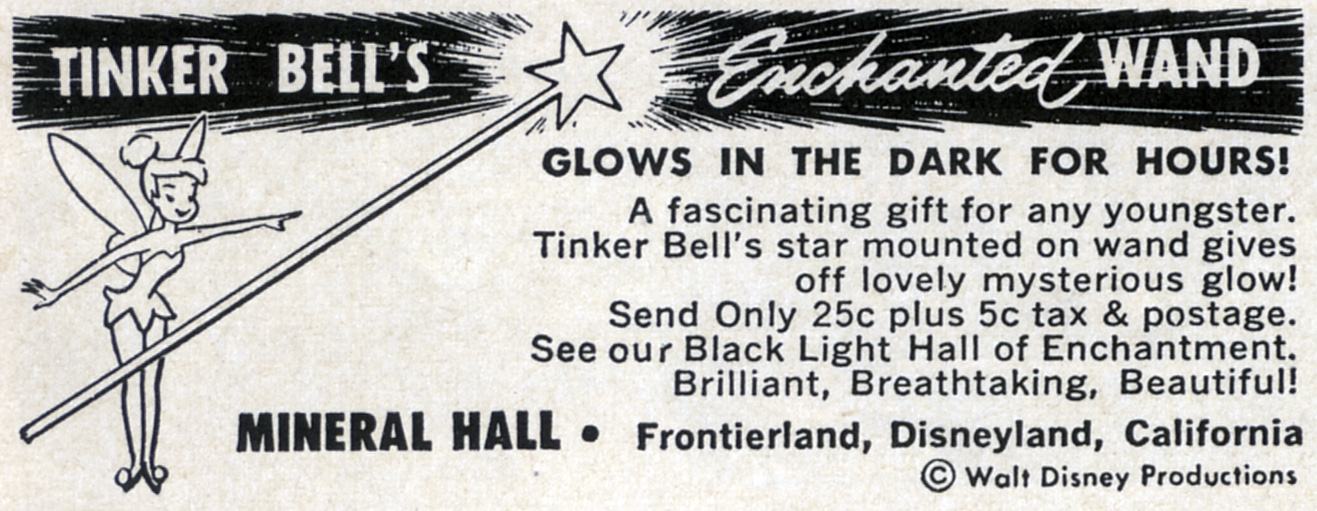
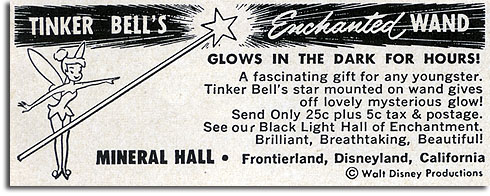 Glows in the dark for hours! We can’t leave for home without a souvenir. And what would say Disneyland to the rubes back home better than Tinker Bell’s Enchanted Wand? It glows in the dark for hours – a lovely, mysterious glow! For the low price of one shiny quarter – beat that, ODV carts! – you too can buy a “fascinating gift for any youngster”. So stop by Mineral Hall in Frontierland to see the Black Light Hall of Enchantment and… wait, what? Black Light Hall of Enchantment?! How come no one tells me about these things? Stupid no time machines and twenty-first century with its expensive pancakes…
Related Posts...
By Michael - November 6th, 2009 It’s been some time since we’ve discussed the upcoming Disney animation slate in any detail, and even longer since I updated the site’s list of animated projects. We’ve mentioned some of the schedule shifts that have occurred in the year and a half since Disney announced their ambitious development plans; most notably, Cars 2 was bumped up to a 2011 opening, pushing Gary Rydstrom’s newt back to 2012. But as the months pass, the crews at Disney and Pixar continue to develop new material. We’ve had one official announcement, 2011’s traditionally animated Winnie-the-Pooh, but there are several other new projects waiting in the wings.
First, though, a look at some of the projects that have been announced already. Disney will soon debut Princess and the Frog, its first traditionally animated feature since 2004. Hopes are high that this December release will revive Walt Disney Animation Studios, and pave the way for many 2D features to come. Early indicators are good; the screening of the film’s first act at the D23 Expo went over like gangbusters, and I was pleasantly surprised by the strength of the parts we were shown. I still have some qualms about some of the character design and animation (again, too loosey-goosey for my tastes), but the general aesthetic of the film looks great and the story seems to be extremely tight and lean. The music’s good, too.
 Rapunzel Rapunzel is looking lovely too… Work on Rapunzel continues for 2010; as that long-in-the-making film moves from story to production, the scuttlebutt coming out of Burbank has become increasingly optimistic. After the story problems that plagued the film for so long, one hopes that things really start to click. The development art that has been released looks top notch.
The first new film to add to our list is the aforementioned Winnie-the-Pooh. Directors Steve Anderson and Don Hall originally brought this project to John Lasseter as an idea for a direct-to-video feature. Lasseter, who apparently has an affinity for the Disney Pooh featurettes from the 1960s and 70s, liked the idea so much he greenlit it for a theatrical release. This came as something of a surprise to observers, who are used to Disney targeting this character directly at the preschool crowd. Lasseter seemed aware of this during his presentation at the D23 Expo, asking the audience to “trust him” that the film won’t be just for little kids, and that we “won’t believe how funny this thing is.” Indeed. Just kiddin’, I love ya Johnny boy.
I’ve always assumed that I was alone in my incredible and all-consuming disdain for the Pooh character and his cohorts. I’ve never liked Pooh, even as a kid. Maybe it’s because each inhabitant of the Hundred Acre Wood seems straight out of a different chapter of the DSM-IV. Anyway, it was amusing to hear both the muted reaction to the Pooh news at D23 and then to watch the documentary the boys and hear Richard and Robert Sherman talk about how they couldn’t stand the stories either. Don’t get me wrong – Winnie-the-Pooh will most likely be highly enjoyable in the end. I just can’t get myself excited about it right now.
What does excite me is the approach they’re taking to the film, which is hand-drawn and will incorporate watercolored backgrounds like the original films. They’re also mining the original Pooh books for five stories that will be strung together around a central narrative. Disney Legend Burny Mattinson, who worked on the original animated featurettes, returned to Disney to guide the story department in the picture’s development. Winnie-the-Pooh will hit theaters in the spring of 2011, filling a gap in Walt Disney Animation Studios’ production slate.
Another previously announced film in development is 2012’s King of the Elves; based on the Philip K. Dick short story, it’s rumored to be computer-animated. The Animation Guild blog mentioned recently that the story is currently being retooled, bringing some changes and the departure of at least one director. Aaron Blaise and Robert Walker were originally announced to direct, and it seems that Blaise has left the film for reasons unknown.
From here, we enter the realm of speculation. There have been a number of projects in and out of development at Disney over the last decade, and these are starting to pop up again as contenders for the next wave of releases. The first of these is The Snow Queen, which was mentioned by Disney producer Don Hahn as in development as recently as the D23 Expo. Hahn showed a slide of concept art from the film during one of his panel discussions, and offhandedly mentioned the project as something they’re working on.
 This is an awful, awful picture I took of the concept art from The Snow Queen at D23. If you could see it, it would show a castle embedded in an icy mountain lit by aurorae. The striking piece was created by artist Paul Felix; if you have a better picture from this presentation, would you send it along? The Snow Queen was in development at Disney from roughly 2000-2003, when it was scuttled because Disney management wanted to get out of the fairy tale game and into the “hip and edgy” business. The project was originally intended for directors Paul and Gaetan Brizzi for when they were finished with Don Quixote, but when that animated adaptation was canceled in early 2001 the Brizzis departed the studio. The Snow Queen was then handed off to Dick Zondag and Dave Goetz to direct, but the project eventually went into turnaround in the middle of 2002. During this break, animator Glen Keane left the project in order to direct his own film (which, eventually, turned out to be Rapunzel).
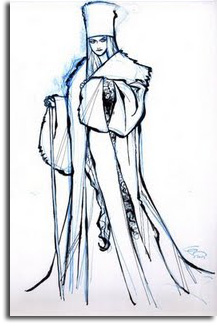 Character design for The Snow Queen by Harald Siepermann. This design is from the earlier attempt at producing this story. The film spiraled into development hell as management decided to retool it as a computer-animated feature, and around 2003 it simply faded away. In early 2006 it was announced that composer Alan Menken and lyricist Glen Slater were developing a stage musical based on The Snow Queen for Tokyo Disneyland; it was canceled abruptly at the end of that year, possibly when the film version went back into development. Cut to around 2007, when John Lasseter had arrived at Disney Feature Animation and was reassessing the development slate. Around that time, work began anew on The Snow Queen. Current rumors online suggest either Mike Gabriel or Dean Wellins are involved to direct. Menken has confirmed in the European press that he’s writing the songs for the film.
If Lasseter’s arrival at Disney brought new life to some projects, it meant the end of others. So it was for Joe Jump, a computer-animated film that was junked in 2008 after about four years of development. The film, a story of a videogame character from the early 1980s who tries to make his way in the modern high-tech gaming world, got some positive buzz when it was going through the story process around 2006. Story artist Sam Levine was leading the project, with designer Joe Moshier helping create the film’s look. In an interview, character designer Jim McPherson spoke about his work on the film:
“…I was appointed to join the Visual Development Team at Walt Disney Feature Animation to work with the director Sam Levine and character designer Joe Moshier on a film called Joe Jump. All the characters were developed in collaboration of drawing and modeling done in ZBrush 2. We translated a more graphic character style into 3D, slightly leaning towards “Toot, Whistle, Plunk and Boom” or UPA cartoons, but with a heavy influence of Milt Kahl and Tom Oreb’s work. Unfortunately, the movie was cancelled after 4 years in development. I hope to eventually get permission to show some of the characters. There were cyborg lizards, heavily armored heroes and amazon women designed in a new style.”
Joe Jump was canceled in order to focus resources on projects that were further along in the development pipeline, but now the blog of the Animation Guild reports that the pixelated hero lives again. Further information is unavailable, but look for the CGI Joe Jump and the (hopefully) hand-drawn The Snow Queen to shuffle into those 2013 and 2014 release slots at some point.
What comes after that? Your guess is as good as mine. Online sources have speculated for several years that Disney has been working on an adaptation of the ancient Hindu epic Ramayana, although I can’t find any compelling source for this. What does lend some credibility to that rumor, aside from Disney’s increased efforts in India over recent years, is their under-the-radar interest in the purchase of a publisher of graphic novels centered on Hindu mythology. No one seems to have noticed this in the shadow of the Marvel deal, but it could indicate that the rumors of Ramayana are not all fanboy speculation. Allow me to say, Disney folk, if you are thinking about this… I really hope you make it work somehow because it could be absolutely killer.
There are certainly other abandoned projects from the early part of this decade that deserve a second chance with the new management; Barry Cook’s My Peoples, Ron Clements and John Musker’s Fraidy Cat, or – please, please, please – the Brizzis’ Don Quixote. Hopefully there’s a lot of room at WDAS for new productions; that will keep a lot of animators employed and make me very, very happy.
Related Posts...
By Michael - November 4th, 2009 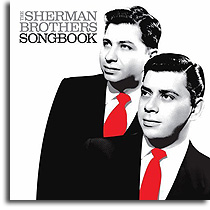 It’s hard to argue that any individual or individuals, aside from Walt himself, has had a greater effect on the musical history of the Walt Disney Company than Richard and Robert Sherman. Of course there have been many prominent and highly talented songwriters at the studio both before and after the brothers’ tenure there, and several iconic composers and orchestrators such as George Bruns and Buddy Baker, but few if any can claim to match the sheer size of the Shermans’ catalogue. In fact, the scope of their creations is so vast and their presence so ubiquitous that one can tend to overlook it – their songs are so ingrained in the Disney experience that it’s hard to conceive that they weren’t always there. It’s hard to argue that any individual or individuals, aside from Walt himself, has had a greater effect on the musical history of the Walt Disney Company than Richard and Robert Sherman. Of course there have been many prominent and highly talented songwriters at the studio both before and after the brothers’ tenure there, and several iconic composers and orchestrators such as George Bruns and Buddy Baker, but few if any can claim to match the sheer size of the Shermans’ catalogue. In fact, the scope of their creations is so vast and their presence so ubiquitous that one can tend to overlook it – their songs are so ingrained in the Disney experience that it’s hard to conceive that they weren’t always there.
For those of us who might need a reminder of just what the Shermans managed to achieve, or those who know these songs well but had never bothered to think about their origin, Walt Disney Records has recently released a 2-disc set of the songwriting duo’s work that brings together 59 tracks from their four decades writing for the company. Newbies will be shocked that all these songs were written by the same individuals, and even long-time fans will be taken aback by the sheer amount of iconic music. One hopes they’ll also actually stop and think about the songs themselves; removed from the context of their individual films or attractions, the songs are allowed to stand on their own merits and the result is fascinating.
The Shermans occupied a niche in musical history that has in many ways disappeared; they were the only staff songwriters Disney ever had, in one of the last studio music departments in Hollywood. From their father, Al Sherman, they inherited a firm rooting in the Tin Pan Alley tradition; this seems to have melded in their style with more modern pop influences, Broadway, and music hall traditions. Listening to so many of their songs together, their style reminds me more than anything else of Cole Porter; their lyrics are witty and verbose, and almost always narrative or conversational in tone. There’s wordplay, alliteration and lots of rhyming, as well as a predilection for invented words. While the production on some of these tracks might be dated at times, the songs themselves remain sharp as a tack.
The Sherman Brothers Songbook is yet another superlative release by Walt Disney Records to be produced Randy Thornton, who is almost singlehandedly responsible for reviving the company’s moribund park album and classic film soundtrack efforts. Here Thornton follows up his 1992 audio retrospective, The Sherman Brothers: Disney’s Supercalifragilistic Songwriting Team, by expanding the number of tracks and presenting the pieces in chronological order – from the 1958 Annette single Tall Paul to their work on The Tigger Movie in 2000. Thornton also wrote the liner notes for the discs, which do not discuss each individual track but rather provide an anecdote from the Shermans’ experiences on each film, television or theme park project.
What’s startling about The Sherman Brothers Songbook is not only the amount of songs present, but the number of things that were left off. This is not to fault the release; think of it merely as a very thorough “greatest hits” compilation and not a replacement for the many soundtracks and collections this release was pulled from. Fans who have bought every Disney music collection over the last twenty years won’t find too many unexpected shockers here, but that’s not the point. This, in many ways, is the Disney version of the Beatles’ One – the essential tracks, masterfully presented.
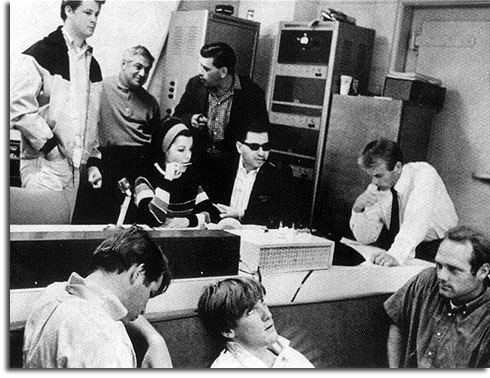 I cannot tell you how much this picture amuses me. Clockwise from top left: Brian Wilson, Tutti Camarata, Annette Funicello, Robert Sherman, Richard Sherman, Al Jardine, Mike Love, Carl Wilson, and Dennis Wilson. (Disney) That’s not to say there’s no room for obscurities on this album. The two discs, combined with the Shermans’ snappy and concise Tin Pan Alley songwriting, allow for a whopping 59 tracks. Wisely, from a collector’s standpoint, Thornton substitutes in less-known versions of certain songs for their more often heard soundtrack counterparts. Thus, instead of the cuts from the film we get Louis Armstrong performing Ten Feet Off the Ground from The One and Only Genuine Original Family Band, and Anne Shelton singing It Won’t Be Long ’til Christmas from The Happiest Millionaire. This wealth of material is made possible by Disney’s publishing strategy at the time, which involved two record labels – Buena Vista Records and Disneyland Records. Buena Vista was the “flagship” label, offering premium titles, cast soundtrack albums, and albums by prominent artists. Disneyland Records was in charge of budget titles, releasing albums targeted mostly at children. They also released a second tier of soundtrack albums, featuring covers of a film’s songs by a variety of studio musicians and vocal groups. This arrangement allowed for the labels to release a wide variety of music in its heyday, not all of it derived directly from Disney films. Three songs from one of these albums, all covers from the film Chitty Chitty Bang Bang, appear on The Sherman Brothers Songbook as bonus tracks. An astounding number of “civilians” believe this MGM film to be a Disney production, and it’s not surprising when you hear the songs. Thankfully, Disneyland Records recorded a cover album at the time, and so these three non-Disney songs by the Shermans can take their rightful place in this collection.
Another rarity from the collection indicates an enticing potential direction for future releases; instead of including Annette’s version of Strummin’ Song from The Horsemasters, Thornton includes a fun demo version of the tune with Annette in the studio with Richard Sherman. While a lot of outtakes would have seemed out of place in a mass-market title like this, one can only imagine the hours upon hours of demos, alternate versions, and scads of unreleased songs by the Shermans that sit in Disney’s vaults. This is a great two-disc collection that serves, in the end, to whets fans’ appetites for a huge box set or series of releases.
Of the music itself, there’s not much one could say that hasn’t been said. The songs sounds great, though; producer Thornton is a stickler for quality and the pieces sound as unblemished and clear as the day they were recorded. Everyone will have their own favorites, and a track or two that they skip over more often than not. Listening with fresh ears will lead you to rediscover the songs or find new favorites; I still can’t get over how truly excellent On the Front Porch from Summer Magic is, despite having heard it many times previously. The disc also features the stateside debut of a track intended for EPCOT Center and eventually used in Tokyo Disneyland; Meet the World is, I believe, the Shermans’ “stickiest” song ever – more addictive, even, than it’s a small world. It’s true.
Rather than try and rate things here with a star or numerical system, I’m going to simply recommend if you should buy, borrow, or bury them. The Sherman Brothers Songbook is a definite buy for any fan of Disney films, animation, or theme park music. Even if you have most of these tracks in your library, having them remastered and collected in one place, along with the rarer tracks, is worth the price of admission. One can only hope that Walt Disney Records continues the trend we’ve seen this year, with the World’s Fair set and now this collection. There is a lot of music waiting to be heard, and this disc represents some of the best.
The Sherman Brothers Songbook is available on CD and as MP3 download.
The Sherman Brothers Songbook
Disc One
1. Tall Paul from the album Annette
2. Pineapple Princess from the album Hawaiiannette
3. The Flubber Song – The Absent-Minded Professor
4. The Parent Trap – The Parent Trap
5. For Now For Always – The Parent Trap
6. Let’s Get Together – The Parent Trap
7. The Wonderful World of Color (Main Title) – The Wonderful World of Color
8. The Spectrum Song – An Adventure In Color
9. The Green with Envy Blues – An Adventure In Color
10. Strummin’ Song (Rehearsal Version) – The Horsemasters
11. Although I Dropped $100,000 in the Market – Symposium on Popular Songs
12. I’m Blue For You (Boo Boo Boo Boo Boo) – Symposium on Popular Songs
13. Castaway – In Search of the Castaways
14. Enjoy It! – In Search of the Castaways
15. On the Front Porch – Summer Magic
16. Femininity – Summer Magic
17. The Ugly Bug Ball – Summer Magic
18. The Tiki, Tiki, Tiki Room – The Enchanted Tiki Room, Disneyland® Park
19. It’s a Small World – The New York World’s Fair
20. There’s a Great Big Beautiful Tomorrow – The New York World’s Fair
21. A Spoonful of Sugar – Mary Poppins
22. Chim Chim Cher-ee – Mary Poppins
23. Feed the Birds (Tuppence a Bag) – Mary Poppins
24. Supercalifragilisticexpialidiocious – Mary Poppins
25. The Monkey’s Uncle – The Monkey’s Uncle
26. That Darn Cat – That Darn Cat
27. Winnie the Pooh – Winnie the Pooh and the Honey Tree
28. Up, Down and Touch the Ground – Winnie the Pooh and the Honey Tree
29. Little Black Rain Cloud – Winnie the Pooh and the Honey Tree
30. I Wan’na Be Like You (The Monkey Song) – The Jungle Book
31. Trust In Me – The Jungle Book
32. My Own Home – The Jungle Book
Disc Two
1. Fortuosity – The Happiest Millionaire
2. Valentine Candy – The Happiest Millionaire
3. Are We Dancing – The Happiest Millionaire
4. It Won’t Be Long ‘til Christmas – The Happiest Millionaire
5. The Wonderful Thing About Tiggers – Winnie the Pooh and the Blustery Day
6. Heffalumps and Woozles – Winnie the Pooh and the Blustery Day
7. The Rain Rain Rain Came Down Down Down – Winnie the Pooh and the Blustery Day
8. Ten Feet Off the Ground – The One and Only Genuine Original Family Band
9. The Happiest Girl Alive – The One and Only Genuine Original Family Band
10. ’Bout Time – The One and Only Genuine Original Family Band
11. Chitty Chitty Bang Bang – Chitty Chitty Bang Bang (BONUS TRACK)
12. Hushabye Mountain – Chitty Chitty Bang Bang (BONUS TRACK)
13. Me Ol’ Bam-Boo – Chitty Chitty Bang Bang (BONUS TRACK)
14. The Aristocats – The Aristocats
15. Scales and Arpeggios – The Aristocats
16. She Never Felt Alone – The Aristocats
17. The Age of Not Believing – Bedknobs and Broomsticks
18. Portebello Road – Bedknobs and Broomsticks
19. The Beautiful Briny – Bedknobs and Broomsticks
20. One Little Spark – Journey Into Imagination, EPCOT ®
21. Makin’ Memories – Journey Into Imagination, EPCOT ®
22. Magic Journeys – Magic Journeys, EPCOT ®
23. Meet the World – Meet the World, Tokyo Disneyland®
24. Pooh’s Lullabee – The Tigger Movie
25. Whoop-De-Dooper-Bounce – The Tigger Movie
26. Your Heart Will Lead You Home – The Tigger Movie
27. Walt Disney and The Sherman Brothers Sing – Progressland Promotional Film
Related Posts...
|
The Progress City Primer
 From the Progress City archives comes this collection of 33 tall tales and true from Disney history. Available in paperback, hardback, and ebook formats. |











Recent Comments