Contribute to Our Research
|
By Michael - April 28th, 2010 Somehow this evening I stumbled across a particular piece of video that instantly brought back some memories.
Back in the 1980s, home video was a big deal. And, increasingly, Disney began to enter into a market that it had been reluctant to consider before. The first waves of live-action home video releases were basically trial balloons, and consisted of a mix of A-list titles and forgotten flops. The Disney animated canon was slower to emerge on the home market, as the company remained intent on sticking to its age-old theatrical re-release strategy (a concept that continues to influence the absurd “Disney vault” concept today).
Anyway, those video releases of the early 1980s were heavily branded; from the signature clamshell cases to the awesome “neon Mickey” logo, there was a great deal of comfortable familiarity with each release.
One of the other elements included on each videocassette was this fantastic little advert, which served to promote all the other films that Disney had released for rental. It’s so wonderfully of its era, and it flashes me back to those exciting trips to the local video store to rent some Disney films for the weekend. Would it be Swiss Family Robinson or The Absent-Minded Professor? That, a collection of Donald Duck cartoons, and a rental of Metroid for the NES and I’d be good to go.
This is one of those bits of video that, even though one might not have seen it in years upon years, is still as familiar as if you’d seen it five minutes ago. The kicker is that this promo was actually put onto the Disney videocassettes after the main feature! Disney was content not to force the ad on viewers, and the heck of it is that I remember watching through the end credits of films specifically to watch this compilation. It helped that those older films had little or no end credits, and the ad could begin immediately after the title card announcing “THE END – A Walt Disney Production”, but it’s still pretty amazing that they’d stick it at the end of the tape instead of the beginning.
Take a look and feel the nostalgia. Also, note that there was a shorter and more common version of this promo, which I could really probably recite in my sleep. Quite a difference from the promos Disney puts on their releases today, eh?
Related Posts...
By Michael - April 28th, 2010
The first major element constituting a net addition to the Florida economy is the investment required to establish Disneyworld as a major tourist attraction. The total construction expenditure needed to develop all facilities supporting the basic economic activities at Disneyworld is estimated to be in excess of $620 million during the first 15 years of construction and operation. This includes the cost of developing the theme park, EPCOT’s commercial, community, and administrative facilities, necessary tourist accommodations, a transportation complex, and industrial facilities. This investment is, in effect, the basic catalyst for all aspects of economic impact.
Since many of the planned facilities will be unique in concept and design, the construction cost estimates are necessarily preliminary. Still, it is quite evident that an expenditure of this size, even over a period of 10 to 15 years, will have an important impact on the statewide construction labor market and on local and statewide suppliers of materials and equipment.
– Economic Research Associates, 1967
Ya think?
To put that $625 million estimate in perspective, EPCOT Center itself is conservatively estimated to have cost $1.2 billion.
Related Posts...
By Michael - April 24th, 2010  Tokyo Disneyland conference room at WED Enterprises
We’ve seen what was happening at EPCOT Center in 1977, but sometimes it’s interesting to look at where projects were in their development relative to others. In many ways, Tokyo Disneyland and EPCOT Center were twin developments; their design and construction overlapped through the late 1970s and early 1980s, and they opened only seven months apart from each other in 1982 and 1983. This period was a high point for the Imagineers at WED Enterprises; never before or since have they simultaneously devised and executed two projects of such magnitude. But if EPCOT was just a model in an Imagineering office at the time, what was Tokyo Disneyland?
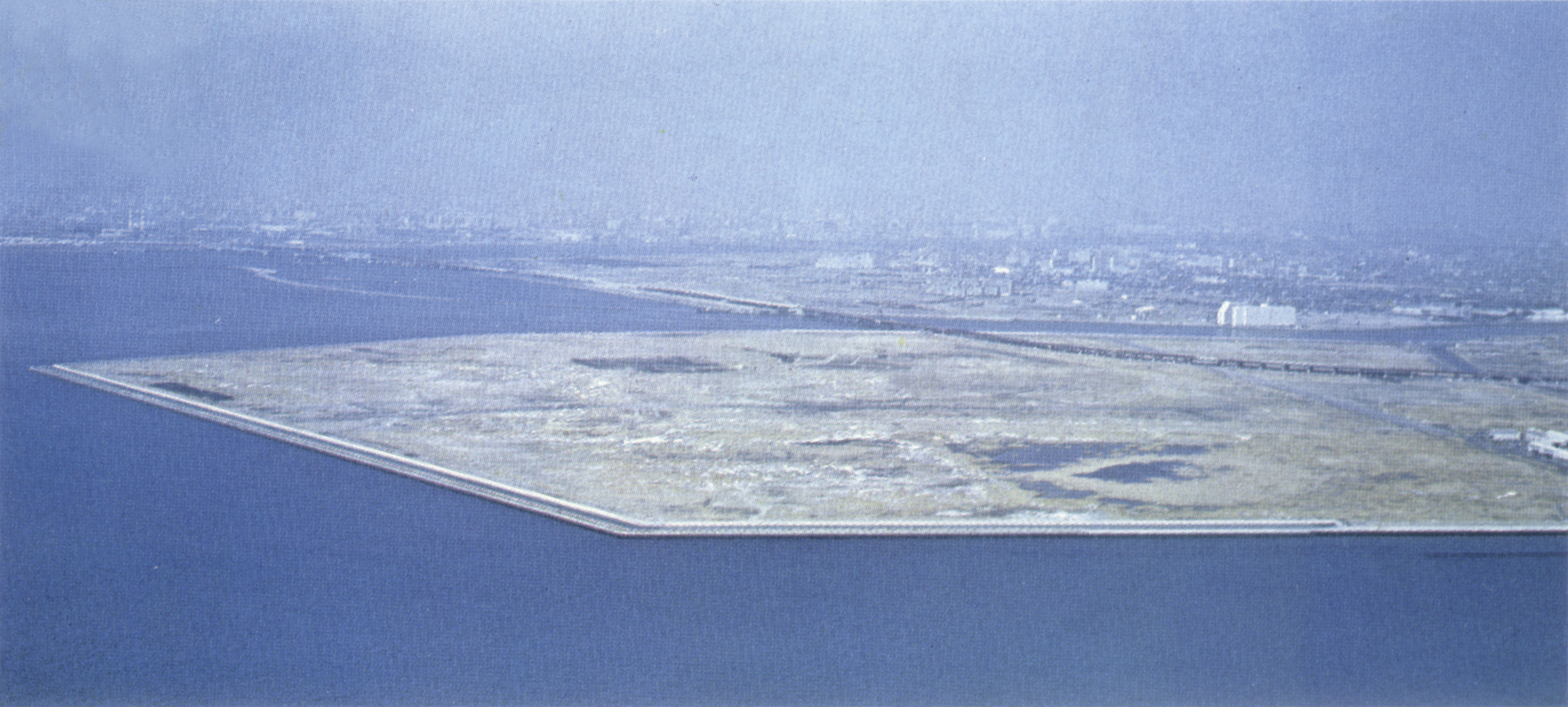
 “The site of the Company’s proposed Japanese theme park, a 600-acre parcel of land bordered on three sides by Tokyo Bay.”
Tokyo Disneyland seemed to have a leg up, as it at least had a cleared site ready for construction. Strangely, though, it wouldn’t open until after EPCOT Center. From the 1977 Walt Disney Productions Annual Report:
During the last week of September, representatives of the Company made a comprehensive presentation to Mitsui Real Estate Development Co., Ltd., Oriental Land Co., Ltd., and Keisei Electric Railway Co., Ltd. in Tokyo covering the results of the phase II work performed by WED Enterprises in close liason with the Japanese interests.
This year-long effort, the expense of which was borne by the Japanese, covered planning, conceptual design, preliminary engineering, preliminary construction, fabrication and installation estimates, operational planning, organizational development planning and marketing and promotional guidelines. This work also developed the areas in which additional information and input will be forthcoming from the Japanese groups covering essential information available to them and based upon their knowledge and information of conditions in their country.
 “THE WORLD BAZAAR: A major new element planned for Tokyo Disneyland is this completely enclosed center for international shopping, dining and entertainment.”
Recently, Oriental Land Co., Ltd. has undergone a major re-organization, with control moving from Keisei Electric Railway Co., Ltd. to Mitsui Real Estate Development Company. Implementation of this change and the necessity for the new organization to appraise the entire project on its own initiative make it probable that a further period of time will elapse before the Japanese and our Company will be in a position to make a decision as to whether the project will go forward.
Further, delays are being experienced in the public access links to the project. The current estimate is that the Tokyo Bay Expressway will not be fully completed until 1982, although the first lanes will open during 1978. The start of construction for the new Keiyo Line Railroad is indefinite at this time.
Assuming a favorable decision to proceed, it would therefore appear that the project could not open to the public before 1982.
 A modern aerial view of the Tokyo Disney Resort from the same direction shows Tokyo Disneyland towards the top of the picture, and Tokyo DisneySea towards the bottom.
As you can see, the Tokyo Disneyland project was in a strange limbo at the time. While a great deal of work was well underway, including preliminary construction, it was still officially undecided whether Disney and the Japanese companies were going to go forward with the project. Even with the delayed opening projected as 1982, the park wouldn’t actually open until Spring of 1983.
 This map overlay from Google Earth matches up with the cleared land for Tokyo Disneyland in 1977. You can see the S.S. Columbia from Tokyo DisneySea in the foreground; Tokyo Disneyland itself is marked with the red pin.
Related Posts...
By Michael - April 23rd, 2010 
Let’s just cut to the chase – I’m a big fan of The Great Mouse Detective.
I’m also a firm believer that this modest 1986 feature is one of the most underrated gems in the Disney animated canon; more than just a solid stepping stone on the way to the later renaissance of feature animation, it’s a very entertaining film in its own right with more than its share of big ideas, funny moments, and interesting animation. To say that the film is overlooked is an understatement; it’s received little attention from the company since its release more than twenty (!) years ago, and I’d venture to guess that a number of fans have never even seen or heard of it.
The Great Mouse Detective (I prefer, rather pedantically, to call it by its development title Basil of Baker Street) has returned to home video via the rather absurdly titled “Mystery in the Mist” edition. Apparently all earlier releases were either some degree less mysterious or misty. I couldn’t detect the difference, but I assume it must be there since it’s in the title.
Anyway, this new edition, which hit stores on April 13th, 2010, is a rather bare-bones affair, with a brief making-of feature that was pulled from an earlier DVD release as its only bonus feature of note. The only new material here is a bizarre little featurette only tangentially related to the film, as well as the requisite slew of new trailers and promo videos. But, for the uninitiated, let’s first take a look at the film itself.
The Film
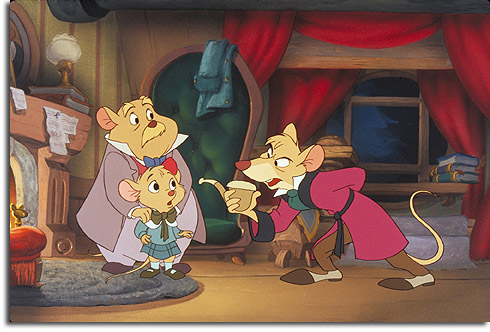
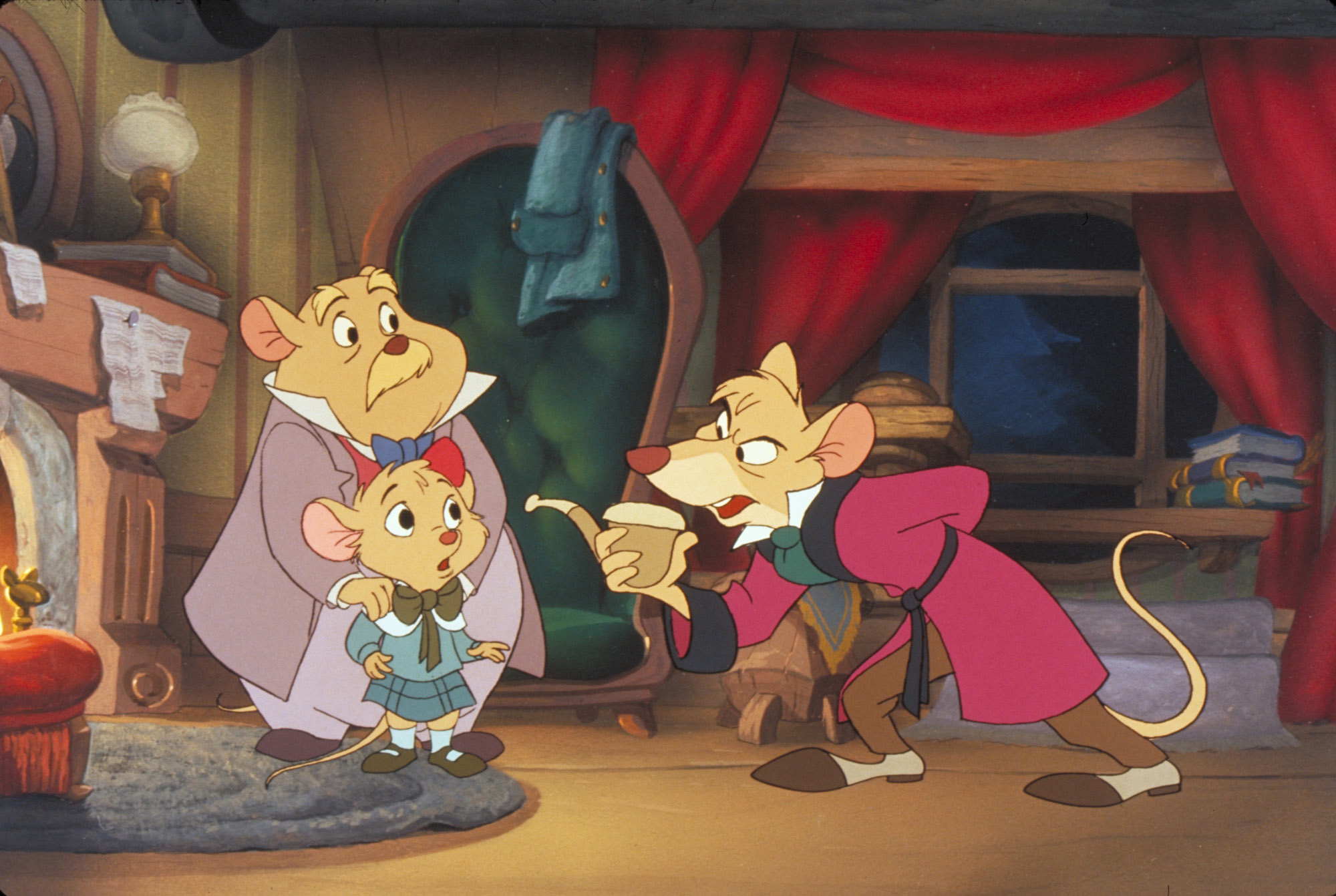
 Dr. Dawson and Olivia Flaversham meet Basil of Baker Street, the Great Mouse Detective
In 1985, the Disney animation studios reached what is considered their lowest ebb when The Black Cauldron flopped upon release. As the recent documentary Waking Sleeping Beauty points out, Disney was defeated at the box office that year by the bottom-drawer TV spinoff The Care Bears Movie. A year later, in July of 1986, The Great Mouse Detective arrived in theaters.
The film was a smaller, leaner production than The Black Cauldron; that earlier release had been in development for around a decade, while Mouse Detective was made on a much smaller budget and a much tighter schedule. It was also the first of the Disney features to be predominantly created by the new generation of talent at the studio; directing alongside veteran storyman & animator Burny Mattinson and animator David Michener were Ron Clements and John Musker, who would famously go on to direct The Little Mermaid, Aladdin, and most recently The Princess and the Frog.
Based on a series of stories by author Eve Titus, The Great Mouse Detective takes place in the fog-shrouded gaslight era London of 1890. It depicts a world in which mice live in a society parallel to our own, with their own houses, pubs, and palaces carved out of the urban clutter. The titular Basil of Baker Street is a detective of great renown in the animal world; his signature magnifying glass, pipe, violin and deerstalker hat mirroring those of his more famous upstairs neighbor at 221B Baker Street, the human detective Sherlock Holmes.
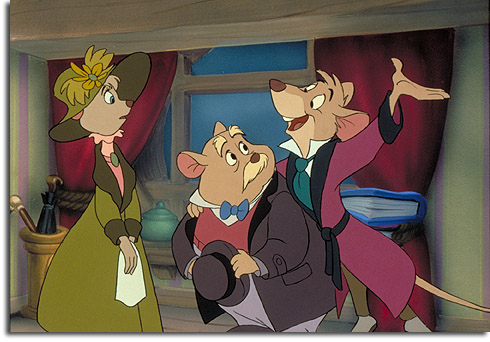
 Dr. Dawson and Basil of Baker Street consult with a new client
From his office beneath Holmes’s townhouse, Basil has made a name for himself by solving innumerable crimes through his combination of forensic science and good old-fashioned detective work. Even the great Basil’s skills, though, are taxed when faced with the nefarious schemes of his mortal nemesis (and the world’s greatest criminal mind) – the vile Professor Ratigan.
We’re introduced to Basil and his world via young Olivia Flaversham, daughter of a great mouse inventor and toymaker, who has just seen her father mousenapped by a gang of thugs. Alone on the streets of London, Olivia meets Dr. David Q. Dawson, just returned from the war in Afghanistan (!); as the rodent stand-in for the famous Dr. Watson, Dawson acts as our narrator throughout the film. The two meet up with Basil, enlist his help in finding Flaversham’s father, and in the process uncover an elaborate scheme by the evil Ratigan that threatens the very fabric of the Empire itself.
 The insidious Professor Ratigan
The film is great fun; it moves at a very quick pace but never seems rushed or frantic. The characters are all appealing, and there’s some really fantastic voice work across the board. Most notable is Vincent Price’s work as Ratigan, a larger than life character that Price later would say was one of his favorite roles. Ratigan is a great villain and actually quite menacing; more to the point, he’s interesting, which always helps.
Basil himself is great fun as a character, exuding a kind of manic energy that is both simultaneously in control of every situation but also just a hair’s breadth from running completely off of the rails. Basil is cool but awkward, confident and insightful but often oblivious. He’s a really fun character that Disney has completely abandoned – it occurred to me as I watched that while it seemed obscene to make two or three sequels to Cinderella, it would be perfectly natural and actually quite worthwhile to continue the serialized exploits of Basil. Barrie Ingham, who voices Basil, and Val Bettin as Dr. Dawson play well off of each other, and their brief appearance together in the making-of featurette was far too brief for my tastes.
The young Ms. Flaversham is equally well-executed, taking a character that could be irritating or saccharine and making her genuinely sweet. Her father, inventor Hiram Flaversham, receives a familiar Scottish brogue courtesy of Scrooge McDuck himself, Alan Young. Long-time character actor Candy Candido contributes his trademark gravelly croak to “a peg-legged bat with a broken wing,” and the great Basil Rathbone himself has a brief cameo as the voice of Sherlock Holmes.
Visually, the film has its highs and lows. The production design is by turns moody and cozy, and goes a great job of creating a very lived-in world for the characters. There are a lot of neat ideas and even “Easter eggs” – look for visual tributes to Dumbo, the Firehouse Five, and even the airship Hyperion! Overall the animation is quite good, but there are some glaring exceptions. Character animation on the leads is mostly great; Basil is dashing, and evokes Errol Flynn at times. Dawson is suitably pleasant, and young Flaversham is as cute as a young Scottish mouse should be. Their animation is fluid and full of detail, as are most incidental characters – there’s a lot of interesting character design here, and even bit roles and background characters seem very evocative of the period. Where things get rough, though, are the group scenes; the animation seems much more crude in the musical numbers especially. In one particular song the mouths of the “chorus” seem out of sync with the lyrics, and this makes me wonder if something musically was changed very late in the process. But while the crowd scenes seem dodgy due to a lack of time or money (or both!), there’s still a lot of great animation to be found. The exception among the main characters, unfortunately, is Professor Ratigan, who is hampered on occasion by lead animator Glen Keane’s trademark…. overexuberance.
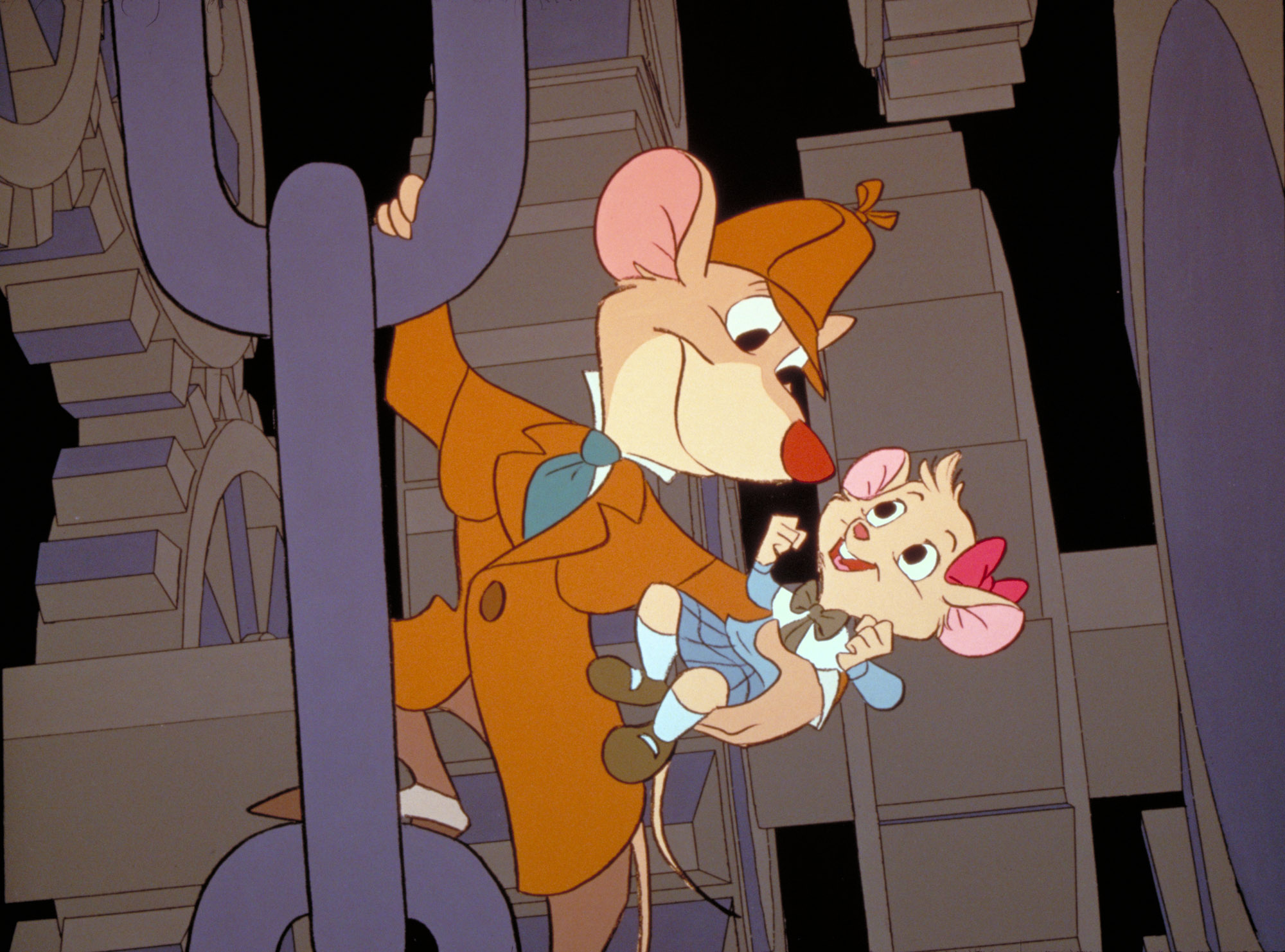
No mention of the film’s animation would be complete without discussing the famous climax inside Big Ben’s tower at Westminster Palace, which marks the earliest prominent use of computer-assisted animation in a Disney feature. Computers were used to render the complex machinery inside the clockwork mechanism, allowing for complex and fluid camera movements within the whirling gears and cogs. The effect still works; perhaps due to its relative simplicity, or the appropriate meshing of technique and subject matter, the scene within Big Ben is still exciting, well staged, and impressive. It remains among the great action finales in Disney films and is a far more organic integration of computer-generated imagery than even many recent features.
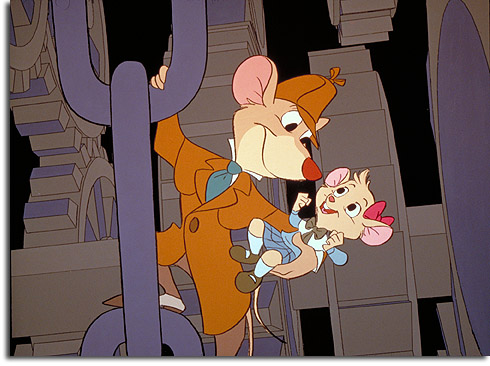
 Seriously, it’s really cool
In the end, perhaps one of the most entertaining aspects of the film is how different it feels from anything you’d get from Disney today. Everything aside from the title feels like it never saw a focus group, and there’s loads of stuff that feels downright bizarre in today’s pasteurized world – both Basil and Ratigan smoke, booze of various sorts flows freely throughout (“Rodent’s Delight”!), people are drugged and kidnapped and murdered, stilettos and daggers fly through the air, people wave guns around, and, oh yeah, there’s totally a showgirl mouse doing a striptease.
Yeah, you heard me.
I’ll just say that if you ever wanted to hear Melissa Manchester sing a song she penned for a showgirl mouse in a rundown sewer-side tavern, this is the film for you. There are a couple of other songs in the film by Henry Mancini, who also contributes the musical score.
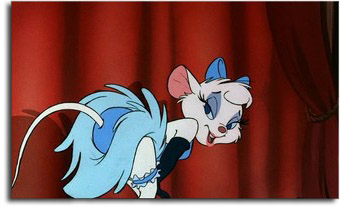
 Yeah, seriously, I was totally not kidding
All in all it’s a good time, and well worth checking out if you’ve missed it over the years.
As mentioned, this new release is titled, rather ridiculously, the “Mystery in the Mist Edition”. Aside from a new transfer there’s nothing new of worth here; if you have the previous pressing of the disc you’re not missing anything. Well, unless you care that the new transfer includes the film’s original title cards whereas the previous DVD’s titles are from the film’s 1992 re-release when it was billed as The Adventures of the Great Mouse Detective.
Video & Audio
It looks good; really good, in fact. Most of the film’s action takes place in the span of a single night so the film is generally darker than most, but the colors in the new transfer were richer than I remembered. It’s far from washed out and it’s mostly free from dust and various other artifacts of its age. It’s good to see Disney at least giving a lesser-known film a respectful digital cleanup. The film is presented in the 1.78:1 aspect ratio.
The soundtrack, in Dolby Digital 5.1, is nice and clear, but due to its age doesn’t feature a lot of fancy surround effects. There’s some nice swooping sounds when Basil and Ratigan are soaring around London in dirigibles, but otherwise it’s just a good, high-quality audio track.
Bonus Materials
There’s not a lot here as far as bonus materials, which is a real shame. The making-of featurette, The Making Of “The Great Mouse Detective” (7:50) is ported from the previous DVD release and looks to have come directly from some television special in the 1980s. It’s fun to see young animators like Glen Keane at work, as well as Vincent Price and the other voice talent. Roy E. Disney also makes a welcome appearance. But it would have been even better to have some current interviews, and perhaps a better look at the actual creative process behind the film and the groundwork it laid for later features.
Also from the original DVD release is a Sing-Along Song for Professor Ratigan’s number, The World’s Greatest Criminal Mind.
New to this release is an odd little nut of a feature called So You Think You Can Sleuth? (4:40). From the blurb on the DVD package, I thought this was going to be one of those awful set-top games that appear on every release. Instead, it’s a short summary of the history of private detectives and forensic science, which culminates in a “mystery” for the viewer to solve. You’re presented with a mystery, conveyed via static black-and-white photos, in which you must determine whether your mother, father, sister, or slouchy unemployed uncle stole all the cookies from the kitchen. It all happens so quickly that you don’t really get a chance to realize how strange it all is until it’s over.
And that’s pretty much it. There are the requisite trailers for upcoming Disney films, which are pushed via the irritating “FastPlay” feature, and this really creepy thing with the actors from The Suite Life trying to hype kids up to pester their parents into buying a Blu-ray player (ironic, since Disney didn’t see fit to release The Great Mouse Detective on Blu-ray). That little gem is even listed as a “Bonus Feature” on the DVD package. Sad. Then there’s one more promo video, which is perhaps the strangest thing I’ve ever seen on a Disney DVD. It starts off like a trailer, and for the life of me I thought it was a promotion for the next video in the Tinkerbell franchise. Oh, look it’s Pixie Hollow. Oh, Pixie Hollow is in danger. Oh, it’s because of DVD piracy.
What?
Yes. According to Disney, and I swear this is true, DVD piracy will DESTROY THE MAGIC OF PIXIE HOLLOW FOREVER. So the next time you start up bittorrent, please remember: you’re killing Tinkerbell. Sleep tight, kids!
The Shallow Stuff (aka the Package)
The Great Mouse Detective comes in a standard-issue black keepcase with a cardboard slipcover. The cover art is the typical eye-gougingly awful Disney marketing artwork with off-model characters crammed in the frame accompanied by bare-bones Adobe Illustrator fonts. There’s no artwork on the disc, and no inserts in the case aside from a coupon for 100 Disney Movie Rewards points and a flier for, again, Disney Blu-ray.
In Summary…
I find this film really, really enjoyable. I think it’s underrated and fun, and really kicked off the renaissance of Disney animation in style. Yet it’s hardly heeded even in fan circles; in the recent film Waking Sleeping Beauty little is said about it except for the controversy surrounding its title change, and much more attention is given to the subsequent Disney release Oliver & Company. Perhaps this is understandable as Oliver was a more profitable release; while The Great Mouse Detective was a modest success it was bested at the box office by Don Bluth’s An American Tail. But The Great Mouse Detective has aged far better than Oliver; the story feels more timeless and less calculated.
While this “Mystery in the Mist” edition has little to recommend it in the way of bonus features, it’s still worth checking out if you’ve passed on previous releases or somehow missed the film altogether. The film’s the thing, after all, and this is a good one.
Click to buy
Related Posts...
By Michael - April 20th, 2010 EPCOT Center’s path from concept to execution was, in so many ways, far more tortured than most Disney fans know. Far from a merely difficult transition from Walt’s concept for a futuristic city to a permanent World’s Fair (or, as modern revisionists would have it, a straight shot from Walt’s mind to the park that opened in 1982), EPCOT’s development occupied the full span of the 1970s and in that time took a number of different forms. EPCOT, in one form or another, was announced on several different occasions – often with great fanfare. But as disjointed as this development process might seem, in retrospect it follows a clear evolution, with concepts changing and merging but core themes remaining throughout.
The ideals that would underpin EPCOT Center were formulated early in the 1970s and grew fairly organically from Walt’s ambitions for EPCOT city; each variation of the EPCOT concept derived its mission, in some fashion, from these ideals. The first of these points was that Walt Disney World itself was, in a way, EPCOT, and would provide a living laboratory for a number of innovative technologies and systems. A second goal for EPCOT centered on the international community, and on ways to bring various cultures together in one place; plans for a World Showcase were in fact the first elements of EPCOT announced for construction in the early 1970s.
The other key aspects of EPCOT, of course, would involve the creation of a futuristic “community” that would allow the public to encounter new technologies and to see how these ideas and innovations would shape their lives in the future. Key to this element of EPCOT would be the involvement of major American corporations, as the Disney organization under Card Walker believed that only American free enterprise held the answers for the problems facing our communities and when given free reign (as Disney itself had been in its self-governed Reedy Creek Improvement District) these corporations could and would address these problems head-on.
 Looking Back At Tomorrow: The EPCOT Future World Theme Center, 1975
Concepts to embody the futuristic aspects of EPCOT’s goals took longer to develop, only truly emerging with some of Card Walker’s EPCOT Center announcements in 1975. As we’ve mentioned previously, this “EPCOT Future World Theme Center” would have been an entirely separate gate from the World Showcase and was the first publicly-announced version of what would evolve into EPCOT Center’s Future World.
Of course, at the time this was intended to be only one of the EPCOT “Theme Centers.” These “centers” of activity (also, on occasion, referred to as “Satellites”) are vaguely mentioned through the years as places where public and private researchers could interact and meet to address society’s ills, all under the watchful eyes of thousands of daily visitors. In fact, it’s occasionally mentioned that these Centers would stretch beyond the borders of Walt Disney World and to various research locations nationwide. It was with an eye towards this goal that Disney held a number of academic conferences under the EPCOT name during the 1970s, focusing on subjects ranging from future technology to health care. Eventually these “Theme Centers” would be abandoned, and they were replaced with a single concept – EPCOT Center.
 That’s More Like It: EPCOT Center, as envisioned in 1979
Obviously, something happened between these early visions and the announcement in 1978 of a theme park that is recognizably EPCOT Center. There’s always been the famous story of Marty Sklar and John Hench, staring down the barrel of an impending visit from Disney executives, pushing the World Showcase and Future World models together to form a single park. But even that tale belies a more complicated truth. The first time the World Showcase and Future World ideas were combined into a single gated attraction appears to be sometime in 1976. But, at the time, the park’s layout was far different, and reversed – guests would enter the park through World Showcase, which would serve as a sort of international Main Street before guiding visitors into the technological realm of Future World. Looking at the plans from the period, it’s clear Disney was still trying to work out a single clear vision for the park. Finally, in 1977, things would start to click into place.
 Getting Better All The Time: EPCOT Center starts to take shape in this 1977 model
With great fanfare, the 1977 Walt Disney Productions Annual Report rather breathlessly heralds the “conceptual breaktrough” of Master Plan 5 – their newest vision of what EPCOT Center would be. To quote CEO Card Walker’s letter to shareholders:
There has never been a greater need for the communication of information about the diverse peoples of our planet, the new systems and technologies evolving to meet the needs of those people, and the alternative decisions we face. Our future depends upon it. For the better we understand today, the choices for tomorrow, the better decisions we will make.
This is what EPCOT Center and its two major themes, Future World and the World Showcase, will be devoted to: the advancement of international understanding and the solution of the problems of people everywhere – through the communication of ideas.
Our dedication to this concept will not be limited to the EPCOT Center site in Florida. It will extend as far as the Disney ability to communicate can reach, including films, television, educational materials and even the licensing of concepts and products. For this reason, we believe, EPCOT Center can open an exciting new dimension for Walt Disney Productions.
At this writing, for example, a series of five television specials exploring each of EPCOT Center’s wide-ranging themes is under development. Our preliminary plans are to inaugurate this series with a gala “Disney Week” on television, recreating the career and dreams of Walt Disney, culminating in a major special on “Walt Disney’s Greatest Dream: EPCOT.”
However, as we have consistently pointed out, EPCOT Center cannot and should not move forward on the financial or creative strength of any one organization. It requires the best thinking and financial support of American industry and the commercial and government interest of other nations as well.
Therefore, while our creative people have been developing the conceptual breakthrough for EPCOT Center, we have continued to seek support for the first phase of World Showcase from foreign industry and governments around the world. Our efforts have included Canada, Costa Rica, England, Israel, Japan, Mexico, Morocco, Poland, Saudi Arabia, South Korea, United Arab Emirates, Venezuela, West Germany, and other countries. Several of these have already indicated their intention to participate as sponsors of pavilions and exhibits in the World Showcase. Others are in varying stages of negotiations which we feel will lead to their participation.
Over the past few months, we have begun to emphasize our concept for EPCOT Center’s Future World. We have discussed the first phase development with such major American corporations as American Telephone & Telegraph, ARCO, Borden, Coca-Cola, Exxon, General Electric, General Motors, IBM, RCA, Sperry Rand, Standard Oil of Indiana, Westinghouse, and others. The initials response from these corporations has been most enthusiastic. And we have entered into negotiations with a number of them which we feel will result in their participation as sponsors of pavilions and exhibits in Future World. We believe EPCOT Center has stimulated many of America’s leading corporations because the EPCOT dynamic is really the America dynamic. It is founded on the principles of American enterprise – and a belief that an informed public can, and will, make better decisions for tomorrow if they understand and believe accurate and relevant information today.
So, you know, no pressure.
 Imagineers Marty Sklar and John Hench with a dimensional model of the 1977 park layout seen above. Note the later, 1978 rendering of the park on the wall behind them.
What’s interesting about Walker’s statement, aside from the list of nations and sponsors who would never join the EPCOT ranks, is how he adheres so strictly to those core EPCOT ideals. As the Disney report would later state:
As conceived here, EPCOT will be a “Showcase for prototype concepts,” demonstrating practical applications of new ideas and systems from creative centers everywhere. It will provide an “on-going forum of the future,” where the best thinking of industry, government and academia is exchanged to communicate practical solutions to the needs of the world community. It will be a “communicator to the world,” utilizing the growing spectrum of information transfer to bring new knowledge to the public. Finally, EPCOT will be a permanent “international people-to-people exchange,” advancing the cause of world understanding.
In addition, we are convinced that EPCOT will provide a much needed symbol of hope and optimism that our major challenges can, and will be met. It will provide outstanding family entertainment from which people may draw enlightenment, as well as enjoyment. And it will, of course, represent a major new extension of our business activities around the world.
It also seems clear that Future World has entered development much more recently than World Showcase; surprisingly, though, the vision described for that area hews very closely on a pavilion-by-pavilion basis to the park that opened in 1982. World Showcase, as you can see from the models above, actually took the form of a double promenade, providing far more open space for potential national pavilions than the final layout. The American Adventure, labeled on the model as “U.S.A.”, sits not at the far end of the World Showcase lagoon, but instead straddles the path from Future World to World Showcase. It would remain in this spot until 1979. But even Disney, proud as they are to promote the success of Master Plan 5, acknowledge that things remain in flux:
As we proceed with our planning for the EPCOT project, the specifics of this plan will, undoubtedly, change time and time again. This is a natural result of the Disney creative process which continually probes for the best alternative. Disneyland, for example, was constructed from Master Plan 67. the Walt Disney World complex, which more than 71 million people have visited, grew out of our 17th Master Plan.
However, the basic concepts contained here will remain substantially the same. For the two major themed areas, “Future World” and the “World Showcase,” together with the “American Adventure,” which acts as a gateway between the world of today and tomorrow, provide what we believe are the best opportunities for meeting the four major objectives we have established to bring Walt Disney’s last and greatest dream to reality.
It seemed, at last, that the Imagineers had found a concept that they liked. So let’s take a look around EPCOT Center in 1977; a familiar yet strangely different park, which is still strongly defined by the divide between its two sections: Future World and World Showcase.
Future World
 “A COMMUNITY OF IDEAS: EPCOT Center will present the challenges and alternatives for tomorrow”
Future World, as you can see, was starting to take a recognizable shape even at this time. Spaceship Earth is in its proper place, as was Communicore. Going clockwise from the bottom left, where today we’d find the Universe of Energy, we have “Life & Health,” “The Land,” “Transportation,” “U.S.A.” (The American Adventure), “Space,” “The Sea,” and “Energy”. If you removed American Adventure, that’s the same number of pavilions that EPCOT Center would feature in its actual phase one, although only Spaceship Earth, Communicore, and “Transportation” – later World of Motion – would remain in their current spots throughout development. The fact that General Motors signed on as EPCOT’s first sponsor in 1978 meant that the Transportation pavilion got a big head start, and if you look at EPCOT construction photos from 1979-1982 you’ll note that the World of Motion is always much farther along in construction than other pavilions. But what’s in this Future World?
 A rather golden-hued Communicore and Spaceship Earth, “a major introductory show.”
The Future World, an American enterprise forum, poses the challenges and previews alternatives for the “Community of the Future.” The principal components of Future World include: A major introductory theme show, Spaceship Earth; the Communicore, a global marketplace of new ideas bringing the public into direct interface with industry; and a series of major pavilions exploring Energy, Life & Health, The Sea, The Land, Transportation, and Space.
The park’s central icon, then as now, was Spaceship Earth. The grand mirrored orb had yet to sprout legs, though, and was not a geosphere – merely a geodome. Judging by artwork and models, a great deal of the attraction would take place in a show building behind the geosphere, not in the dome itself.
 “EPCOT INTRODUCTION: Standing at the entrance to EPCOT Center, Spaceship Earth will introduce guests to the concept and meaning of the project.”
Spaceship Earth
Spaceship Earth is the major theme show and introduction to the concept and meaning of EPCOT, focusing on the relationship between communications and humankind’s continuing dynamic – survival. It is an optimistic statement recognizing our enormous challenges and concluding strongly that creative men and women of the world can develop a viable “instruction book for Spaceship Earth.”
Central to the meaning of the show is the fact that access to accurate and relevant information and the continuing ability to create new and better tools for survival have been the real dynamic of our voyage aboard Spaceship Earth.The Disney staff is creating an exciting and unique theatrical experience for the dramatic spherical structure which will dominate the entrance into EPCOT Center. A time machine journey into the past to trace man’s progress as he acquires and utilizes new knowledge. Surging forward through time, guests will see historical milestones unfold as man records, communicates more broadly and finally uses computer technology to process ever increasing amounts of information.
As the Spaceship Earth show concludes, the audience is invited to go forth into EPCOT’s Future World, into the many pavilions offering dramatic new vistas into vitally important topics affecting the future of humankind.
Communicore
 “Communicore, the global marketplace of new ideas.”
As you can probably see from these renderings, Communicore was intended as a much more vibrant and vital section of Future World than it ever was in actuality, and certainly much more so than Innoventions is today. Communicore was the community – and communications – core of EPCOT, and it would be the place where guests would synthesize the information from the various theme pavilions and interact with these new futuristic concepts in relatable ways.
As its name suggests, this global marketplace of new ideas will be the communications core of EPCOT Center. Here, industry and the public will participate in a “hands on” exchange of new and exciting ideas, systems, products and technologies.
 “FUTURE WORLD TRAVEL PORT: This artist concept depicts a Communicore attraction where guests will electronically preview their vacations.” (Note the Mark III Monorail in the background)
Some of the beginning concepts for this “information marketplace” include:
Telstore – a Future World “video bookstore” where guests could experience first-hand the newly emerging world of video information for the home.
Future World Travel Port – an electronic travel port where visitors could “dial-in” their travel interests and other itinerary requirements and watch an “instant preview” of their upcoming vacation.
FuturePlan – a career center concept where immediate information would be offered about careers for young people and the newly developing field of second careers for retiring citizens.
Informat Arcade – a concept providing new experiences for the public in information retrieval, which would include a “Casino of information” in game-playing format … taking the penny arcade of the past into the information age.
Other ideas for the Communicore will be developed by joint task forces of Disney designers and industry participants and may include such things as The Good Health Emporium, the drug store of tomorrow and The Future World Office, a paperless place of business.
The drug store of tomorrow? A career center? The penny arcade of the information age? As you can see, Communicore would have been a much different place had these plans gone through; it would have certainly served more as a futuristic mirror to Disneyland’s Main Street, U.S.A. Although I have to say, I’m intrigued by this “paperless place of business” of which they speak…
Life & Health Pavilion
 “The study model of the Life & Health Pavilion includes an area offering guests a ride through the fantastic wonders of the body and The Great Midway of Life, where they will learn their personal responsibility for good health habits.”
This pavilion, though obviously long planned, was also a long time coming for EPCOT fans. A health-themed pavilion would not actually open in the park until 1989, when Wonders of Life debuted. Still, as you might be able to tell, that pavilion drew a great deal of inspiration from these early plans. The interior of the pavilion would have had a very whimsical design, courtesy of veteran Imagineer Rolly Crump. Guests would enter “The Great Midway of Life” in the central circular area, around which were a number of shows and experiences. Some of these would later have analogous attractions in the similarly circular Wonders of Life building.
While a more thorough exploration of this abandoned pavilion will have to wait for a future post, I would like to point out the various attractions in the model. After entering on the right-hand side of the picture, guests moving clockwise would encounter The Joy of Living, a sensory funhouse (at the bottom of the photo), the Tooth Follies, The Head Trip (which would eventually become Cranium Command), Good Health Habits, and, in the large angular show building at the top of the picture, The Incredibly Journey Within. This massive dark ride would have transported guests via omnimover into the human body, where they would pass giant animatronic replicas of a beating heart and breathing lungs.
 Red blood cell-shaped omnimover vehicles carry guests through The Incredible Journey Within
Visitors to the Life & Health Pavilion will experience a new awareness and appreciation of themselves. “The Joy of Living,” a multimedia show, will extol the beauty, the dignity and strength of man from birth to the golden years. “The Incredible Journey Within” will take guests to explore the inner workings of the fascinating, complex human machine. Along the “Great Midway of Life,” they’ll participate in a whimsical series of experiences, learning that good health is based, more than anything else, on their own personal responsibility and behavior.
The Land
 This early concept for The Land, designed by Imagineer Tony Baxter, led guests through a series of biomes in giant, crystal-shaped show buildings
The Land pavilion, occupying the spot that would eventually go to Horizons, was originally a much different kind of pavilion than that one we would come to know in 1982. Designed by rookie Imagineer Tony Baxter (I wonder whatever became of him?), the various attractions in this original design focused more on the world around us than on the cultivation of crops. Large crystalline buildings, which would later inform the design of Journey into Imagination, would have housed a series of varying climates and ecosystems. Guests could explore these different habitats on foot; there would also be an animatronic show and a balloon ride through the various crystal buildings called The Blueprints of Nature. Unfortunately the original sponsor for the pavilion, a lumber company, fell through and were replaced by Kraft. This switched the focus of the pavilion from ecology to food and farming, and this concept was abandoned. Happily, Baxter would go on to create Journey into Imagination.
 “LAND PAVILION: Among preliminary concepts is this experience, stressing harmony between man and his environment.”
The Land Pavilion will graphically illustrate man’s role as a “protector” of this finite resource, as well as his alternatives and choices in maintaining, and even enhancing, the delicate balance within the natural environment. Through a variety of exciting and informative shows and experiences, guests will be introduced to the basic concepts essential for understanding the need for harmony between man and his home on “The Land.”
Transportation
 “TRANSPORTATION PAVILION: A concept for “hands-on” experience with working prototype vehicles of the future will be a part of this guest experience.”
This early version of EPCOT’s Transportation-themed pavilion bears many similarities to its successor, the World of Motion. The round building is somewhat familiar, as is the open central courtyard. This design is a lot more busy, though, and there’s a lot more going on – from the full-scale STS orbiter hanging over the courtyard to the external vehicle track. While this version of the pavilion features a dark ride similar to what guests would eventually ride in the real park, it seems that there was an additional attraction where guests were allowed to ride some sort of “futuristic” prototype vehicle. Little is publicly known about this facet of the ride, but some renderings seem to look not unsimilar to the current Test Track.
 Conceptual rendering for the Transportation pavilion
The Transportation Pavilion will show how man has progressed through time in direct relation to his ability to move from one location to another. Visitors will see man’s earliest and most humble designs grow and change as he reaches out to explore the world around him. They’ll be treated to simulated trips aboard some of today’s modes of transportation … and have a glimpse at future transportation systems … including a “hands-on” involvement with working prototypes of tomorrow’s vehicles.
Space
 Rendering of the massive “space vehicle” that would be the feature attraction of EPCOT’s fabled Space pavilion
Oh, the Space pavilion. If anything puts a wistful look in the eye of a true EPCOT geek, it’s a mention of the Space pavilion. This grand, massive attraction was announced for EPCOT early on, and later slipped to phase II status behind Life & Health. It never saw the light of day.
Little is really known about this pavilion, but not for lack of fan curiosity. Produced with the assistance of author Ray Bradbury, the centerpiece of this pavilion would have been a massive simulator attraction that would have moved an entire theater in sync with outer-space visuals.
 “SPACE PAVILION: Designer John De Cuir, Sr. and Writer Ray Bradbury discuss the model of the interstellar “Space Vehicle” which will highlight this pavilion.”
A huge, interstellar “Space Vehicle” will transport passengers to the outer frontiers of the universe, highlighting man’s efforts to reach out for the stars around him … from the early pioneers who looked and wondered … to modern-day space travelers and their triumphs … to the challenges and possibilities of future space technology and exploration.
The Seas
 These now-famous renderings of The Seas were used to promote the much more elaborate earlier version of the pavilion through EPCOT Center’s opening in 1982 and even beyond
The Seas is another well-known missed opportunity for Disney fans. While The Living Seas did eventually open in 1986, years behind schedule due to difficulties in finding a suitable sponsor, it lacked the elaborate dark ride with its grand themes that would have served as a highlight of this original version. This early version also contains mention of an entirely separate attraction, featuring legendary mariners and their feats. Note, too, that one of the alternate concepts for the pavilion’s exterior is much more organic and rough than the final design.
 “SEAS PAVILION: This WED study model includes a dramatic ‘ride beneath the seas.'”
Guests will board the clipper ship, “Spirit of Mankind,” to sail through moments of peril and triumph with seven legendary mariners … the great explorers who charted the seas for civilization. In another adventure, Poseidon the Sea Lord will challenge visitors to journey through the ocean depths … from the Continental Shelf to the Great Coral Reef. Finally arriving at “Sea Base Alpha,” guests will experience an authentic ocean environment with live marine life, an undersea restaurant, and a showcase of oceanographic exhibits and displays.
Energy Pavilion
 “PRACTICAL APPLICATIONS: The Energy Pavilion will feature demonstrations of solar energy applications.”
Here’s another familiar face – the Energy pavilion. That angled, reflective wedge would survive the development process to become well-known to generations of EPCOT visitors. What’s funny, though, is that the model shown earlier depicts an entirely different version of the Energy pavilion design – a semi-circular bank of mirrors facing a central solar collector. That design would be shown prominently in various EPCOT promotional films during 1978, but as this rendering shows it was a competing concept that would win out in the end. Look closely, though, and you’ll see some details missing from the final design: various solar collectors, what appears to be a greenhouse, and a wind-powered turbine.


Even from the outside, the Energy Pavilion will be a strong visual statement as it generates power via its own solar energy systems. Here, the formation of fossil fuel energy will be portrayed, climaxed by a sudden energy storm of wind, lightening, rain, fire and volcanic eruptions, demonstrating the almost endless potential of raw energy available for man.
 This early rendering of the Energy attraction shows how little it actually changed throughout its years of development
Then visitors will see man overcoming the major crises of the past and finally the choices he must consider today … racing against the clock in a search for new energy, and finally harnessing tomorrow’s vast new sources for “The Future World of Energy.”
The American Adventure … Gateway to the WORLD SHOWCASE
 While the American Adventure attraction described in 1977 sounds familiar, its show building certainly wasn’t
By this point in EPCOT’s development, Imagineers had a fairly good handle on what they wanted to do with The American Adventure. This was roughly the sixth concept that designers had proposed for the American pavilion, but it’s obviously similar to the attraction as it exists today – with two big differences. First, instead of its current location as host of World Showcase on the far side of the lagoon, it was located as a “bridge” between Future World and World Showcase. The positioning of the pavilion between these two realms affected its design; instead of the colonial bricks of the final show building, this version of the pavilion would have been housed in a then-current modernist structure. The other major difference in this early version was that in addition to Benjamin Franklin and Mark Twain, Will Rogers acted as a third host and representative of the 20th century. Fearing (sadly) that Rogers would be too obscure for modern audiences, Imagineers eventually relieved him of his hosting role and relegated him to a cameo.
 “AMERICAN ADVENTURE: These models and renderings picture the “main spokesmen” guests will meet as they experience the story of the American people: Benjamin Franklin, Mark Twain and Will Rogers.”
“America has been settled by the people of all nations, all nations may claim her for heir own. We are not a narrow tribe of men … No: our blood is as the flood of the Amazon, made up of a thousand noble currents all pouring into one. We are not a nation so much as a world…”
These words, written by Herman Melville, are the inspiration for The American Adventure – standing at the crossroads, facing onto the Future World and acting as the gateway and “host” to the nations of the World Showcase. Here, visitors will experience the remarkable three-century story of the American people, from the first step onto Plymouth Rock, to the first step onto the moon. Three of the most eloquent spokesmen in American history, Benjamin Franklin, Mark Twain, and Will Rogers, will lead a cast of performers “brought to life” through the Disney Audio-Animatronics process of three-dimensional animation. Their message is one of optimism for the future – that in their times too, American dreamed of a better tomorrow – and that a nation, founded in liberty and freedom, gives its citizens the opportunity and incentive to build on the great foundations of the past.
World Showcase
 Unlike earlier proposed versions of World Showcase, the design revealed in Master Plan 5 featured highly-themed national pavilions circling two large lagoons
Despite having been in development longer than Future World, little is said in 1977 about World Showcase. This is most likely due to the rather unsuccessful scramble to sign up national participants. As you can see in the model at the beginning of this story, World Showcase was rather optimistically designed to have two rows of countries, with plenty of room for several dozen national pavilions. This was not to be, of course.
The big breakthrough in Master Plan 5 was the idea that seems second-nature today – that the national pavilions would be housed in separate buildings around the lagoon, and that they should all have highly themed exteriors to match their national sponsor. This plan was the brainchild of Imagineer Harper Goff, and it flew in the face of the original World Showcase plans that called for the national pavilions to be housed adjacent to each other in very modern, featureless semi-circular structures. The pavilions would be well-themed on the inside, but to all outward appearances they would be identical.
 More of Harper Goff’s concept art for World Showcase
Goff hated this idea, and envisioned a highly-themed area that would use well-known visual icons for each country, much like World Showcase does today. Try as he might, though, he couldn’t get it past Card Walker, who preferred the more modern approach to the area. Goff knew he was right, though, and one day when a number of potential international sponsors and investors were to tour Imagineering, Goff made sure to leave a number of his elaborate paintings of the forbidden World Showcase concept lying around in plain sight. Needless to say, the money men were smitten with Goff’s detailed and lush paintings and he won the argument by default.
 Concept art from this era suggests a number of possible themes for World Showcase nations
In prior years, we have reported extensively on our concepts for the pavilions and exhibits of World Showcase. During this year, WED Imagineers, working with potential participating nations, have continued to refine these concepts creating many new renderings and models, some of which are shown here. In 1977, we have also developed an exciting new concept for the overall design of World Showcase which we are pleased to present publicly for the first time.
In this new interfacing design concept, countries from around the world will stand side-by-side in friendship along the banks of a broad lagoon … symbolic of the waters that bind together the diversified peoples of the world.
 Concept for the “Arab World” pavilion
A “Community of Nations,” World Showcase will be the first permanent international exposition of its kind anywhere … communicating the culture, history, tourism and accomplishments of each participating country. Here, guests will visit a wide variety of exciting shows and ride through attractions, restaurants and shopping streets unique to the individual nations, and areas presenting travel and products of industry.
 Imagineering concept for Japan pavilion
EPCOT Center’s World Showcase is a true people-to-people concept. Participating nations will be invited to send their outstanding young adults to operate the attractions, shops, restaurants and exhibits of their pavilion. And these young people will not only work together, they will also live, play and learn together. Many of these young adults will be future leaders of their countries. Their association and work experience in EPCOT Center could be a significant step toward generating greater understanding among the peoples of the world.
 Concept for Germany pavilion
That last bit alludes to something that Card Walker mentioned often during these years – the hope that the international students coming to work at EPCOT would return as friends to lead their own nations. Walker often referred to his hopes that some day Israeli and Palestinian leaders, or U.S. presidents and Soviet premiers, could defuse global tensions as they reminisced about their days at EPCOT. It seems funny now, but it was a big part of how EPCOT was promoted in the 1970s.
 This Imagineering model for the Canadian pavilion is remarkably similar to the finished product except for a few things – first, that Quebecois flag would never fly in the real world, and also, if you look carefully… lumberjacks! I want lumberjacks!
EPCOT in 1977 might seem like a million years away from the park that would open in 1982, but for the first time it had really started to feel like a fully-formed idea and you can see the roots of many attractions that were to become fan favorites. Within the next year, Disney executives would commit to the idea, sponsors would come aboard, and throughout 1978 the idea of what EPCOT Center was to be became clearer and more real. And it all started with Master Plan 5.
Related Posts...
|
The Progress City Primer
 From the Progress City archives comes this collection of 33 tall tales and true from Disney history. Available in paperback, hardback, and ebook formats.
|
Recent Comments