The next item in our list of what I’d like to see taken care of this year in the Disney parks:
#6 – Disney’s Hollywood Studios… Oh, boy…
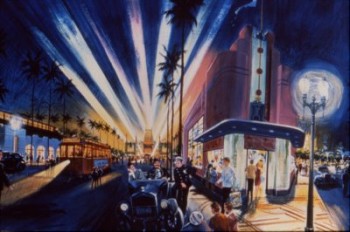
What once was, can be again…
Just for fun, let’s torture an analogy. Let’s say that somewhere, just off-campus near Progress City University, there’s an infamous sorority house. These undergrads haven’t gotten the memo that hazing has been forbidden by the administration, and for initiation they make the various Disney resorts stand up on the table and have their “problem areas” circled with red marker. Before they lose their charter, they have a go at Walt Disney World and this is the result:

Oh, Disney-MGM Studios / Disney’s Hollywood Studios, where should I start? Unlike the Animal Kingdom, which is a well-realized concept, lovingly crafted yet incomplete, the Studios is a rampaging Frankenstein’s monster of low expectations, abandoned ambitions and half-finished plans. All of the four Florida parks need serious work and additions, but only the Studios needs a sizable portion to be razed and rebuilt wholecloth.
What’s ironic is that I used to be quite a fan of the Studios. I’ve loved film in general, and the culture of the 1930s and 40s specifically, since I was a kid. The Studios seemed a natural for my tastes. Much of it still is – Hollywood Boulevard remains beautiful, despite the accursed Hat (more on that later). The Sunset Boulevard expansion only increased the scope and theming of the area, and added a couple of much-needed attractions to the park. But once one reaches the replica of Graumann’s Chinese (again, setting the hat aside), the park falls apart. There a number of reasons for this, but the main reason the Studios is such a mess nowadays is that it was once a very different theme park with very different purpose.

In the beginning: EPCOT Center’s unbuilt
Great Moments at the MoviesMuch of the Studios’ genesis remains debatable, but most fans know the oft-repeated story that its origin came in large part from a concept developed for EPCOT Center. What was to become The Great Movie Ride was conceived first as an attraction for Future World, to be placed in a pavilion between Journey into Imagination and The Land. According to legend, new CEO Michael Eisner saw the designs on a tour of Imagineering and decided that the concept should be expanded into an entirely new park. And so, the Studios were born.
Cynics might point out that the rest of the park Eisner dreamed up bore a striking resemblance to plans for a Universal Studios tour long intended for Orlando – plans that Eisner had seen during his previous stint as president of Paramount. Squeamish about entering the Orlando market on their own, Universal had approached Paramount in the early 1980s about partnering on their new gate in Florida. Eisner was thus privy to all of Universal’s plans for Orlando, and although he rejected the partnership offer as head of Paramount, when he left that studio for Disney he quickly proposed the idea of a studio attraction to combat Universal’s impending presence in Florida. Universal executives were furious – and litigious – but Eisner went ahead with construction of the Disney-MGM Studios and, despite Universal’s long head start in planning, managed to get Disney’s park opened a year ahead of its rival’s.
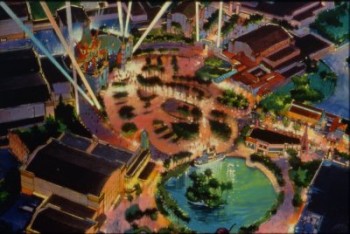
The park was built so quickly because it was far smaller and simpler than Disney’s other parks. The Studios was not intended as a full day attraction like the Magic Kingdom or EPCOT Center – Eisner was playing it very safe with his first major project as CEO. But when the massive crowds that arrived to see the new Disney park overwhelmed the handful of opening day attractions, it became apparent that the park desperately needed expansion, and soon.
Thus began two decades of fits and starts, of announced and canceled projects, and of Rube Goldberg-like expansion. While I’ll save most of my historical lecturing for the Studios’ 20th anniversary in May, it’s important to see how the problems faced by past expansions shaped the park as it is today. The layout of the Studios is so strange that guests unfamiliar with the park’s past must be baffled by its randomness.
The most daunting problem faced by the Studios is its location. Hemmed in by World Drive on the west and Buena Vista Drive to the north, there’s not much room for expansion. Past blue-sky theories have involved expanding over World Drive to adjoining property, but one assumes that would be an action of last resort. As it stands, the existing areas of the park are so chaotic that there’s plenty of room to expand by razing obsolete buildings and infrastructure and starting over.
The confusing layout and unnecessary backstage areas stem from the Studios original mission – to be both a movie-based theme park and an actual working studio. Orlando had its eye set on becoming “Hollywood East” with tax incentives and lax labor laws meant to lure production to Disney and Universal’s soundstages. When Disney-MGM opened, more than half the park was closed off to guest traffic, and guests were unable to view any of these areas without taking the Studio Tour. The arch to the right of the Chinese Theater was intended to be the gateway to the “real” studio, and aside from the entrances to the Backlot Tour and the Animation Tour, everything beyond that gate was closed to guest access. On the other side of the park, everything south of the Indiana Jones arena was inaccessible.

Turning back time: The area shaded green represents the guest areas and show buildings of the Disney-MGM Studios in 1989 (including Star Tours, which opened soon afterward); the blue area approximates the original backstage and production areas of the park
As production waned, the “theme park” side of the park began to encroach on the “studios” side. The walking part of the backstage tour was slowly whittled down to the point that what’s left – the water tank show – serves merely as preshow for the tram tour. The tram tour has also seen massive cutbacks, and now serves mainly as a way to get guests to the worn-out Catastrophe Canyon.
The production areas slowly have become guest areas, with Mickey Avenue opening up to guests and a series of temporary attractions filling some of the former soundstages. This is the area that’s becoming “Pixar Place”, with Toy Story Mania occupying one former soundstage and the upcoming Monsters, Inc. coaster filling another.

The park today: Guest areas and show buildings in green (includes Catastrophe Canyon); backstage areas in blue
This is where the problems begin. The park’s layout made sense when half of it was a working studio and not meant for guest access. The theme park areas – Hollywood Boulevard and Echo Lake – were laid out and themed like traditional Disney attractions. The backstage areas were not intended for guests and thus do not adhere to the design traditions necessary for adequate guest flow. Essentially, as they expanded, Disney had to “fake it” – creating traffic corridors where there were none before, and trying to link areas of the park together that were never intended to commingle.
Unfortunately, a large part of this transition came towards the end of Eisner’s tenure, when any real spending was out of question. What Disney should have done at this time was to remove the soundstages and various support facilities and start over, laying out new areas along proper practices of park design. Instead, we essentially get rides crammed in to unthemed warehouses, with no access to the space needed for later expansion in more remote backstage areas. There are no visual “weenies”, no overarching theme, and no sense of place in these areas – it’s just a hodgepodge. Without massive demolition and rebuilding it will remain that way. Even if WDI goes in and drops E-tickets in all those old facilities, what we’ll wind up with are rows of parallel streets with rides in contiguous, identical rectangular buildings. Not too inspiring.
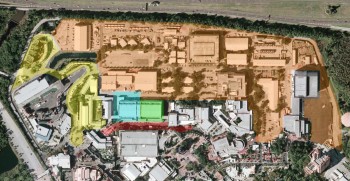
Where’s that bulldozer? The backstage former production area in orange – the grid layout is not conducive to good theme park design, and should be removed to allow for expansion. For reference, what’s left of the tram tour is highlighted in yellow, Mickey Avenue/Pixar Place is in red, Toy Story Mania’s former soundstage is in green and the area earmarked for the
Monsters, Inc. coaster is in blue.
These are issues Disney is going to have to face soon if they plan on any expansion in the Studios. The eventual disposition of all the former backstage areas need to be decided, and they have to determine what’s going to happen with the vestiges of that era. It’s commonly accepted in fan circles that the tram tour isn’t long for the world, as it occupies the biggest patch of easily re-purposed land in the park. It seems that the tram and Catastrophe Canyon will go the way of the dodo as soon as management opens the purse-strings and lavishes some attention on the Studios, which depending on your way of thinking may or may not be within our lifetimes. Even if Burbank were to suddenly get generous, expansion in this area will have to wait for other projects that are closer to a greenlight, such as Star Tours 2.0 and the planned Monsters, Inc. coaster.
The other legacy attraction that needs addressing is the Animation Tour. This attraction was actually expanded over the years, and eventually altered to incorporate the swanky new building created for Florida’s burgeoning feature animation department. Then, Eisner shut down the successful Florida animation unit and the tour’s reason for being vanished. The attraction is now a sad shell of its former self, with no real animators to speak to guests and the show film changed from the amusing yet informative Return to Neverland to a pointless puff piece from California Adventure’s animation exhibit. The tour has no flow anymore and no real draw, aside from some character meet and greets. Disney animation deserves a spot in this park, and the content and scope of the tour needs to be re-thought. Disney also needs to decide whether they’re going to have an animation unit in Florida again, and if not they need to make better use of the space they’re now wasting on backstage office buildings.
One of the rumors that made the rounds when Disney changed the park’s name to “Hollywood Studios” was that the park would be re-conceived as consisting of a series of themed “studios”. These would be analogous to the “lands” of the Magic Kingdom, and would center around the different properties the shows and attractions were based on. Thus, one would get “Lucas Studios” and “Muppet Studios”, “Pixar Place” and so on. I have no idea whether this is true or not, but I think it’s a far superior way to structure the park than exists now, and provided the layout of the park could be restructured in a more logical fashion I think that this plan would be an excellent and thematically consistent way to envision the park going forward.
So, assuming they take my advice and fix all these critical infrastructure issues, what else does the park need? Well, new attractions. And a thorough refreshing of old attractions. They need to decide if they’re still going to attempt to address elements of filmmaking process – otherwise, vestigial elements like the tram tour and Sounds Dangerous need to be replaced with something relevant to the park’s purpose. I don’t think the production aspect need be eliminated entirely, but Sounds Dangerous still needs to go no matter what.
I’m going to sound like a broken record on this one, but the park needs more dark rides. As of now, it has only two (if you count Toy Story Mania). The only animatronic spectacle of the sort that guests tend to associate with Disney is The Great Movie Ride. Give us more – the history of the park is littered with interesting concepts that remain unbuilt. Again, I’ll talk more about this in May but there’s no reason why, with the realms of film, TV, radio and theatre at their fingertips, WDI can’t create a slew of amazing and amusing experiences.
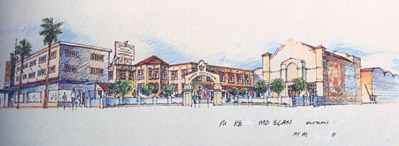
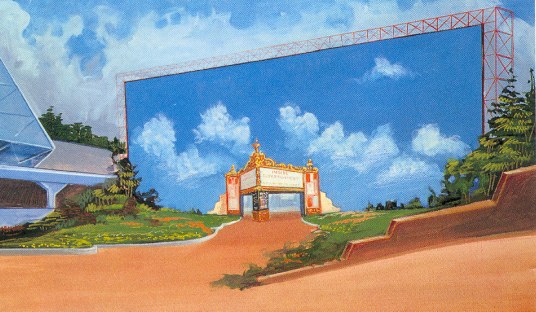
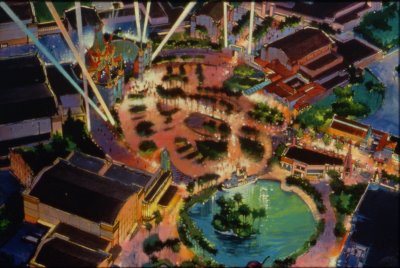
From the Neverworld files – Mickey’s Movieland
The park also needs more of those small atmospheric touches that make the other parks so unique. It would be a cinch to bring California Adventure’s planned Red Line Trolley to Sunset and Hollywood Boulevard. Who knows – maybe they can find a way to make a studio tram ride that circles the park like the Magic Kingdom’s railroad. Live entertainment should also be expanded – this is the park that’s traditionally known for its epic live shows and those should become a feature of the park rather than something that gets cut first when times are tight.
All in all, the park needs logic. It needs a reason to exist, and a purpose for its now seemingly random attractions. Most of all, it needs a master plan that will determine which of the former production areas are available for future expansion, and will prevent major attractions being built in the short-term that would make long-term expansion difficult.
The romance of old Hollywood is ingrained in the global collective consciousness, and there’s no reason why a park like this can’t be a crown jewel for Disney. The entrance of the park, with its ambient music and wonderful theming, should only be the start of an amazing experience instead of its pinnacle. The Studios’ layout and divided sense of personality suited its purpose and made sense in 1989, but it doesn’t anymore. The park’s goals have changed, and it’s time to make a suitable investment in bringing it up to the standards of its peers.

No. Just no.
One last note – the Hat. Rarely are there things that so unite fandom, that are so universally reviled, as the Hat. You’ll hear any number of rumors as to its purpose, but I continue to be unable to fathom what they were thinking when they built the Hat. Out of scale and completely incongruous with its surroundings, the Hat blocks the carefully designed sightlines down Hollywood Boulevard and the once-spectacular view of the Chinese Theater. It serves no purpose, only sheltering a pin stand, and a rather feeble pin stand at that. It’s hard to believe that it’s plagued the park for nearly a decade, and one can only fervently hope that it will eventually follow the path of its once-feared-permanent brethren, the Hand. The Hat makes me deeply angry. Why not put the Hat as an entrance to a rebuilt Animation tour? Just get it out from in front the Chinese Theater. Seriously. What were they thinking? Ok, breathe…
Seriously. Ditch the hat.
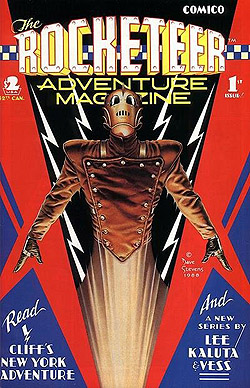
And build a Rocketeer ride. Seriously.
That is all.
Related Posts...


 Debbi was never able to shake her cruel nickname – shame on you, Joe Potter!












Recent Comments