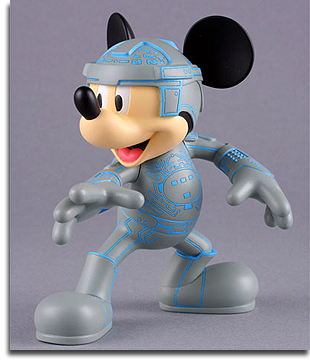
 Hope you installed your mouse driver
Ok, that’s pretty cool.
Sideshow Collectibles has just revealed this vinyl figurine of Mickey Mouse as TRON. The figure, by Medicom, will be released later this year.
|
Hope you installed your mouse driver Ok, that’s pretty cool. Sideshow Collectibles has just revealed this vinyl figurine of Mickey Mouse as TRON. The figure, by Medicom, will be released later this year. Related Posts...An important addendum to the below article about the rumors surrounding the remodeling of Florida’s Fantasyland and Imagineering’s new technology initiative. I have further reason to believe that WDI is indeed working on something involving the “NextGen” (or “NGE”) technology called the “Personal Experience Portal.” I don’t have any information on what the portal, or “PEP”, would actually entail, but if it meshes with previous reports it might possibly relate to the interface by which guests could enter their personal information before their trip. The information would be embedded on their RFID tags and allow various interactions in the park. This is merely speculation, though. Another question about the RFID technology was how it would be implemented – it was widely assumed that the RFID chips would be implanted into guest passes. It appears, though, that the program could use wristbands, possibly called “X-Bands”, to contain guest information. Disney has used wristbands before for Extra Magic Hours, but I’m surprised that they’d use them for this program – it seems rather unwieldy. Then again, this is all based on the faintest rumors so we don’t really know how it will all come together. Remember – this is all speculation based on hints, but it’s interesting enough that I thought I’d share. One thing is certain, and it’s that Disney is working on something. For those of you viewing from Orlando or Burbank… you can click below to email me… Related Posts...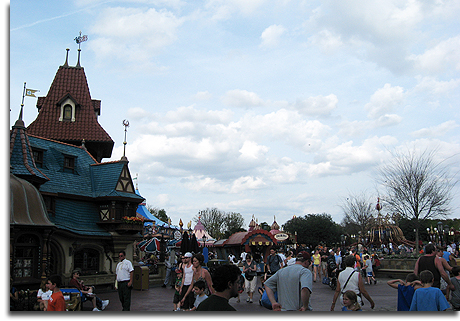 One of your theme parks requires a critical upgrade. Installation may require rebooting. Proceed (Y/N)? One of your theme parks requires a critical upgrade. Installation may require rebooting. Proceed (Y/N)?On again, off again, on again? The saga of the Magic Kingdom’s Fantasyland renovation continues with a new rumor from an unexpected source – Al Lutz. The MiceAge impresario has made a name for himself over the last decade by revealing the inner workings of Team Disney Anaheim, serving as the first to warn of the oncoming storm that was Paul Pressler. He assiduously documented the resort’s steep decline under the reign of Pressler and his successor Cynthia Harriss, including the disastrous opening of California Adventure, as well as its revival under the auspices of Matt Ouimet. His spies feed him a constant stream of rumors about upcoming changes to Disneyland and California Adventure, but rarely does he comment on Walt Disney World. It thus came as a surprise when Walt Disney World featured prominently in his recent update. You’ve probably heard the news by now; according to Lutz, not only do plans for a redevelopment of Fantasyland continue in Florida, but they now have an added technological twist. Disney CEO Bob Iger is said to have already visited Orlando twice this year for presentations on the subject, and thought nothing has yet been greenlighted, Iger has given the plan his initial approval. The rumors of a Fantasyland facelift began to circulate online last year. With California Adventure debuting a new dark ride based on The Little Mermaid in 2011, speculation began that Florida’s Magic Kingdom would benefit by receiving a clone of the E-Ticket. The ride would allegedly be placed on the former site of the 20,000 Leagues Under the Sea lagoon, and would anchor a newly redesigned Fantasyland. Orlando’s Fantasyland, constructed in 1971, has the unfortunate distinction of being the oldest iteration of that land in all the Disney parks. The Magic Kingdom’s older sibling, Disneyland, received an entirely new Fantasyland in 1983, the same year that Tokyo Disneyland opened. Paris and Hong Kong followed, but despite a few cosmetic alterations Florida’s Fantasyland has remained the same. 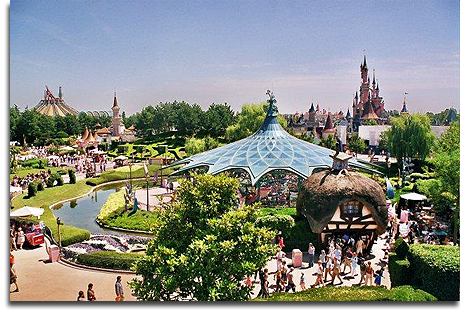 The bucolic Fantasyland of Disneyland Paris The bucolic Fantasyland of Disneyland ParisIn fact, in that time Fantasyland has lost two attractions – the Skyway and 20,000 Leagues Under the Sea. It also tragically lost Mr. Toad’s Wild Ride in favor of The Many Adventures of Winnie the Pooh, and the space originally held by the Mickey Mouse Revue is now Philharmagic. There has been no expansion – by my count, Disneyland’s Fantasyland houses thirteen attractions while Orlando’s only has eight. Disneyland lacks only Philharmagic, as their Winnie the Pooh ride is in another land; Walt Disney World is missing the Circus Train, Canal Boats, Castle Walkthrough, Matterhorn, and dark rides based on Alice in Wonderland, Pinocchio, and – sigh – Mr. Toad. While the planned renovations in Orlando would not come close to adding all these attractions, they would allegedly give the area a complete makeover and add the Mermaid E-ticket. Other less frequently repeated rumors from last year also mentioned a family rollercoaster themed to the minecars from Snow White and the Seven Dwarves, and the subsequent conversion of the old Snow White dark ride to something based on Beauty and the Beast. These plans, along with all of the other expansion ideas for Florida, were said to be boxed last year when the economy went sour. As the Disney parks remain packed in Orlando, though, it’s hoped that the cash spigots are now open again. According to Lutz, these plans are currently fighting their way through the gauntlet of the budgeting process and would indeed include the addition of the Mermaid attraction. The real surprise here is the technology that Lutz claims Imagineers hope to utilize in their remodeled versions of existing attractions.  Wait, this thing must be broken – it says you sat through Sounds Dangerous Wait, this thing must be broken – it says you sat through Sounds DangerousRadio frequency identification, or RFID, is an emerging technology that many companies are now using to track information. The technology has seen a wide variety of uses, from embedded identification information in passports to swipeable keycards for mass transit and credit transactions. RFID involves a small integrated circuit that can either actively transmit information or passively wait to be activated by a remote source. The potential for the technology is nearly limitless, as are the privacy concerns surrounding its use. Lutz claims that Imagineers hope to use RFID technology in concert with their new Fantasyland attractions. Tiny RFID chips could be embedded in park passes or other items, and if programmed with the right data could allow attractions to access personalized information about each guest. A crude analogue would be the old E.T. attraction at Universal, where guests would swipe cards when boarding and be greeted by name at the end of the ride. Using RFID, Disney could program chips with far more than a guest’s name. This initiative, which is apparently referred to at WDI as “Next Generation” or “NextGen”, would allegedly begin at Walt Disney World but soon spread to California and beyond. Disneyland’s 750,000 annual passholders would be a prime target for these embedded chips, which would not only facilitate ride interactions but also allow the tracking of spending habits. Upon the release of Lutz’s report, a number of sources chimed in to collaborate his story. Apparently WDI has very high hopes for RFID, and are looking at a number of ways to incorporate the technology into all aspects of the park experience. Possible uses involve upgrades to FastPass that would remove the need for physical card transactions, keyless room entry at the resorts, and integration with Photopass and other programs. The other obvious reason for this expensive initiative is the potential for Disney to track everything guests do in the parks, from spending and eating habits to how long they’re waiting in line. While many will no doubt balk at the ominous potential for misuse of this system, it’s certain that Disney is already doing everything they can to track guest information. At least now they’ll be getting accurate information, which could possibly bode better than their existing survey methodology in which guest questionnaires can be worded to evoke a desired response. Of course, statistics can always be made to lie in order to produce a certain outcome, but the sheer amount of data generated by RFID tracking would make it difficult to skew conclusions and, say, pretend no one rides the Carousel of Progress or that anyone likes the Tiki Room UNDER NEW MANAGEMENT. It would also show me riding the WEDway over and over and… over and over, and I’m fine with Disney knowing that. 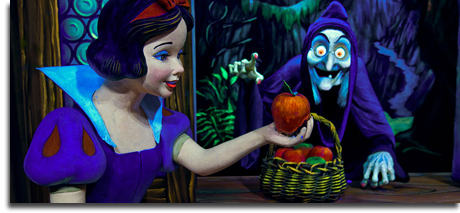 “Would you like an apple too, DEB-BIE FROM ALB-ER-QUER-QUE?” “Would you like an apple too, DEB-BIE FROM ALB-ER-QUER-QUE?”There are many possible creative uses for this technology, and I hope that WDI comes up with something really spectacular. They just have to be really, really careful about how they incorporate it. I can’t imagine anything potentially cheesier than having Peter Pan waving at the end of his ride and giving everyone in your boat personal shout-outs – talk about yanking you out of the illusion. The worst thing possible would be for them to incorporate this new technology and have it constantly screaming LOOK AT THIS! The absolute greatest moments of Disney illusioneering come when it’s totally unclear how an effect is achieved. The ballroom ghosts at the Haunted Mansion have befuddled guests for years – the focus is not the technology but the illusion. RFID should be used to make totally random and surprising things happen throughout the park, but not in a way that guests see it coming or immediately know why it happened. This is a fine line that the Imagineers are walking, and it can wind up astonishing or tacky. Here’s hoping they’re judicious. Of course, keep in mind that this is all still unapproved. Al Lutz knows Disneyland gossip well, but has been known to get things wrong about Florida in the past. Enough people, though, have chimed in with words of support that this feels real. Hopefully the greenlight will come soon; those parks aren’t getting less crowded and Fantasyland isn’t going to fix itself. UPDATE: Silly me – I write all this only to find out that Foxx had already posted a far more thoughtful dissection of the 1971 Fantasyland with several perceptive critiques and suggestions. I had never considered the obvious stylistic shift from Fantasyland West to East – indeed, if the entire land had as much atmosphere as the old Skyway station area it would be a great piece of design. I had always hoped that the 20K site would partially be used for a new version of Toad – where it, Pooh, and an Alice dark ride could collectively form an enclave of British facades to transition from the Italian and Gothic sections to the west. Foxx is correct – Fantasyland needs another body of water, and the return of certain landscaping elements. As seen in the photo at the top of this story, there’s a gaping hole where there should be some sense of depth and a back “wall” to the area. As it is, there’s only blue sky… Related Posts... Like the mighty phoenix, the Treehouse Villas rise again. This rendering depicts the new Treehouses that will open this summer (Disney) Like the mighty phoenix, the Treehouse Villas rise again. This rendering depicts the new Treehouses that will open this summer (Disney)For long-time fans of Walt Disney World, it’s been a hard fifteen years or so. Many of the special things that made the resort so unique have disappeared, replaced during wave after wave of expansion and homogenization. Amongst those lost treasures were the Treehouse Villas, originally built in 1975 as part of Disney’s plans to build a community at Lake Buena Vista. Lake Buena Vista was originally intended as a recreational and residential development, built to test many of the concepts that Walt had proposed for EPCOT city. While Walt Disney Productions still planned to build EPCOT, Lake Buena Vista was intended to serve as an opportunity for the company to dip their toes in the pond of residential development; its eventual goal was to combine recreational development with residences for retired cast members. EPCOT city was where the Disney cast would live while working for the company, and Lake Buena Vista was where they would retire. 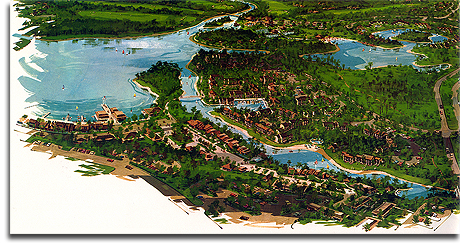 Conceptual rendering of the Lake Buena Vista community, 1971. “Condominiums, town houses, apartments and country club villas intended to fulfill the needs of families, retirement and vacation home owners, as well as corporate visitors to Walt Disney World…” Conceptual rendering of the Lake Buena Vista community, 1971. “Condominiums, town houses, apartments and country club villas intended to fulfill the needs of families, retirement and vacation home owners, as well as corporate visitors to Walt Disney World…”As plans for EPCOT were abandoned, so were Lake Buena Vista’s residential aspirations. Without year-round residents, Disney wouldn’t have to provide services like schools or share voting control of the Reedy Creek Improvement District. Lake Buena Vista then began to be planned as a purely recreational community; a series of areas focused on different leisure activities were planned to extend northward from the current location of the Downtown Disney Marketplace. In addition to the townhouse-like villas, Disney also planned to build apartments, condos and single-family homes. It was still intended that many of these units would be private seasonal residences – descriptions from the time sound like early versions of the timeshare concept. Of all these plans, only the Villas were eventually built. Various types of Villas debuted throughout the 1970s and, while originally targeted at corporate clients and businesses for corporate retreats, they eventually began to be marketed to the average guest. They became the Village Resort in the 1980s, and were later converted to the Villas at the Disney Institute in the 1990s. When Eisner’s Institute concept failed in 2002, the Villas were slowly demolished to make way for the opening of Saratoga Springs – another Vacation Club property – in 2004. 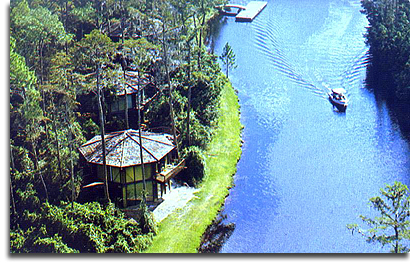 The original Treehouse Villas, in happier days The original Treehouse Villas, in happier daysYet throughout all this, the Treehouses survived. They were “temporarily” closed in the post-2001 tourism slump, but it became one of those mystery closures like the Magic Kingdom’s 20,000 Leagues Under the Sea attraction when something goes down for a “temporary” rehab and never reappears. In the following years, they were used as housing for Disney’s international College Program cast members before several of the Villas were damaged by hurricanes in 2004. Faced with the cost of actually refurbishing the buildings, Disney chose to abandon them. If left to their own devices, I suspect that Disney would have bulldozed the Treehouses in 2004 to make way for more bland and generic Saratoga Springs buildings. The Villas had long been seen as inefficient – single units spaced out in the woods took a lot of time to clean and maintain on a daily basis. But due to an amazingly fortunate 1985 wetlands preservation law, they couldn’t touch the area. The Treehouses are built within the 100-year flood plain, and are on protected wetlands. Disney, no matter how much they might have wanted to, could not have cleared the woods to build more massive DVC units. Instead, they were faced with two options: abandon the area, or rebuild the Treehouses. Even this was not a simple choice. The Villas needed rehabbing, but Disney was limited in their refurbishment options. The Treehouses, if built today, would be in violation of two important building codes – the previously mentioned wetlands protection codes and the Americans with Disabilities Act (ADA). Since the Treehouses had been built in 1975, they were allowed to continue to operate under a grandfather clause in both cases. But if Disney were to substantially rebuild them, or build something new on the site, the new construction would have to fall in line with modern regulations. Considering all the hassle that would be required just to restore an area that, while pleasing long-time fans, would probably be less profitable than the average DVC site, most of us thought we’d never see the beloved Treehouses again. Then, at the end of 2007 and in early 2008, permits began to be filed for the reconstruction of the Treehouse Villas. As the initial nebulous reports became more clear, it came to light that Disney would not be re-opening the original Treehouses, but instead would demolish and replace them with redesigned units. Soon there were schematics and renderings and it started to sink in – the Treehouses were coming back. All of it became official when the project was announced in September of 2008. It was a very, very happy day.  Passport to Villas Old & New: The original Treehouse design (left) and the new model (right). The ground level of each design is shaded in green. Passport to Villas Old & New: The original Treehouse design (left) and the new model (right). The ground level of each design is shaded in green.The new Treehouses very closely resemble the originals, with one important difference. In order to comply with wetlands regulations, the designers greatly reduced the square footage of the Villas’ ground floor. The original Treehouses featured three bedrooms, two of which were on the second floor while one room – set at the bottom of a spiral staircase – remained on the ground. The new design enlarges the second story of the Treehouses, allowing space for all three rooms, while removing the ground floor entirely. This reduces the footprint of each unit from 340 square feet to 84 square feet, effectively increasing the area of the surrounding wetlands. Sixty new Treehouses have been built to replace the original units. In order to preserve the character of the area, the new units were built in modular segments in Wingate, PA, and lifted into position on-site over the surrounding trees by a large crane. The existing area’s pool and clubhouse will also be refurbished to their original specs, and a new dock has been built on the Sassagoula to provide boat service to Downtown Disney. The Treehouses will officially be a part of Saratoga Springs, and will share that resort’s check-in and recreational facilities.  Floor plan of the new Treehouse Villas Floor plan of the new Treehouse VillasThe floor plan of the new villas retains the three bedrooms and two bathrooms of the original. In the above diagram, the layout is as follows: – Master Bedroom (Green) – With queen bed – Master Bathroom (Yellow) – Second Bedroom (Dark Blue) – With queen bed – Third Bedroom (Light Blue) – The press release claims this bedroom will contain a bunk bed, unfortunately – Second Bathroom (Orange) – Opens to main room – Kitchen (Red) – Open to main room, features granite countertops and bar seating – Laundry Facilities (Purple) The main room, which is the large white area in the diagram, features a six-person dining room table and a television area with a queen-size sleeper sofa and single-person sleeper chair. All said, each Treehouse will sleep nine guests. The kitchen is fully-featured, and the main room and all three bedrooms feature flat-screen televisions.  Interior rendering of the new Treehouse Villas (Disney) Interior rendering of the new Treehouse Villas (Disney)I took a special trip down the Sassagoula in March to check on the progress of the Treehouses. Sure enough, they look like they’re well on track to open this summer as announced. Many units look completely finished – Disney had left the lights on (and curtains open) inside many of the units at night, so one could clearly see from the river that the interiors of several Treehouses had been fully furnished. Some units were obviously still under construction, but it looked like there was only minor finishing work, painting and furnishing left to do. It’s great to see the Treehouses back along the Sassagoula, and Disney gets quite a bit of credit for sticking to the original octagonal design and overall aesthetic of the area. Whatever the reason for their revival, it’s just good to have the Treehouses there – and for something to go right for fans of classic Walt Disney World. There doesn’t appear to be a single down side to this one – good job, Team Disney. Snapshots from March below the fold… Continue reading Treehouse Villas II: Electric Boogaloo Related Posts...
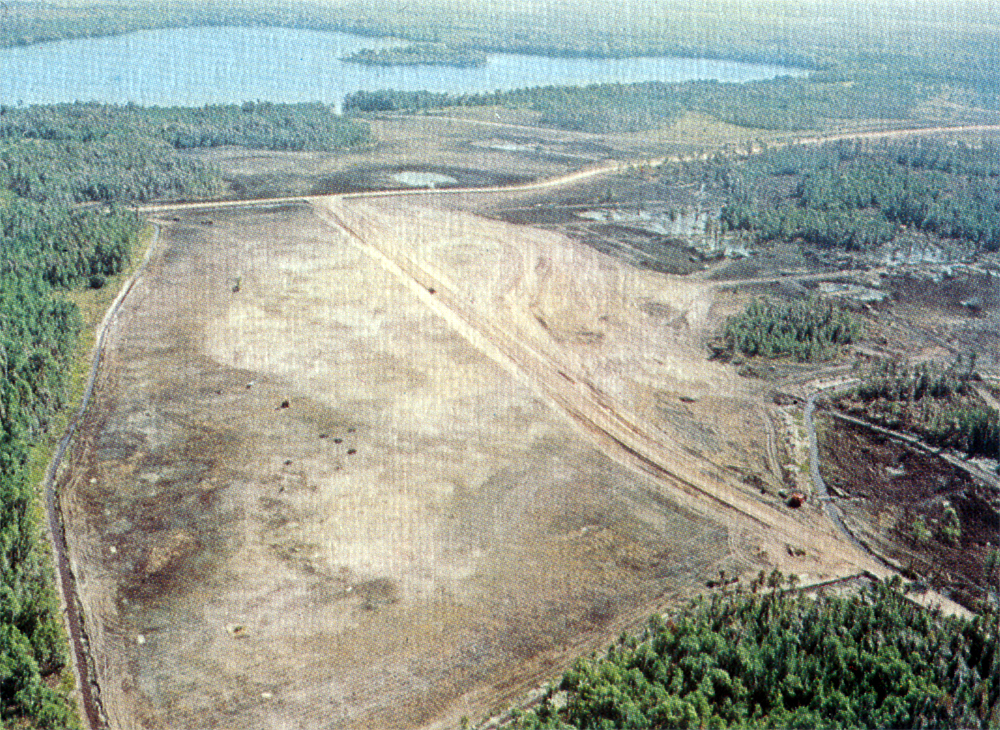
The history of Disney theme parks is littered with images of cleared terrain and construction sites, and they’re usually pretty dull. This one, though, caught my eye. It’s the Magic Kingdom, circa 1967. Note the lack of… well, pretty much anything. Obviously there’s no park or hotels, but you might also notice the conspicuous absence of the Seven Seas Lagoon. The lake in the picture is Bay Lake, and the island is the former Discovery Island (the former former Treasure Island). Thus the photographer is positioned outside the future Frontierland, looking across the park towards Tomorrowland, with Bay Lake and then Fort Wilderness in the far background. Over the course of the next few years, the Utilidor structure would be built on this cleared land, and then covered with fill dirt from the excavation of the Seven Seas Lagoon. It’s not until you see a picture like this that you truly realize the impact the Seven Seas Lagoon has on the aesthetic of the resort; driving through the woods to park in front of the Magic Kingdom would be far less effective theatre than having to get there by boat or monorail. Even though they’d later reduce the effect by letting buses unload at the park itself instead of the TTC, the lagoon still helps to separate the Magic Kingdom as something special and provides a proscenium unparalleled in the Disney resorts. Related Posts... |





 From the Progress City archives comes this collection of 33 tall tales and true from Disney history. Available in paperback, hardback, and ebook formats.  |
|
|
Copyright © 2007-2026 - Subscribe to Entries (RSS) and Comments (RSS). Read our Privacy Policy and Legal Page. This website is unaffiliated with The Walt Disney Company or its subsidiaries. Powered by WordPress & Atahualpa |
||
Recent Comments